Solanum indicum
L.
White sparrow, Indian nightshade
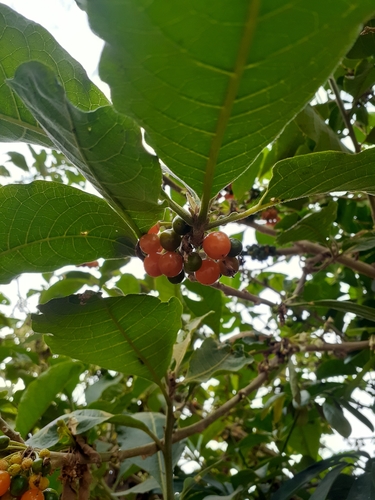
(c) Noopur🍀, some rights reserved (CC BY-NC)

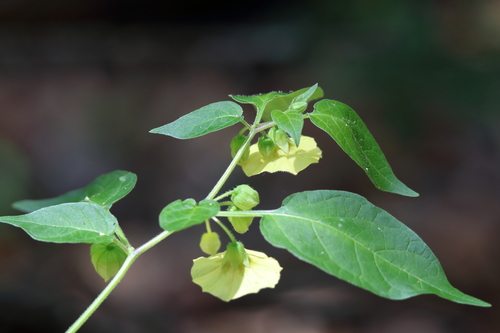
(c) Cheng-Tao Lin, some rights reserved (CC BY)

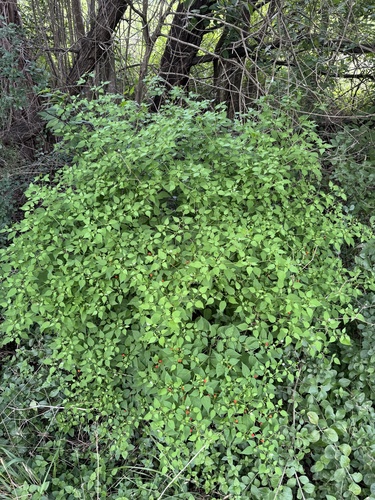
(c) Cheng-Tao Lin, some rights reserved (CC BY)
What to Eat
Edible parts: Leaves, Fruit
Ripe fruit is used to make fermented drink, soup, sauces, and fried dishes (though bitter), while half-ripe fruit is used in curries and as a vegetable. Leaves are cooked as a vegetable. Harvested fruit stores for up to 7 days.
Where to Find It
A tropical plant. It grows in open spaces and along roadsides. It is also cultivated. In Yunnan in China it grows between 1100-1450 m above sea level. It grows in secondary forest. It grows in wetlands.
Africa, Asia, Bangladesh, Central Africa, China, Congo DR, Côte d'Ivoire, East Africa, Himalayas, India, Indochina, Indonesia, Iran, Ivory Coast, Laos, Madagascar, Malaysia, Middle East, Myanmar, Nepal, Northeastern India, Philippines, SE Asia, Sierra Leone, Sri Lanka, West Africa,
How to Identify
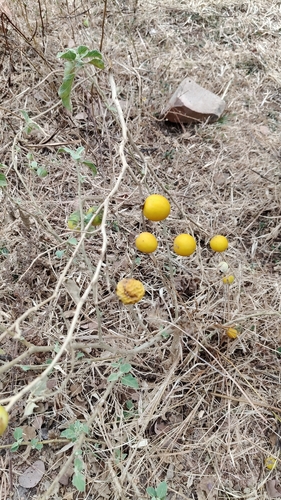
A small shrub. It grows 1-3 m tall. The stems and branches are thorny. They are yellowish-green. The leaves are 8-12 cm long by 6-8 cm wide. The flowers are blue to purple. The fruit are round and 1 cm across. They are red when ripe. The seeds are 2.5 mm wide and kidney shaped.
Nutrition Score: 29/100
| Part | Moisture | kJ | kcal | Protein | Vit A | Vit C | Iron | Zinc |
|---|---|---|---|---|---|---|---|---|
| Fruit | 74.4 | 163 | 39 | 3.1 | — | — | 1.2 | — |
Wikipedia
Source ↗Solanum indicum can refer to: Solanum indicum L., a synonym of Solanum lasiocarpum Dunal Solanum indicum Roxb., a synonym of Solanum melongena L., eggplant A number of varieties and subspecies now assigned to Solanum anguivi Lam.
Production
In India the fruit are available September to December.
Other Information
The fruit are sold in markets.
Notes
There are about 1400 Solanum species. It is also used in medicine.
Names & Synonyms
Anjangkha neu, Barhanta, Barhanti, Beako, Bhantaki, Bhekuri, Bhot bengena, Bhut-katai, Bipi, Birhatta, Bokoir, Byakura, Cheru-chunda, Cheruvaz-hudhena, Chicharti, Deuri tita, Dorli, Futki begun, Gelo jay-beso, Gnagnan, Gurkamai, Hecho, Hkanjawi, Inoti, Kaju, Kakaminchi, Karanchi, Kandal, Karimulli, Karimullu, Karinchi, Katang-kari, Kazaw-kha, Khamka, Khayan-kazaw, Khungkha-raja, Kochipoka, Kuntainara, Kutuma, Leenguipi, Leipung Khangga, Mak kaen kon, Mangbe, Mawanhuo, Mulli, Panthao khimkhatai, Pappara-mulli, Parta bhetango, Poison berry, Ranvangi, Ringani, Ringni, Samphoh, Samphok, Sam tok, Siqhaq, Soh-ngan, Sotabayom, Tella-mulaka, Terong peuheur, Terong pipit hijau, Terong pipit puteh, Tetbegun, Tibbatu, Tid bhagnri, Tita bhekuri, Titbegun, Tit bhek, Vrihati, Xiha
References (50)
- Aberoumand, A., 2008, Comparison of protein values from seven wild edible plants of Iran. African Journal of Food Science. Vol 2. pp 73-76
- Aberoumand, A. and Deokule, S. S., 2009, Determination of Elements Profile of Some Wild Edible Plants. Food Anal. Methods. 2:116-119
- Ambasta, S.P. (Ed.), 2000, The Useful Plants of India. CSIR India. p 580
- Ara, R. I. T., 2015, Leafy Vegetables in Bangladesh. Photon eBooks. p 73
- Arora, R. K., 2014, Diversity in Underutilized Plant Species - An Asia-Pacific Perspective. Bioversity International. p 51
- Baro, D., Baruah, S. and Borthukar, S. K. 2015, Documentation on wild vegetables of Baksa district, BTAD (Assam). Scholars Research Library. Archives of Applied Science Research, 2015, 7 (9):19-2
- Barua, U., et al, 2007, Wild edible plants of Majuli island and Darrang districts of Assam. Indian Journal of Traditional Knowledge 6(1) pp 191-194
- Brahma, S., et al, 2013, Wild edible fruits of Kokrajhar district of Assam, North-East India, Asian Journal of Plant Science and Research 3(6):95-100
- Burkill, I.H., 1966, A Dictionary of the Economic Products of the Malay Peninsula. Ministry of Agriculture and Cooperatives, Kuala Lumpur, Malaysia. Vol 2 (I-Z) p 2080
- Choudhury, B., 1979, Eggplant, in Simmonds, N.W., (ed), Crop Plant Evolution. Longmans. London. p 278
- Davis, S.D., Heywood, V.H., & Hamilton, A.C. (eds), 1994, Centres of plant Diversity. WWF. Vol 1 or 2. p 99
- Dhyani, S.K., & Sharma, R.V., 1987, Exploration of Socio-economic plant resources of Vyasi Valley in Tehri Garwhal. J. Econ. Tax. Bot. Vol. 9 No. 2 pp 299-310
- Diop, A. l., et al, 2021, Cultural importance of wild edible plants in three sympatric communities: Agni, Akyé and Gwa in the Department of Alépé (Southeast of Côte d’Ivoire). Ethnobotany Research and Applications 22:35. p 7
- Dutta, U., 2012, Wild Vegetables collected by the local communities from the Churang reserve of BTD, Assam. International Journal of Science and Advanced Technology. Vol. 2(4) p 123
- Facciola, S., 1998, Cornucopia 2: a Source Book of Edible Plants. Kampong Publications, p 237
- Gangte, H. E., et al, 2013, Wild Edible Plants used by the Zou Tribe in Manipur, India. International Journal of Scientific and Research Publications, Volume 3, Issue 5
- Ghimeray, A. K., Lamsal, K., et al, 2010, Wild edible angiospermic plants of the Illam Hills (Eastern Nepal) and their mode of use by local community. Korean J. Pl. Taxon. 40(1)
- Guite, C., 2016, Study of wild edible plants associated with the Paite Tribe of Manipur, India. International Journal of Current Research. Vol. 8, Issue 11, pp. 40927-40932
- Hani Medicine of Xishuangbanna, 1999, p 659
- Hossain, U. & Rahman, A., 2018, Study and quantitative analysis of wild vegetable floral diversity available in Barisal district, Bangladesh. Asian J. Med. Biol. Res. 2018, 4 (4), 362-371
- Jardin, C., 1970, List of Foods Used In Africa, FAO Nutrition Information Document Series No 2.p 102
- Jin, Chen et al, 1999, Ethnobotanical studies on Wild Edible Fruits in Southern Yunnan: Folk Names: Nutritional Value and Uses. Economic Botany 53(1) pp 2-14 (var. recurvatum)
- Kar, A., 2004, Common wild vegetables of Aka tribe of Arunachal Pradesh. Indian Journal of Traditional Knowledge 3(3) pp 305-313
- Luczaj, L., et al, 2021, Wild food plants and fungi sold in the markets of Luang Prabang, Lao PDR. Journal of Ethnobiology and Ethnomedicine (2021) 17:6
- Macmillan, H.F. (Revised Barlow, H.S., et al), 1991, Tropical Planting and Gardening. Sixth edition. Malayan Nature Society. Kuala Lumpur. p 357
- Marandi, R. R. & Britto, S. J., 2015, Medicinal Properties of Edible Weeds of Crop Fields and Wild plants Eaten by Oraon Tribals of Latehar District, Jharkhand. International Journal of Life Science and Pharma Research. Vo. 5. (2) April 2015
- Martin, F.W. & Ruberte, R.M., 1979, Edible Leaves of the Tropics. Antillian College Press, Mayaguez, Puerto Rico. p 220
- Medhi, P. & Borthakur, S. K., 2012, Phytoresources from North Cachur Hills of Assam -3: Edible plants sold at Hflong market. Indian Journal or Natural Products and Resources. 3(1) pp 84-109
- Medhi, P. & Borthakur, S. K., 2013, Wild edible plants sold by the Zeme Nagas at the makeshift market of Mahur, Dima Hasao district of Assam. Pleione 7(1): 84 - 93. 2013
- Medhi, P., Sarma, A and Borthakur, S. K., 2014, Wild edible plants from the Dima Hasao district of Assam, India. Pleione 8(1): 133-148
- Namsa, et al, 2011, Ethnobotany of the Monpa ethnic group ay Arunachal Pradesh, India. Journal of Ethnobiology and Ethnomedicine 7:31
- Narzary, H., et al, 2013, Wild Edible Vegetables Consumed by Bodo tribe of Kokrajhar District (Assam), North-East India. Archives of Applied Science Research, 5(5): 182-190
- Pagag, K. & Borthakur, S.K., 2012, Wild edible wetland plants from Lakhimpur district of Assam, India. Pleione 6(2): 322 - 327
- Patiri, B. & Borah, A., 2007, Wild Edible Plants of Assam. Geethaki Publishers. p 89
- Pradhan, R., et al, 2020, Potential Wild Edible Plants and its Significance in Livelihood of Indigenous People of Male Mahadeshwara Hills, Karnataka. Economic Affairs Vol. 64, No. 4 pp. 01-14
- Rajapaksha, U., 1998, Traditional Food Plants in Sri Lanka. HARTI, Sri Lanka. p 477
- Sadhale, A., et al, 1991, Ethnobotanical studies of sacred grove at Ajiwali, Pune district. J. Econ. Tax. Bot. Vol. 15 No. 1 pp 167-172
- Saikia, M., 2015, Wild edible vegetables consumed by Assamese people of Dhemaji District of Assam, NE India and their medicinal values. Archives of Applied Science Research, 2015, 7 (5):102-109
- Sawian, J. T., et al, 2007, Wild edible plants of Meghalaya, North-east India. Natural Product Radiance Vol. 6(5): p 421
- Sharma, B.D., & Lakshminarasimhan, P., 1986, Ethnobotanical Studies on the Tribals of Nasik District (Maharashtra). J. Econ. Tax. Bot. Vol. 8 No. 2 pp 439-446
- Singh, H.B., Arora R.K.,1978, Wild edible Plants of India. Indian Council of Agricultural Research, New Delhi. p 78
- Singh, P.K., Singh, N.I., and Singh, L.J., 1988, Ethnobotanical Studies on Wild Edible Plants in the Markets of Manipur - 2. J. Econ. Tax. Bot. Vol. 12 No. 1 pp 113-119
- Singh, V. B., et al, (Ed.) Horticulture for Sustainable Income and Environmental Protection. Vol. 1 p 220
- Smith, F. I. and Eyzaquirre, P., 2007, African leafy vegetables: Their role in the World Health Organization's global Fruit and Vegetables Initiative. AJFAND, Vol. 7 No. 3
- Srivastava, R. C., 2009, Traditional knowledge of Adi tribe of Arunachal Pradesh on plants. Indian Journal of Traditional Knowledge. 8(2): 146-153
- Srivastava, R. C., 2010, Traditional knowledge of Nyishi (Daffla) tribe of Arunachal Pradesh. Indian Journal of Traditional Knowledge. 9(1):26-37
- Tanaka,
- Terashima, H., & Ichikawa, M., 2003, A comparative ethnobotany of the Mbuti and Efe hunter-gatherers in the Ituri Forest, Democratic Republic of Congo. African Study Monographs, 24 (1, 2): 1-168, March 2003
- Terra, G.J.A., 1973, Tropical Vegetables. Communication 54e Royal Tropical Institute, Amsterdam, p 73, 76
- Uphof,