Solanum lyratum
Thunb.
Bai Ying, Hiyodori-Shogo
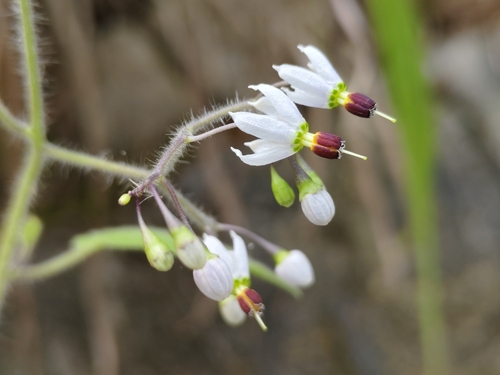
(c) 綾蛾Actias, some rights reserved (CC BY-NC), uploaded by 綾蛾Actias

(c) 羅元甫, some rights reserved (CC BY-NC)
What to Eat
Edible parts: Leaves
The leaves are edible when cooked. Caution is advised regarding toxicity.
Known Hazards
Where to Find It
It is a tropical and subtropical plant. It grows between 100-2,900 m above sea level in southern China. In Sichuan and Yunnan.
Asia, Cambodia, China, Indochina, Japan, Korea, Laos, Myanmar, SE Asia, Taiwan, Thailand, Tibet, Vietnam,
How to Identify
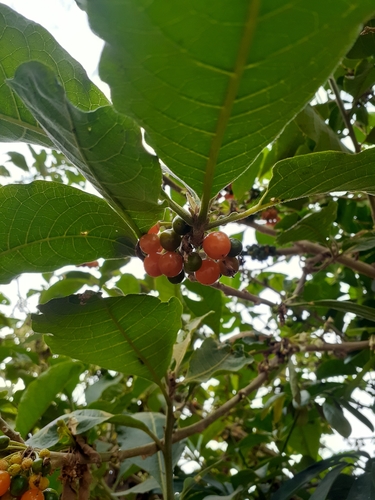
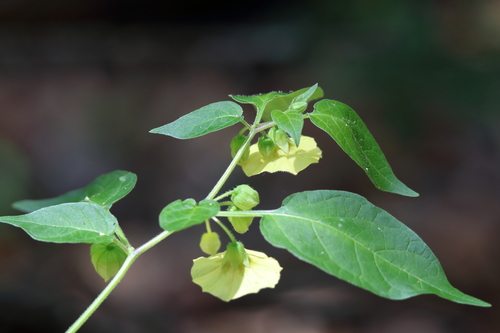
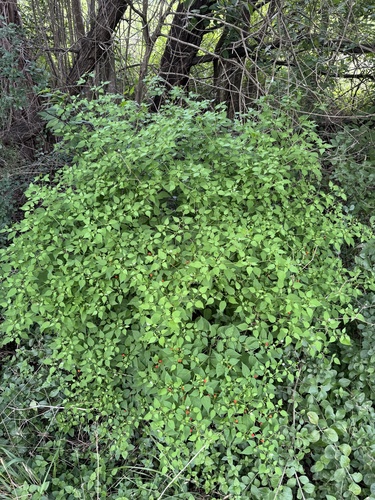
A herb that grows as a vine. It has many branches. It grows 3 m tall. It is hairy. The leaves are narrowly oval or lyre shaped and 3-11 cm long by 2-6 cm wide. The base is heart shaped. There can be 3-5 lobes. There can be a few or many flowers in a group near the ends of branches. They are blue to purple or white.
How to Grow
We have very little information on this species and do not know if it will succeed in Britain, though judging by its native range it should succeed outdoors in many parts of the country. The following notes are based on the general needs of the genus. Succeeds in most soils.
Propagation: Sow seed in early spring in a warm greenhouse. Once seedlings are large enough to handle, prick them out into individual pots and plant outside after the last expected frosts.
Medicinal Uses
The whole plant is depurative and febrifuge. A decoction is used in the treatment of leucorrhoea, abscesses, cancer of the oesophagus and stomach, and enlarged thyroid glands. The leaves are boiled with mother's milk to treat nausea in babies. The stems are used medicinally to treat convulsions in infants, while the branches and leaves are used for clearing heat and cooling the blood.
Other Uses
None known Special Uses
Wikipedia
Source ↗Solanum lyratum, the lyreleaf nightshade, is a species of flowering plant in the family Solanaceae, native to China, Taiwan, Vietnam, Cambodia, the Korean Peninsula, and Japan. Usually found in forests, it is also somewhat weedy and can be found on disturbed ground.
Notes
There are about 1400 Solanum species.
References (1)
- Plants for a Future database, The Field, Penpol, Lostwithiel, Cornwall, PL22 0NG, UK. http://www.scs.leeds.ac.uk/pfaf/