Solanum macranthum
Dunal
Brazilian potato tree
(c) Didier Levasseur, some rights reserved (CC BY-NC)
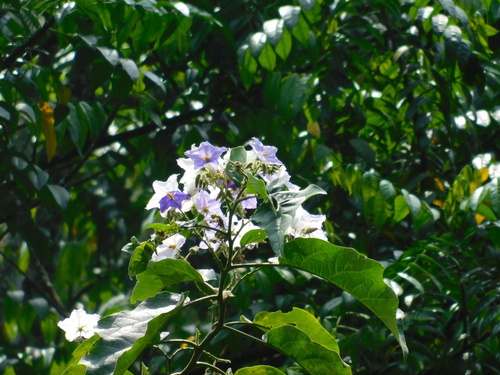
(c) Ganjar Cahyadi, some rights reserved (CC BY-NC)
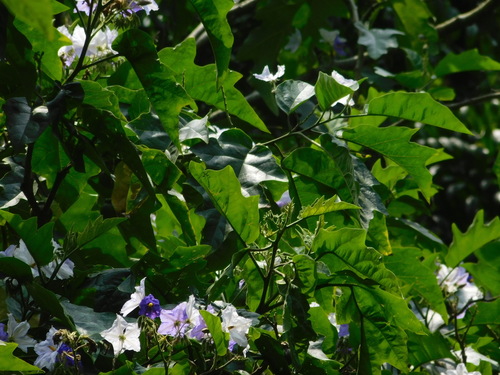
(c) Ganjar Cahyadi, some rights reserved (CC BY-NC)
What to Eat
Edible parts: Fruit
The fruit are eaten.
Where to Find It
A tropical plant.
Africa, Asia, Australia, Brazil, East Africa, Eswatini, Guyana, India, Malawi, Malaysia, SE Asia, South Africa, Southern Africa, South America, Sri Lanka, Swaziland,
How to Identify
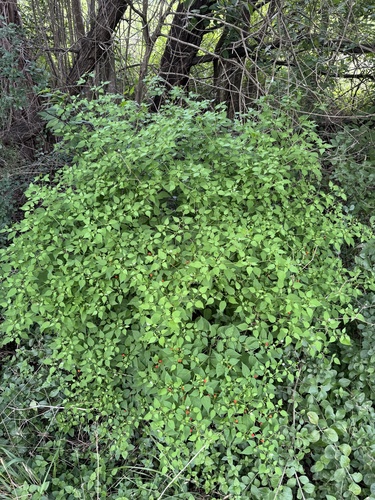
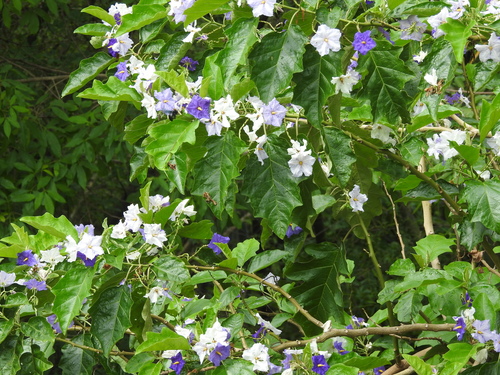
A small tree. It grows 10 m high. The branches and leaves can have sharp, hooked prickles. The leaves are large and 25-30 cm long. They are in clusters at the ends of branches. They are rough on the upper surface and hairy underneath. There are deep irregular lobes around the edges. They are unequal sided at the base. The flowers are shaped like stars and have 5 joined petals. The flowers can be 5 cm across. They are in clusters at the ends of branches. The flowers are pale purple to white. The stamens are yellow. The fruit are large berries. They can be 3 cm across. They are green to yellow when ripe.
Medicinal Uses
The fruit contain solasodine, which is used in medicine.
Production
It is fast growing but short lived.
Other Information
It is cultivated.
Notes
There are about 1400 Solanum species. The fruit contain solasodine. It is used in medicine.
Names & Synonyms
Potato Seed, Potato tree, Terung pokok
References (8)
- Ambasta, S.P. (Ed.), 2000, The Useful Plants of India. CSIR India. p 580
- Bodkin, F., 1991, Encyclopedia Botanica. Cornstalk publishing, p 935
- Dharani, N., 2002, Field Guide to common Trees & Shrubs of East Africa. Struik. p 162
- Lord, E.E., & Willis, J.H., 1999, Shrubs and Trees for Australian gardens. Lothian. p 262
- Milow, P., et al, 2013, Malaysian species of plants with edible fruits or seeds and their evaluation. International Journal of Fruit Science. 14:1, 1-27
- Reis, S. V. and Lipp, F. L., 1982, New Plant Sources for Drugs and Foods from the New York Botanical Garden herbarium. Harvard. p 274
- Solan. syn. 43. 1816
- Swaziland's Flora Database http://www.sntc.org.sz/flora