Solanum scabrum
Mill.
Garden huckleberry, African nightshade

(c) Igor, some rights reserved (CC BY-NC), uploaded by Igor
(c) carla1964, some rights reserved (CC BY-NC)

(c) Alexander Iosipenko, some rights reserved (CC BY-NC), uploaded by Alexander Iosipenko
What to Eat
Edible parts: Fruit, Leaves, Vegetable
The ripe fruit is used cooked in preserves, jams, and pies and has a pleasant musky taste. Only fully ripe fruits should be used, as unripe fruits contain the toxin solanine. It is often cooked with a little baking soda first to remove any bitterness. The fruit contains approximately 2.5% protein, 0.6% fat, 5.6% carbohydrate, and 1.2% ash, and measures up to 12mm in diameter. Young leaves and new shoots can be eaten raw or cooked as a potherb or added to soups, though the plant's possible toxicity should be noted.
Known Hazards
Where to Find It
A tropical and subtropical plant. It grows in warm humid forest. Seed germinate best at 15-30°C and growth is best between 20-30°C. It grows from sea level to 2,000 m above sea level. It needs 500 mm rainfall. It suits hardiness zones 9-12. In Sichuan and Yunnan.
Africa, Asia, Australia, Benin, Burkina Faso, Burundi, Cameroon, Cape Verde, Central Africa, Central African Republic, CAR, Chad, China, Congo DR, Côte d'Ivoire, East Africa, Equatorial Guinea, Ethiopia, Gabon, Ghana, India, Ivory Coast, Kenya, Liberia, Mozambique, New Zealand, Nigeria, North America, Philippines, Reunion, Rwanda, SE Asia, Sierra Leone, South Africa, Southern Africa, Sudan, Taiwan, Tanzania, Tibet, Togo, Uganda, USA, West Africa, Zambia,
How to Identify
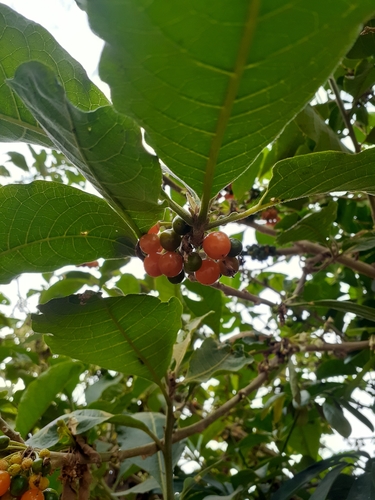
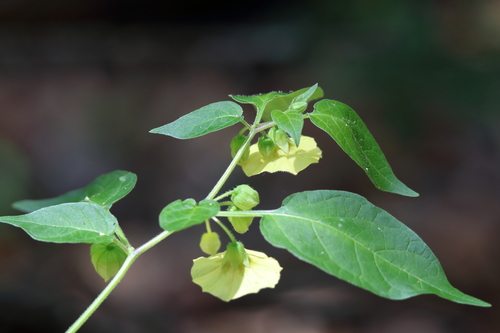
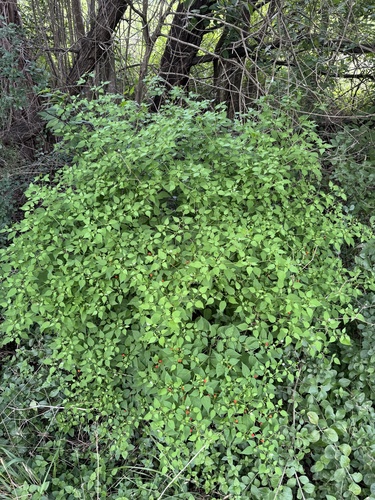
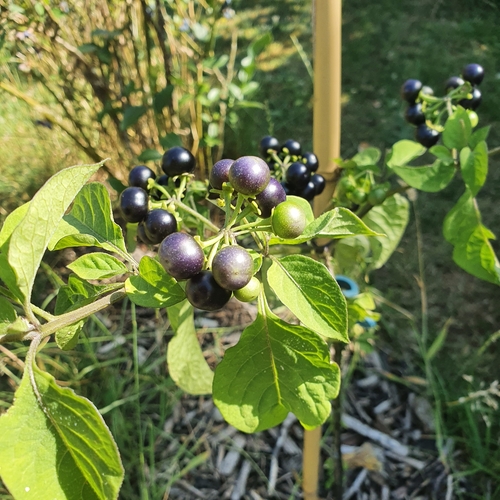
A bushy plant. It grows 60 cm high and spreads 45 cm wide. It grows each year from seed. The leaves are broadly oval. The flowers are small and white. The fruit are black berries. They are 18 mm wide. The fruit are purplish-black.
Nutrition Score: 27/100
| Part | Moisture | kJ | kcal | Protein | Vit A | Vit C | Iron | Zinc |
|---|---|---|---|---|---|---|---|---|
| Leaves | 89.5 | — | — | 4.4 | — | — | 3 | 0.5 |
How to Grow
Succeeds in most soils. Dislikes shade. Caterpillars and slugs are particularly fond of this plant and can totally destroy it. This is a cultivated form of S. nigrum, grown for its edible fruit. There is at least one named form. See notes about possible toxicity at the top of this page. There is some disagreement among taxonomists as to the correct name of this plant. It is also listed as S. melanocerasum. Grows well with clover. Does not grow well with wormwood or white mustard and, when these plants are growing Closely related to S. nigra, they increase its content of toxic alkaloids.
Propagation: Sow seed in spring in situ. Seed can also be started in a greenhouse in spring, which will generally produce larger crops. Prick seedlings out into individual pots when large enough to handle and plant out in late spring.
Medicinal Uses
The whole plant is antiperiodic, antiphlogistic, diaphoretic, diuretic, emollient, febrifuge, narcotic, purgative, and sedative. It is harvested in autumn when flowers and fruit are both present and dried for later use. Use with caution given the plant's noted toxicity. The leaves, stems, and roots are used in treating cancerous sores, leucoderma, and wounds. Extracts of the plant are analgesic, antispasmodic, anti-inflammatory, and vasodilatory. It has been used in the manufacture of locally analgesic ointments, and the fruit juice has been applied to relieve toothache.
Other Uses
None known
Wikipedia
Source ↗Solanum scabrum, also known as garden huckleberry, is an annual or perennial plant in the nightshade family. The geographic origin of the species is uncertain; Linnaeus attributed it to Africa, but it also occurs in North America, and it is naturalized in many countries. In Africa it is cultivated as a leaf vegetable and for dye from the berries.
Production
The leaves are highly perishable after harvest.
Other Information
It is a cultivated food plant. Fruit are sold in markets.
Notes
There are about 1400 Solanum species.
Names & Synonyms
Am b 'lito zeriga, Kinsumba
References (33)
- 1996, California Rare Fruit Growers, Inc. Pepino dulce Fruit fact
- Abbiw, D.K., 1990, Useful Plants of Ghana. West African uses of wild and cultivated plants. Intermediate Technology Publications and the Royal Botanic Gardens, Kew. p 38
- Abukutsa-Onyango, Mary, 2007, The diversity of cultivated African leafy vegetables in three communities in western Kenya. AJFAND, Volume 7, No. 3
- Achigan-Dako, E, et al (Eds), 2009, Catalogue of Traditional Vegetables in Benin. International Foundation for Science.
- Adebooye, O. C. et al, 2005, Seed constraint to cultivation and productivity of African indigeous leaf vegetables. African Journal of Biotechnology 4(13) pp 1480-1484
- Akinola, R., et al, 2020, A Review of Indigenous Food Crops in Africa and the Implications for more Sustainable and Healthy Food Systems. Sustainability 2020, 12, 3493;
- AVRDC files
- Burkill, H. M., 1985, The useful plants of west tropical Africa, Vol. 5. Kew.
- CRÉAC'H, (As Solanum guineense)
- Cundall, P., (ed.), 2004, Gardening Australia: flora: the gardener's bible. ABC Books. p 1347 (As Solanum melanocerasum)
- Duarte, M. C., et al, 2022, Diversity of Useful Plants in Cabo Verde Islands: A Biogeographic and Conservation Perspective. Plants 2022, 11, 1313 p 7
- Facciola, S., 1998, Cornucopia 2: a Source Book of Edible Plants. Kampong Publications, p 237
- FAO, 1988, Traditional Food Plants, FAO Food and Nutrition Paper 42. FAO Rome p 450, 464
- Gard. dict. ed. 8: Solanum no. 6. 1768
- Gbile, Z. O. and Adesina, S. K., 1988, Nigerian Solanum Species of Economic Importance. Annals of the Missouri Botanical Garden, Vol. 75, No. 3. p 864
- Grubben, G. J. H. and Denton, O. A. (eds), 2004, Plant Resources of Tropical Africa 2. Vegetables. PROTA, Wageningen, Netherlands. p 493
- Hibbert, M., 2002, The Aussie Plant Finder 2002, Florilegium. p 291 (As Solanum intrusum)
- Latham, P., 2004, Useful Plants of Bas-Congo province. Salvation Army & DFID p 261
- Maundu, P. et al, 1999, Traditional Food Plants of Kenya. National Museum of Kenya. 288p
- Oniang’o, R., Grum, M. and Obel-Lawson, E., editors. 2008. Developing African leafy vegetables for improved nutrition. Regional workshop, 6-9 December 2005. Rural Outreach Program, Nairobi, Kenya. p 3
- Plants for a Future database, The Field, Penpol, Lostwithiel, Cornwall, PL22 0NG, UK. http://www.scs.leeds.ac.uk/pfaf/
- Ruiters-Welcome, A. K., 2019, Food plants of southern Africa. Ph.D. thesis. Univ. of Johannesburg p 104 (As Solanum melanocerasum)
- Samuels, J., 2015, Biodiversity of Food Species of the Solanaceae Family: A Preliminary Taxonomic Inventory of Subfamily Solanoideae. Resources 2015, 4. 277-322
- Smith, F. I. and Eyzaquirre, P., 2007, African leafy vegetables: Their role in the World Health Organization's global Fruit and Vegetables Initiative. AJFAND, Vol. 7 No. 3
- Tanaka,
- Tindall, H.D., 1983, Vegetables in the Tropics, Macmillan p 361 (As Solanum intrusum)
- Ulian, T., et al, 2020, Unlocking plant resources to support food security and promote sustainable agriculture. Plants, People, Planet. 2020;2:421–445.
- USDA, ARS, National Genetic Resources Program. Germplasm Resources Information Network - (GRIN). [Online Database] National Germplasm Resources Laboratory, Beltsville, Maryland. Available: www.ars-grin.gov/cgi-bin/npgs/html/econ.pl (10 April 2000)
- van Wyk, B., 2005, Food Plants of the World. An illustrated guide. Timber press. p 349 (As Solanum melanocerasum)
- Weinberger, K., Msuya J., 2004, Indigenous Vegetables in Tanzania. Significance and Prospects. Technical Bulletin No. 31 AVRDC, Taiwan/FAO p 4
- Welcome, A. K. & Van Wyk, B.-E., 2019, An inventory and analysis of the food plants of southern Africa. South African Journal of Botany 122 (2019) 136–179 (As Solanum melanocerasum)
- Wiersema, J. H. & Leon, B., 2013, World Economic Plants. A Standard Reference CRC Press. 2nd Ed. p 647
- World Checklist of Useful Plant Species 2020. Royal Botanic Gardens, Kew