Solanum simile
F. Muell
Oondooroo
(c) jjudy, some rights reserved (CC BY-NC), uploaded by jjudy

(c) Mango parker, some rights reserved (CC BY-NC), uploaded by Mango parker
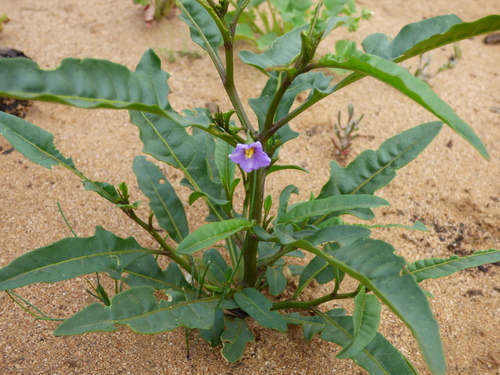
(c) jjudy, some rights reserved (CC BY-NC), uploaded by jjudy
What to Eat
Edible parts: Fruit, Caution
The fruit is edible and grows up to 15mm in diameter. No further details are available, but some caution is advised — unripe fruit should not be eaten at all.
Known Hazards
How to Identify
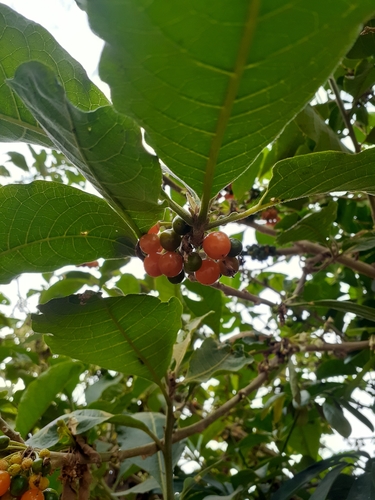
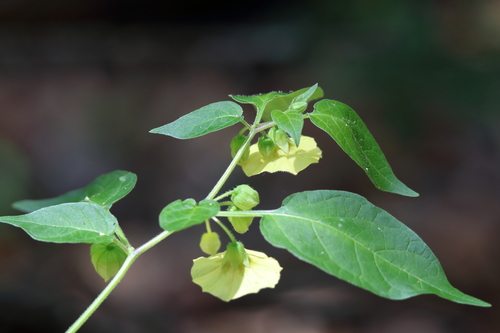
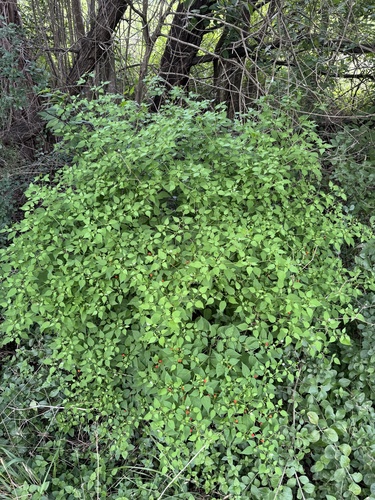
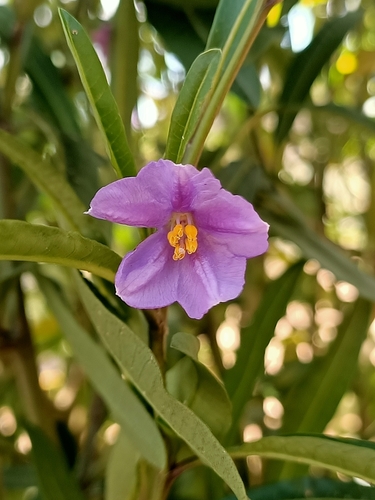
A small shrub. It grows 0.5-2 m high. The leaves are dark green and narrow and alternate. The flowers are violet and blue. They are 2 cm across. The petals are round and the stamens are yellow. The fruit is fleshy and round. It is green to pale purple. They are 1.5 cm across.
How to Grow
We have very little information on this species and do not know if it will succeed in Britain, though judging by its native range it is unlikely to succeed outdoors except in the very mildest parts of the country. Plants tolerate temperatures down to at least -7°c in Australian gardens, but this cannot be translated directly to British gardens due to our cooler summers and longer, colder and wetter winters. It is quite possible that this species can be grown at the foot of a warm sunny wall and be treated as a herbaceous perennial. As long as the roots are given a good mulch in autumn they should survive quite cold winters. This species is closely related to S. aviculare. The following notes are based on the general needs of the genus. Succeeds in most soils in a sunny position..
Propagation: Sow seed in spring in a warm greenhouse; it germinates in 2–3 weeks at 20°C. Prick seedlings out into individual pots when large enough to handle. If growing as annuals, plant out after the last expected frosts with some protection such as a cloche until established. If growing as perennials, particularly at the limits of cold-hardiness, it is better to keep plants under glass for their first winter in fairly large pots (12cm or larger) to accommodate strong root growth. Top growth may die back over winter but roots should survive if greenhouse temperatures stay above approximately -5°C. Plant out in early summer the following year; plants will be somewhat hardier in their second winter. Alternatively, take half-ripe cuttings in July or August in a frame — very easy, rooting within a couple of weeks. Pot into fairly large containers and overwinter in the greenhouse before planting out in early summer.
Medicinal Uses
The plant is a source of solasonine, which is used in the manufacture of steroidal drugs and contraceptives. The unripe fruit is the richest source of this compound.
Other Uses
Plants can be grown as a screening hedge in climates suitable for them.
Wikipedia
A woody shrub reaching 2m tall by 1.5m wide, hardy to UK zone 9. Hermaphrodite flowers pollinated by insects. Grows in light sandy, medium loamy, and heavy clay soils with preference for well-drained conditions across mildly acidic to basic pH ranges. Requires full sun and tolerates both dry and moist soils.
Notes
There are about 1400 Solanum species.
References (11)
- Bodkin, F., 1991, Encyclopedia Botanica. Cornstalk publishing, p 935
- Cherikoff V. & Isaacs, J., The Bush Food Handbook. How to gather, grow, process and cook Australian Wild Foods. Ti Tree Press, Australia p 120
- Cribb, A.B. & J.W., 1976, Wild Food in Australia, Fontana. p 75
- Gott, B & Conran, J., 1991, Victorian Koorie Plants. PO Box 666 Hamilton, Victoria 3300, Australia. p 37
- Lazarides, M. & Hince, B., 1993, Handbook of Economic Plants of Australia, CSIRO. p 223
- Leiper, G & Houser, J., Mutooroo. Plant Use by Australian Aboriginal People. Assembly press, Queensland.
- Mallee Wildflower Committee, Flowers of the Mallee. p 20
- Paczkowska, G . & Chapman, A.R., 2000, The Western Australian Flora. A Descriptive Calatogue. Western Australian Herbarium. p 538
- Plants for a Future database, The Field, Penpol, Lostwithiel, Cornwall, PL22 0NG, UK. http://www.scs.leeds.ac.uk/pfaf/
- Samuels, J., 2015, Biodiversity of Food Species of the Solanaceae Family: A Preliminary Taxonomic Inventory of Subfamily Solanoideae. Resources 2015, 4. 277-322
- Zola, N., & Gott, B., 1992, Koorie Plants Koorie People. Koorie Heritage Trust. p 25