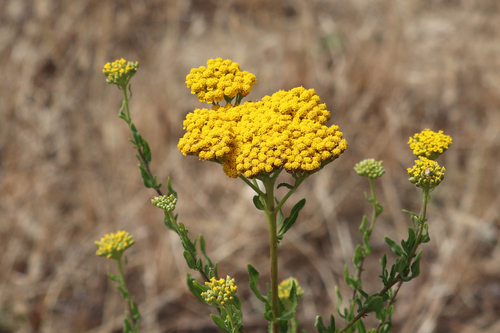
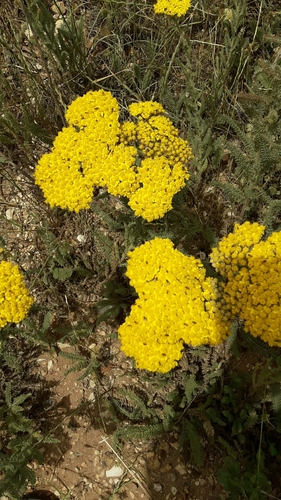
Solidago spectabilis
(D. C. Eaton) A. Gray
Nevada goldenrod

(c) Liam O'Brien, some rights reserved (CC BY-NC), uploaded by Liam O'Brien

(c) lonnyholmes, some rights reserved (CC BY-NC), uploaded by lonnyholmes

(c) 2004 Brent Miller, some rights reserved (CC BY-NC-SA)
What to Eat
Edible parts: Seeds
The seeds are edible, though no further details on preparation or harvest are recorded.
Where to Find It
It is a temperate plant.
North America, USA,
How to Identify
A perennial herb reaching 50 cm (1 ft 8 in) tall with hermaphrodite flowers pollinated by insects. Flowers from July to August. Hardy to UK zone 7. Grows in light sandy, medium loamy, and heavy clay soils, including dense clay. Tolerates mildly acidic, neutral, basic, and very alkaline soil pH. Adapts to semi-shade or full sun and prefers moist soil. Attracts wildlife.
How to Grow
Propagation: Sow seed in spring in a cold frame, barely covering it, and keep the compost from drying out. Prick seedlings into individual pots once large enough to handle, overwinter in pots, and plant out in spring or early summer. Divide in spring or autumn. Larger divisions can go directly into permanent positions; smaller ones are best potted up and grown on in a lightly shaded cold frame until well established before planting out in summer.
Medicinal Uses
The leaves and flowering stems are antiseptic. An infusion of the dried powdered herb can be used for this purpose.
Other Uses
Mustard, orange, and brown dyes can be obtained from the whole plant. The plant also attracts wildlife.
Wikipedia
Source ↗Solidago spectabilis is a species of goldenrod known by the common names Nevada goldenrod, basin goldenrod, and showy goldenrod. It is native to the western United States in the Great Basin and surrounding areas. It is found in California, Arizona, Nevada, Oregon, and Utah. There are historical records saying it once grew in southwestern Idaho, but is now extirpated there. This variety has also been seen in the western Montana county of Sanders. Solidago spectabilis grows in moist habitats, including bogs, meadows, seeps, streambanks, hot springs, and wet areas on alkali flats. It is a rhizomatous perennial herb producing one or more upright stems that can reach two meters (5 feet) in maximum height. It is mostly hairless, but can have occasional patches of rough hairs. There is a basal rosette of fleshy, lance-shaped leaves measuring up to 25 centimeters (10 inches), the blades borne on winged petioles. The edges may be wavy or slightly toothed. Leaves higher up the stem are smaller and usually smooth-edged. The inflorescence is a large upright or arching array of many flower heads, with some containing up to 100 heads. Each flower head contains 8-22 yellow disc florets surrounded 5-15 narrow yellow ray florets each no more than 4 millimeters long.
Notes
There are about 100 Solidago species.
References (5)
- Beckstrom-Sternberg, Stephen M., and James A. Duke. "The Foodplant Database." http://probe.nalusda.gov:8300/cgi-bin/browse/foodplantdb.(ACEDB version 4.0 - data version July 1994)
- Kermath, B. M., et al, 2014, Food Plants in the Americas: A survey of the domesticated, cultivated and wild plants used for Human food in North, Central and South America and the Caribbean. On line draft. p 828
- Moerman, D. F., 2010, Native American Ethnobotany. Timber Press. p 537
- Plants for a Future database, The Field, Penpol, Lostwithiel, Cornwall, PL22 0NG, UK. http://www.scs.leeds.ac.uk/pfaf/
- Proc. Amer. Acad. Arts 17:193. 1882