Sonchus schweinfurthii
Oliv. & Hiern.
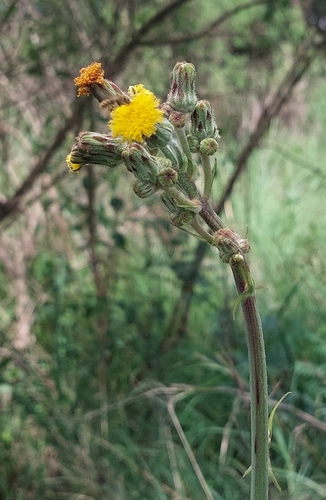
(c) Bart Wursten, some rights reserved (CC BY-NC), uploaded by Bart Wursten
What to Eat
Edible parts: Leaves, Vegetable
The leaves are eaten as a vegetable.
Known Hazards
Where to Find It
A tropical plant. It grows in seasonally or permanently wet soils.
Africa, Angola, Burundi, Cameroon, Central Africa, Central African Republic, CAR, Congo, East Africa, Ethiopia, Guinea, Guinée, Kenya, Malawi, Mozambique, Nigeria, Rwanda, Southern Africa, Sudan, Tanzania, Uganda, West Africa, Zambia, Zimbabwe,
How to Identify
A herb. It is erect and can grow for several years. It grows 1-1.5 m tall. The taproot is slightly woody. It has a single stem and branches. The stem is hollow and it has ridges along it. The leave stick upwards and are thinly leathery. The leaves on the stem are 36 cm long by 3 cm wide. The upper leaves clasp the stem and are more narrow.
Notes
There are about 60 Sonchus species.
Names & Synonyms
Achak, Mshunga, Mshunga-pwapwa, Nsombya, Toriba
References (9)
- Etkin, N.L. (Ed.), 1994, Eating on the Wild Side, Univ. of Arizona. p 51
- Flora Zambesiaca. http://apps.kew.org/efloras
- Fowler, D. G., 2007, Zambian Plants: Their Vernacular Names and Uses. Kew. p 77
- Harkonen, M. & Vainio-Mattila, K., 1998, Some examples of Natural Products in the Eastern Arc Mountains. Journal of East African Natural History 87:265-278
- Johns, T., and Kokwaro, J.O., 1991, Food Plants of the Luo of Siayo District, Kenya. Economic Botany 45(1), pp 103-113
- Johns, T., Mhoro, E. B. and Sanaya, P., 1996, Food Plants and Masticants of the Batemi of Ngorongoro District, Tanzania. Economic Botany, Vol. 50, No. 1, pp. 115-121
- Mutie, F. M., et al, 2023, Important Medicinal and Food Taxa (Orders and Families) in Kenya, Based on Three Quantitative Approaches. Plants 2023, 12, 1145
- Vainio-Mattila, K., 2000, Wild vegetables used by the Sambaa in the Usumbara Mountains, NE Tanzania. Ann. Bot. Fennici 37:57-67
- World Checklist of Useful Plant Species 2020. Royal Botanic Gardens, Kew