Acmella oleracea
(L.) R. K. Jansen
Para cress, Brazilian cress
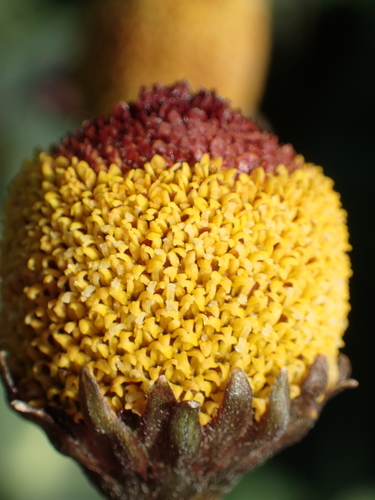
no rights reserved, uploaded by 葉子
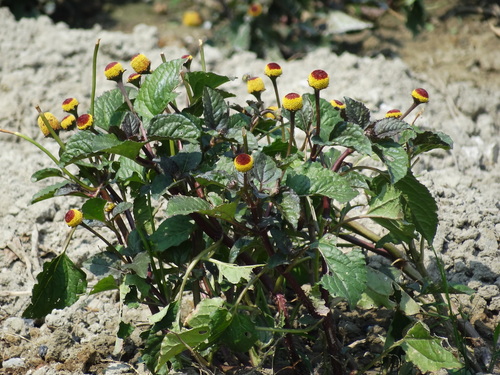
no rights reserved, uploaded by 葉子
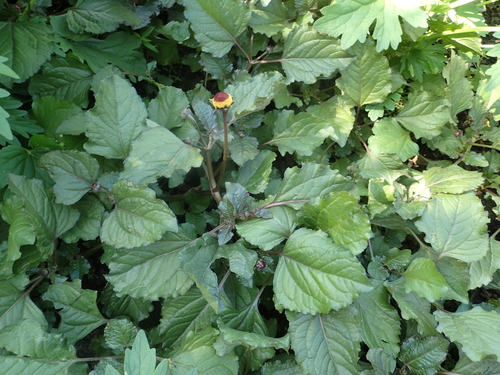
no rights reserved, uploaded by 葉子
What to Eat
Edible parts: Leaves, Vegetable, Flowers
Leaves can be eaten raw or cooked, and are a memorable addition to salads — they stimulate the salivary glands while numbing the tongue and lips. Though they smell like any ordinary leafy green, the taste is something else entirely. It is somewhat reminiscent of Echinacea but without the bitterness or nausea that plant can cause. First comes a strong, spicy warmth spreading across the tongue, which quickly shifts into a prickling sensation. The salivary glands respond dramatically, producing large amounts of saliva. The prickling mellows into an acidic, slightly metallic sharpness with tingling, then numbness — lasting anywhere from two to twenty minutes depending on the person and quantity eaten. A pungent aftertaste can linger for an hour or more. The leaves are a popular ingredient in Amazonian soups and have become a favourite vegetable among Europeans living in Madagascar. A concentrated plant extract — sometimes called jambu oil or jambu extract — is used as a flavouring in foods, chewing gum, and chewing tobacco, described as having a citrus, herbal, tropical, or musty odour with a pungent, cooling, tingling, numbing, or effervescent taste. This extract also finds use as a flavouring agent in cosmetics and shampoos.
Known Hazards
Where to Find It
It is a tropical plant. It grows in regions with an average temperature of 26°C. The rainfall is 2,700 mm per year. The relative humidity is 85%. It is damaged by frost.
Africa, Amazon, Asia, Bangladesh, Benin, Brazil*, Canada, Central Africa, Central African Republic, CAR, China, Colombia, Comoros, Congo DR, Cuba, East Africa, Ecuador, Gabon, Hawaii, Himalayas, India, Indochina, Indonesia, Leeward Is., Madagascar, Mali, Mauritius, Myanmar, Nepal, Northeastern India, Pacific, Peru, Reunion, SE Asia, South America*, Sri Lanka, Taiwan, Thailand, Tibet, Tropics, USA, Vietnam, West Africa,
How to Identify
A shrub or small tree. It grows 5 m tall. There are prickles along the stem. The leaves are twice divided and there are 8-18 pairs of pinnae. There are up to 50 pairs of pinnules on each pinnae. The flowers are yellow. They are in large clusters at the ends of branches. The pods are flattened.
How to Grow
It can be grown from seed. It can also be grown from shoots or cuttings. For seed germination a temperature above 21°C is needed.
Propagation: Sow seed at a temperature of 21°c — germination takes approximately two weeks. Cuttings can be taken when the plant is not in flower.
Medicinal Uses
The most widespread medicinal use is for toothache and infections of the throat and gums. Flower heads are used fresh or dried and powdered worldwide, though roots and leaves have also been recommended. The plant is used to treat dysentery and rheumatism, to support the immune system, and to combat blood parasites — particularly malaria, both as a preventative and a cure. The leaves are sialagogue. Leaves and flower heads together are analgesic, anthelmintic, antibacterial, and antifungal. Note that some of the active medicinal compounds are destroyed by desiccation or freezing. In-vitro studies have demonstrated strong antibacterial activity against Escherichia, Klebsiella, Proteus, Pseudomonas, Salmonella, and Staphylococcus, as well as inhibition of Candida albicans.
Other Uses
The plant has proved effective as a natural insecticide against yellow fever mosquito (Aedes aegypti) larvae and corn earworm moth (Helicoverpa zea) larvae. It is widely grown as an ornamental for its attractive, colourful flower heads, and is known to attract fireflies when in bloom, as well as bees, butterflies, and birds. Jambu extract is used in cosmetics and shampoos. The flowers are well suited to cutting, drying, and preserving. The plant grows successfully in containers.
Wikipedia
Source ↗Acmella oleracea is a species of flowering herb in the family Asteraceae. Common names include toothache plant, Szechuan buttons, paracress, jambu, buzz buttons, tingflowers and electric daisy. Its native distribution is unclear, but it is likely derived from a Brazilian Acmella species. A small, erect plant, it grows quickly and bears gold and red inflorescences. It is frost-sensitive but perennial in warmer climates. Its specific epithet oleracea means "vegetable/herbal" in Latin and is a form of holeraceus (oleraceus).
Other Information
It is cultivated as a vegetable in some places. It is also sold in markets.
Notes
There are about 30 Acmella species. It has medicinal uses. It has antibacterial activity.
Names & Synonyms
An-ka-sa-kir, An-sa-te, Ansapui, Berro, Berro de Para, Borousni, Brede mafane, Cresson de Para, Ibouoni, Jambu, Marsang, Marshang, Motum mersh, Nyi-ra-ki, Oubouonou, Phak khrat, Rasun sak, Sichuan buttons, Tipebouoti, Toothacheplant, Yoritampobou
References (35)
- Ambasta, S.P. (Ed.), 2000, The Useful Plants of India. CSIR India. p 593
- Anderson, E. F., 1993, Plants and people of the Golden Triangle. Dioscorides Press. p 222 (As Spilanthes oleracea)
- Arora, R. K., 2014, Diversity in Underutilized Plant Species - An Asia-Pacific Perspective. Bioversity International. p 34
- Balkrishna, A., et al, 2022, Indigenous Uses of Plants among Forest-dependent Communities of Seijosa, Arunachal Pradesh. International Journal of Economic Plants 2022, 9(1):064-080
- Bandyopadhyay, S. et al, 2009, Wild edible plants of Koch Bihar district, West Bengal. Natural Products Radiance 8(1) 64-72 (As Spilanthes oleracea)
- Chowdery, T., et al, 2014, Wild edible plants of Uttar Dinajpur District, West Bengal. Life Science Leaflets. 47:pp 20-36 http://lifesciencesleaflets.ning.com
- Dansi, A., et al, 2012, Diversity of the Neglected and Underutilized Crop Species of Importance in Benin. The Scientific World Journal. Volume 2012, Article ID 932947, 19 pages
- Ethnobotany of Karen in Khun Tuen Noi Chiang Mai. http://khuntuennoi.myspecies
- Facciola, S., 1998, Cornucopia 2: a Source Book of Edible Plants. Kampong Publications, p 42
- Grubben, G. J. H. and Denton, O. A. (eds), 2004, Plant Resources of Tropical Africa 2. Vegetables. PROTA, Wageningen, Netherlands. p 35
- Hermandez Bermejo, J.E., and Leon, J. (Eds.), 1994, Neglected Crops. 1492 from a different perspective. FAO Plant Production and Protection Series No 26. FAO, Rome. p 12
- Jardin, C., 1970, List of Foods Used In Africa, FAO Nutrition Information Document Series No 2.p 104
- Kachenchart, B., et al, 2008, Phenology of Edible Plants at Sakaerat Forest. In Proceedings of the FORTROP II: Tropical Forestry Change in a Changing World. Bangkok, Thailand.
- Kar, A., et al, 2013, Wild Edible Plant Resources used by the Mizos of Mizoram, India. Kathmandu University Journal of Science, Engineering and Technology. Vol. 9, No. 1, July, 2013, 106-126 (As Spilanthes oleracea)
- Katz, E., et al, 2012, No greens in the forest? Note on the limited consumption of greens in the Amazon. Acta Soc Bot Pol 81(4):283–293
- Kew Plants of the World Online
- Khodram,S. D., et al, 2019, Local knowledge of edible flowers used in Mizoram. Indian Journal of Traditional Knowledge Vol 18(40 pp 715-723
- Latham, P. & Mbuta, A. K., 2017, Plants of Kongo Central Province, Democratic Republic of Congo. 3rd ed p 18
- Li, S., et al, 2020, Monpa, memory, and change: an ethnobotanical study of plant use in Mêdog County, South-east Tibet, China. Journal of Ethnobiology and Ethnomedicine. (2020) 16:5 p 17
- Martin, F.W. & Ruberte, R.M., 1979, Edible Leaves of the Tropics. Antillian College Press, Mayaguez, Puerto Rico. p 186
- Medhi, P., Sarma, A and Borthakur, S. K., 2014, Wild edible plants from the Dima Hasao district of Assam, India. Pleione 8(1): 133-148 (As Spilanthes acmella var. oleracea)
- Murtem, G. & Chaudhrey, P., 2016, An ethnobotanical note on wild edible plants of Upper Eastern Himalaya, India. Brazilian Journal of Biological Sciences, 2016, v. 3, no. 5, p. 63-81 (As Spilanthes oleracea)
- Nakahara, K. et al, 2002, Antimutagenicity of Some Edible Thai Plants, and a Biocative Carbazole Alkaloid, Mahanine, Isolated from Micromelum minutum. Journal of Agricultural and Food Chemistry. 50: 4796-4892
- Namsa, et al, 2011, Ethnobotany of the Monpa ethnic group ay Arunachal Pradesh, India. Journal of Ethnobiology and Ethnomedicine 7:31 (As Spilanthes oleracea)
- Segnon, A. C. and Achigan-Dako, E. G., 2014, Comparative analysis of diversity and utilization of edible plants in arid and semi-arid areas in Benin. Journal of Ethnobiology and Ethnomedicine. 10:80
- Staples, G.W. and Herbst, D.R., 2005, A tropical Garden Flora. Bishop Museum Press, Honolulu, Hawaii. p 165
- Suksri, S., et al, 2005, Ethnobotany in Bung Khong Long Non-Hunting Area, Northeast Thailand. Kasetsart J., (Nat. Sci) 39: 519-533
- Syst. Bot. Monogr. 8:65. 1985
- Terra, G.J.A., 1973, Tropical Vegetables. Communication 54e Royal Tropical Institute, Amsterdam, p 76
- Tsering, J., et al, 2017, Ethnobotanical appraisal on wild edible plants used by the Monpa community of Arunchal Pradesh. Indian Journal of Traditional Knowledge. Vol 16(4), October 2017, pp 626-637
- USDA, ARS, National Genetic Resources Program. Germplasm Resources Information Network - (GRIN). [Online Database] National Germplasm Resources Laboratory, Beltsville, Maryland. Available: www.ars-grin.gov/cgi-bin/npgs/html/econ.pl (10 April 2000) (As Acmella oleraceae)
- van Wyk, B., 2005, Food Plants of the World. An illustrated guide. Timber press. p 353
- Villachica, H., (Ed.), 1996, Frutales Y hortalizas promisorios de la Amazonia. FAO, Lima. p 323
- Wiersema, J. H. & Leon, B., 2013, World Economic Plants. A Standard Reference CRC Press. 2nd Ed. p 12
- World Checklist of Useful Plant Species 2020. Royal Botanic Gardens, Kew