Spilanthes paniculata
Wallich ex DC.
Spot flower, Brazil cress, Toothache plant
(c) johnallcock, some rights reserved (CC BY-NC)

(c) Inaya Rizqi, some rights reserved (CC BY-NC)
(c) johnallcock, some rights reserved (CC BY-NC)
What to Eat
Edible parts: Leaves, Vegetable, Flowers, Leaves - tea
The tender parts and young leaves are cooked as a potherb, often with dry meat. Young flower heads are eaten fresh. Seeds are used in pickles and curries. The harvested shoots can be stored for 3-4 days, and leaves are sold in local markets.
Where to Find It
A tropical plant. It grows in old gardens and along tracks. It grows in wetlands. In Nepal it grows to about 1800 m altitude. In Yunnan.
Asia, Bangladesh, Bhutan, Cambodia, China, Himalayas, India, Indochina, Laos, Malaysia, Myanmar, Nepal, Northeastern India, Pacific, Papua New Guinea, PNG, SE Asia, Sri Lanka, Thailand, Tropics,
How to Identify
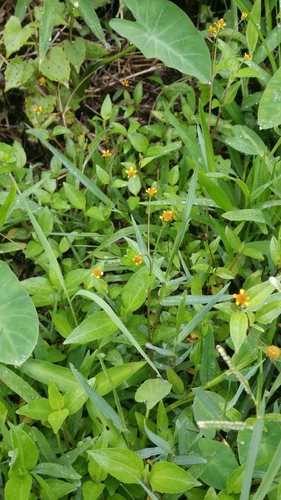
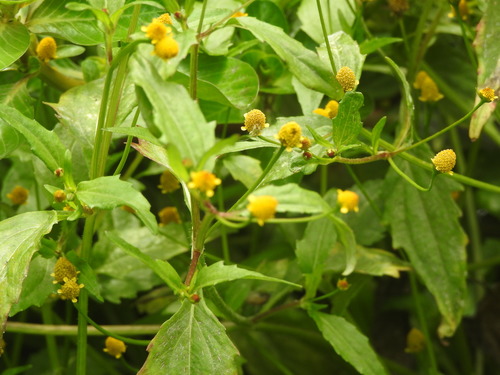
An erect herb. It is an annual plant. It grows 30-60 cm high. The leaves are oval and have teeth around the edge. The leaf tapers towards the tip and is wedge shaped towards the base. The leaves are 2.5-4 cm long by 1.5-2 cm wide. The leaf stalk is 1-3 cm long. The flower heads can be in the axils of leaves or at the ends of branches. The flower stalk is 8-15 cm long. The flower receptacle is cone shaped. Flowers are yellow. The fruit is one seeded and dry. Fruit are triangular shaped.
How to Grow
Plants are grown from seeds. It can be grown from stem cuttings.
Medicinal Uses
The plant is grown for medicinal purposes.
Other Information
It is a commercially cultivated vegetable. Leaves are sold in local markets.
Notes
The plant is grown for medicine. It is also used to kill fish and mosquitoes.
Names & Synonyms
Ansa tlang, Ansah, Ansha, Bhringaraj, Bhuin timur, Chiivio, Getang, Hotaedaw, Huhuni sak, Jari laifang, Jati malkathu, Klungbua, Kuvi-vu, Marcha, Marchang, Marsang, Marshang, Movqnav, Namlang marchang vajungnam, Oshun shak, Pakkradhuawaen, Payngson, Paynson, Phak khad dok noy, Ran, Samberna, Roshun shak, Tian wen cao, Ushomoi, Ushumoi, Usumwi, Yakho hama
References (35)
- Ambasta, S.P. (Ed.), 2000, The Useful Plants of India. CSIR India. p 593
- Anderson, E. F., 1993, Plants and people of the Golden Triangle. Dioscorides Press. p 222
- Angami, A., et al, 2006, Status and potential of wild edible plants of Arunachal Pradesh. Indian Journal of Traditional Knowledge 5(4) October 2006, pp 541-550
- Arora, R. K., 2014, Diversity in Underutilized Plant Species - An Asia-Pacific Perspective. Bioversity International. p 51, 109
- Azam, F. M. S., et al, 2014, Are Famine Food Plants Also Ethnomedicinal Plants? An Ethnomedicinal Appraisal of Famine Food Plants of Two Districts of Bangladesh. Evidence-Based Complementary and Alternative Medicine Volume 2014, Article ID 741712, 28 pages
- Baro, D., Baruah, S. and Borthukar, S. K. 2015, Documentation on wild vegetables of Baksa district, BTAD (Assam). Scholars Research Library. Archives of Applied Science Research, 2015, 7 (9):19-27
- Dutta, U., 2012, Wild Vegetables collected by the local communities from the Churang reserve of BTD, Assam. International Journal of Science and Advanced Technology. Vol. 2(4) p 124
- Hani Medicine of Xishuangbanna, 1999, p 495
- Henty, E.E., & Pritchard, G.S., 1973, Weeds of New Guinea and their control. Botany Bulletin No 7, Division of Botany, Lae, PNG. p 84
- IUCN (2013). Ecological Survey of the Mekong River between Louangphabang and Vientiane Cities, Lao PDR, 2011-2012. Vientiane, Lao PDR: IUCN. 241 pp.
- Jacquat, C., 1990, Plants from the Markets of Thailand. D.K. Book House p 92
- Japanese International Research Centre for Agricultural Science www.jircas.affrc.go.jp/project/value_addition/Vegetables
- Jiwajinda, S., et al, 2002, Suppressive Effects of Edible Thai Plants on Superoxide and Nitric Oxide Generation. Asian Pacific Journal of Cancer Prevention, Vol 3, 2002
- Johnson, N., 2002, Environmental Change in northern Thailand: Impact on Wild Edible Plant Availability. Ecology of Food and Nutrition, 41: 5, 373-399
- Kar, A., 2004, Common wild vegetables of Aka tribe of Arunachal Pradesh. Indian Journal of Traditional Knowledge 3(3) pp 305-313
- Kays, S. J., and Dias, J. C. S., 1995, Common Names of Commercially Cultivated Vegetables of the World in 15 languages. Economic Botany, Vol. 49, No. 2, pp. 115-152
- Konsam, S., et al, 2016, Assessment of wild leafy vegetables traditionally consumed by the ethnic communities of Manipur, northeast India. Journal of Ethnobiology and Ethnomedicine, 12:9
- Li, D. et al, 2017, Ethnobotanical survey of herbal tea plants from the traditional markets in Chaoshan, China. Journal of Ethnopharmacology. 205 (2017) 195-206
- Lim, T. K., Edible Medicinal and Non-Medicinal Plants Volume 7 Flowers
- Luczaj, L., et al, 2021, Wild food plants and fungi sold in the markets of Luang Prabang, Lao PDR. Journal of Ethnobiology and Ethnomedicine (2021) 17:6
- Manandhar, N.P., 2002, Plants and People of Nepal. Timber Press. Portland, Oregon. p 438
- Martin, F.W. & Ruberte, R.M., 1979, Edible Leaves of the Tropics. Antillian College Press, Mayaguez, Puerto Rico. p 186
- Medhi, P. & Borthakur, S. K., 2012, Phytoresources from North Cachur Hills of Assam -3: Edible plants sold at Hflong market. Indian Journal or Natural Products and Resources. 3(1) pp 84-109
- Medhi, P. & Borthakur, S. K., 2013, Wild edible plants sold by the Zeme Nagas at the makeshift market of Mahur, Dima Hasao district of Assam. Pleione 7(1): 84 - 93. 2013PNG. p 563, 562
- Narzary, H., et al, 2013, Wild Edible Vegetables Consumed by Bodo tribe of Kokrajhar District (Assam), North-East India. Archives of Applied Science Research, 5(5): 182-190
- Pagag, K. & Borthakur, S.K., 2012, Wild edible wetland plants from Lakhimpur district of Assam, India. Pleione 6(2): 322 - 327
- Patiri, B. & Borah, A., 2007, Wild Edible Plants of Assam. Geethaki Publishers. p 73
- Peekel, P.G., 1984, (Translation E.E.Henty), Flora of the Bismarck Archipelago for Naturalists, Division of Botany, Lae,
- Pegu, R., et al, 2013, Ethnobotanical study of Wild Edible Plants in Poba Reserved Forest, Assam, India. Research Journal of Agriculture and Forestry Sciences 1(3):1-10
- Pfoze, N. L., et al, 2012, Survey and assessment of floral diversity on wild edible plants from Senapati district of Manipur, Northeast India. Journal of Biodiversity and Environmental Sciences. 1(6):50-52
- Saikia, M., 2015, Wild edible vegetables consumed by Assamese people of Dhemaji District of Assam, NE India and their medicinal values. Archives of Applied Science Research, 2015, 7 (5):102-109
- Sarma, H., et al, 2010, Updated Estimates of Wild Edible and Threatened Plants of Assam: A Meta-analysis. International Journal of Botany 6(4): 414-423
- Srivastava, R. C., et al, 2010, Indigenous biodiversity of Apatani plateau: Learning on biolcultural knowledge of Apani tribe of Qrunachal Pradesh for sustainable livelihoods. Indian Journal of Traditional Knowledge 9(3): 432-442
- Terra, G.J.A., 1973, Tropical Vegetables. Communication 54e Royal Tropical Institute, Amsterdam, p 76
- Zeven, A. C. & de West, J. M. J., 1982, Dictionary of cultivated plants and their regions of diversity. Wageningen. p 51