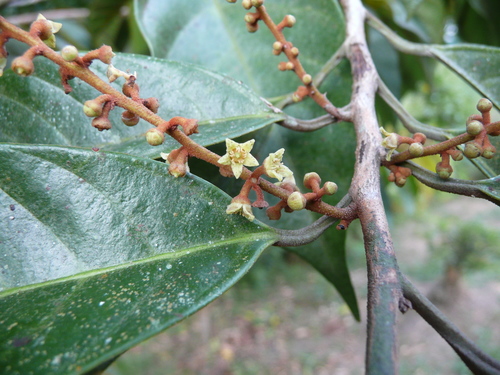
Strombosia philippinensis
(Baill.) Rolfe
Tamayuan
OlacaceaeFruit

wikimedia · cc-by-sa
Wikimedia Commons - JDipterocarpus
Wikimedia Commons - JDipterocarpus

wikimedia · cc-by-sa
Wikimedia Commons - JDipterocarpus
Wikimedia Commons - JDipterocarpus

gbif · cc0
President and Fellows of Harvard College
President and Fellows of Harvard College
What to Eat
Edible parts: Fruit
The fleshy portion of the fruit is eaten raw.
Where to Find It
A tropical plant. They are scattered in lower forested belts throughout the Philippines.
Asia, Pacific, Philippines, SE Asia,
Countries: United Arab Emirates, Afghanistan, Armenia, Australia, Azerbaijan, Bangladesh, Bahrain, Brunei, Bhutan, China, Fiji, Micronesia, Georgia, Indonesia, Israel, India, Iraq, Iran, Jordan, Japan, Kyrgyzstan, Cambodia, Kiribati, North Korea, South Korea, Kuwait, Kazakhstan, Laos, Lebanon, Sri Lanka, Marshall Islands, Myanmar, Mongolia, Maldives, Malaysia, Nepal, Nauru, New Zealand, Oman, Papua New Guinea, Philippines, Pakistan, Palau, Qatar, Saudi Arabia, Solomon Islands, Singapore, Syria, Thailand, Tajikistan, Timor-Leste, Turkmenistan, Tonga, Turkey, Tuvalu, Taiwan, Uzbekistan, Vietnam, Vanuatu, Samoa, Yemen
How to Identify
A medium sized tree with smooth twigs. The leaves are smooth, alternate and oblong. They are bluntly rounded with a sharp point. The flowers are creamy white and clustered along the branches. The sepals are like bracts. The fruit is round and 1.25 cm across. They are hard and dark green.
Medicinal Uses
The plant is used as an antidote for Lophopetalum poisoning.
Other Uses
The dull yellowish to pinkish wood is heavy. It is used for house building. The wood is used for fuel.
References (1)
- Monsalud, M.R., Tongacan, A.L., Lopez, F.R., & Lagrimas, M.Q., 1966, Edible Wild Plants in Philippine Forests. Philippine Journal of Science. p 512