Uapaca nitida
Muell. Arg.
Narrow-leaved mahobohobo
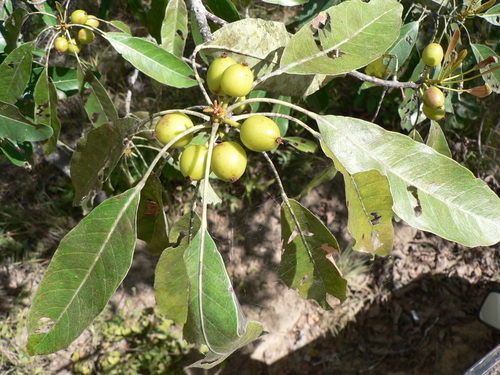
(c) Günter Baumann, some rights reserved (CC BY-NC-SA)

(c) Bart Wursten, some rights reserved (CC BY-NC)
What to Eat
Edible parts: Fruit
The ripe fruit are eaten raw or made into a juice drink by squeezing the fruit in water.
Where to Find It
A tropical plant. It occurs at low altitude. It grows on swampy soil that does not become flooded. It grows between 40-1,830 m above sea level. It can grow in arid places. It grows in miombo woodland.
Africa, Angola, Burundi, Central Africa, Congo, East Africa, Kenya, Malawi, Mozambique, Southern Africa, Tanzania, Zambia, Zimbabwe,
How to Identify
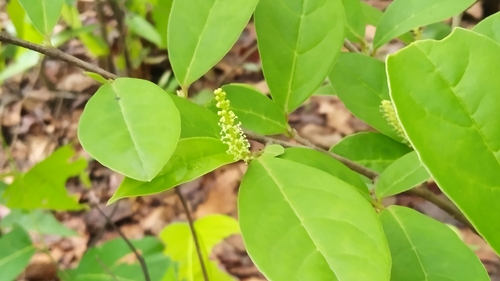
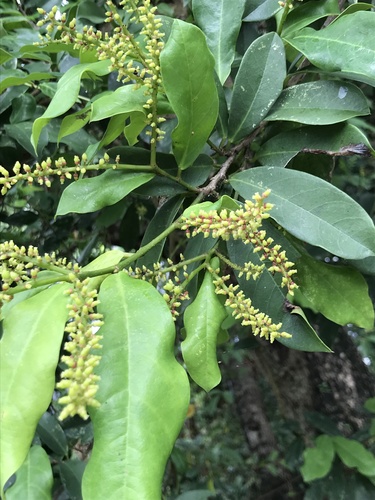
A small to medium sized tree. It grows to 10 m high. The bark is dark grey, rough and cracked. The leaves are narrowly oval and 5-16 cm long by 1.5-4.5 cm wide. They are shiny green above. The flowers are creamy-green and small. The fruit are oval and 2 cm long. They have 12 faint ribs. The fruit are red when ripe. The fruit are edible.
Nutrition Score: 40/100
| Part | Moisture | kJ | kcal | Protein | Vit A | Vit C | Iron | Zinc |
|---|---|---|---|---|---|---|---|---|
| Fruit | 69.6 | 350 | 84 | 8 | — | — | — | — |
How to Grow
Plants can be grown from fresh seeds.
Propagation: Seed - best sown as soon as it is ripe.
Other Uses
The wood is soft. It is used for hut poles, bedsteads and spoons. The wood is used for fuel and to make charcoal.
Production
In Tanzania fruit are collected from November to December. The fruit are sometimes buried for a few days to ripen.
Names & Synonyms
Cagigoura, Kasokolowe, Mgombo, Mngambu, Msalinja, Msanyinja, Msechela mtoto, Mselechera, Msuku mpinini, Mtalala, Mucunapa, Mutaendgedze, Mutongoso, Sokolobwe, Tsangidze
References (17)
- Flora 47:517. 1864
- Fowler, D. G., 2007, Zambian Plants: Their Vernacular Names and Uses. Kew. p 28
- Fox, F. W. & Young, M. E. N., 1982, Food from the Veld. Delta Books. p 196
- Jardin, C., 1970, List of Foods Used In Africa, FAO Nutrition Information Document Series No 2.p 166
- JSTOR Global Plants edible
- Kakeya, 1976,
- Le Houerou, H. N., (Ed.), 1980, Browse in Africa. The current state of knowledge. International Livestock Centre for Africa, Ethiopia. p 162
- Malaisse, F., 1997, Se nourrir en floret claire africaine. Approche ecologique et nutritionnelle. CTA., p 69
- Mpasiwakomu, R. A., 2017, The Diversity and Utilization of Wild Edible and Medicinal Plant Species found in Uvinza Miombo Woodlands, Tanzania. M. Sc. thesis University of Tanzania.
- Peters, C. R., O'Brien, E. M., and Drummond, R.B., 1992, Edible Wild plants of Sub-saharan Africa. Kew. p 113
- Royal Botanic Gardens, Kew (1999). Survey of Economic Plants for Arid and Semi-Arid Lands (SEPASAL) database. Published on the Internet; http://www.rbgkew.org.uk/ceb/sepasal/internet [Accessed 16th April 2011]
- Ruffo, C. K., Birnie, A. & Tengnas, B., 2002, Edible Wild Plants of Tanzania. RELMA p 688
- Tredgold, M.H., 1986, Food Plants of Zimbabwe. Mambo Press. p 132
- Van Wyk, Br. and van Wyk P., 2009, Field Guide to Trees of Southern Africa. Struik Nature. p 80
- White, F., Dowsett-Lemaire, F. and Chapman, J. D., 2001, Evergreen Forest Flora of Malawi. Kew. p 263
- Williamson, J., 2005, Useful Plants of Malawi. 3rd. Edition. Mdadzi Book Trust. p 255
- World Checklist of Useful Plant Species 2020. Royal Botanic Gardens, Kew