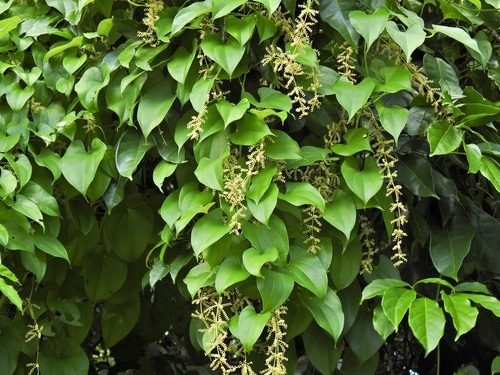
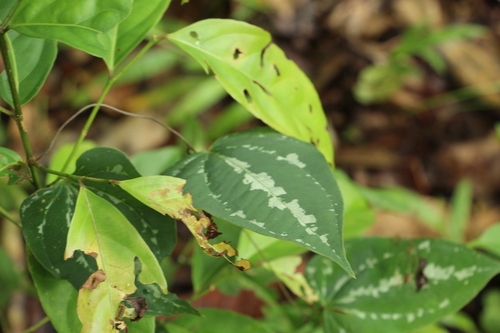
Dioscorea hamiltonii
Hook. f.
Sandikilangu
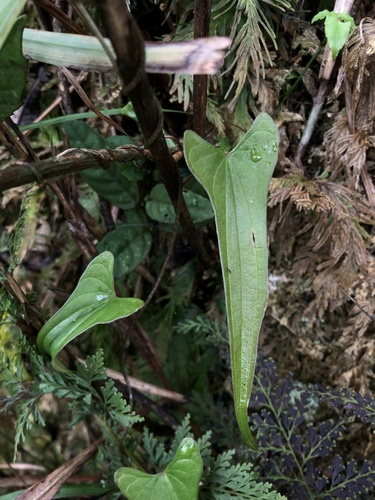
(c) biobank-lantauhk, some rights reserved (CC BY-NC), uploaded by biobank-lantauhk
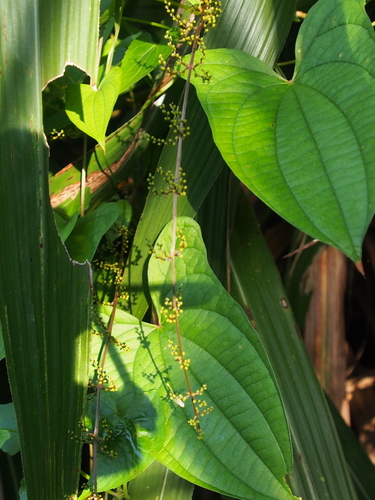
(c) Sunnetchan, some rights reserved (CC BY-NC-ND), uploaded by Sunnetchan
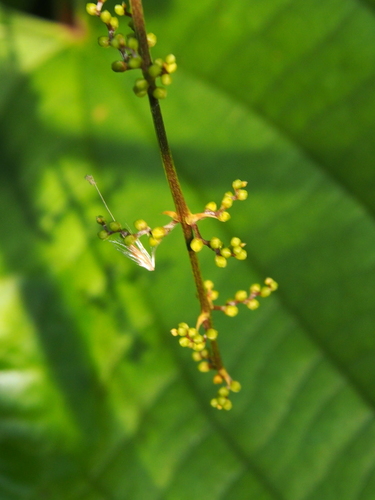
(c) Sunnetchan, some rights reserved (CC BY-NC-ND), uploaded by Sunnetchan
What to Eat
Edible parts: Tubers, Root, Bulbils
The tubers are boiled and eaten, and are also eaten raw by children. The bulbils are cooked and eaten. Tubers are sold in local markets.
Where to Find It
A tropical plant. In Yunnan.
Andamans, Asia, Bangladesh, China, Himalayas, India, Indochina, Indonesia, Laos, Myanmar, Nepal, Northeastern India, SE Asia, Thailand, Vietnam,
How to Identify
A yam. It is a climbing plant and the stems wind clockwise. The tubers are deeply buried. It has bulbils in the axils of the leaves. The leaves can be opposite or alternate. The leaves are heart shaped and 10 cm long by 8 cm wide. The tubers can occur singly or in pairs. Flowers are on spikes with male and female flowers separately. Male spikes are zigzag and 40 cm long while female spikes are curved and 20 cm long. The fruit are capsules 2 cm wide. The seeds have brown wings.
How to Grow
It can be grown from the bulbils.
Propagation: Seed - Tubercles.
Medicinal Uses
The rhizomes constitute a restorative and antifebrile remedy. They have a beneficial effect in the treatment of dyspepsia, general debility, chronic enteritis, chronic diarrhoea and dysentery, spermatorrhoea, night sweats, diabetes mellitus, polyuria, merrorrhoea, lumbago, vertigo and photopsia. The tuber is used externally for poulticing boils. The tubers are collected towards the end of the growing season as the plant begins to wither. They are carefully washed, soaked in an aqueous solution of alum for 2 - 3 hours, then subjected to sulphur fumigation for 48 hours. They are then dried in the sun or in ovens.
Wikipedia
Source ↗Dioscorea hamiltonii is a species of Dioscorea native to southern China, Taiwan, northern Indochina (Thailand, Vietnam, Myanmar) and the Himalayas (Nepal, Sikkim, Bhutan, Assam). Dioscorea hamiltonii is used as an ingredient in a type of chè: chè củ mài.
Production
Tubers are harvested when the plant withers.
Other Information
Tubers are sold in local markets. They are also eaten raw by children.
Notes
There are about 650 species of Dioscorea.
References (28)
- Ambasta, S.P. (Ed.), 2000, The Useful Plants of India. CSIR India. p 175
- Aryal, K. P., et al, 2018, Diversity and use of wild and non-cultivated edible plants in the Western Himalaya. Journal of Ethnobiology and Ethnomedicine (2018) 14:10
- Behera K. K., et al, 2008, Wild Edible Plants of Mayurbhanj District, Orissa, India. J. Econ. Taxon. Bot. Vol. 32 (Suppl.) pp 305-314
- Castillo, C., 2013, The Archaeobotany of Khao Sam Kaeo and Phu Khao Thong: The Agriculture of Late Prehistoric Southern Thailand. Ph. D. thesis University College, London p 380
- Chi, V. L. et al, 2007 , Root and Tuber Crops in Vietnam: Focus on yam germplasm. Ethnobotany Research and Applications. 5:259-272 (As Dioscorea persimilis)
- Dangol, D. R. et al, 2017, Wild Edible Plants in Nepal. Proceedings of 2nd National Workshop on CUAOGR, 2017.
- Deb, D., et al, 2013, Wild Edible Plants and Their Utilization in Traditional Recipes of Tripura, Northeast India. Advances in Biological Research 7(5):203-211
- Dutta, B., 2015, Food and medicinal values of certain species of Dioscorea with special reference to Assam. Journal of Pharmacognosy and Phytochemistry. 3(4): 15-18
- Gangwar, A. K. & Ramakrishnan, P. S., 1990, Ethnobotanical Notes on Some Tribes of Arunachal Pradesh, Northeastern India. Economic Botany, Vol. 44, No. 1 pp. 94-105
- Ghimeray, A. K., Lamsal, K., et al, 2010, Wild edible angiospermic plants of the Illam Hills (Eastern Nepal) and their mode of use by local community. Korean J. Pl. Taxon. 40(1)
- Jha, P. K., et al, 1996, Plant genetic resources of Nepal: A guide for plant breeders of agricultural, horticultural and forestry crops. Euphytica 87:189-210
- Lim, T. K., 2015, Edible Medicinal and Non Medicinal Plants. Volume 9, Modified Stems, Roots, Bulbs. Springer p 37
- Medhi, P., Sarma, A and Borthakur, S. K., 2014, Wild edible plants from the Dima Hasao district of Assam, India. Pleione 8(1): 133-148
- Medhi, P., Sarma, A and Borthakur, S. K., 2014, Wild edible plants from the Dima Hasao district of Assam, India. Pleione 8(1): 133-148
- Misra, R. C., et al, 2013, Genetic resources of wild tuberous food plants traditionally used in Similipal Biosphere Reserve, Odisha, India. Genetic Resources and Crop Evolution. Vol. 60 No. 2. Springer
- Murtem, G. & Chaudhrey, P., 2016, An ethnobotanical note on wild edible plants of Upper Eastern Himalaya, India. Brazilian Journal of Biological Sciences, 2016, v. 3, no. 5, p. 63-81
- Ogle, B. M., et al, 2003, Food, Feed or Medicine: The Multiple Functions of Edible Wild Plants in Vietnam. Economic Botany 57(1): 103-117 (As Dioscorea persimilis)
- Ramachandran, V.S. and Nair, V.J., 1981, Ethnobotanical studies in Cannanore District, Kerala State (India). J Econ. Tax. Bot. Vol 2 pp 65-72
- Rijal, A., 2011, Surviving on Knowledge: Ethnobotany of Chepang community from mid-hills of Nepal. Ethnobotany Research & Applications 9:181-215
- Sang, D. T., & Mizoue, K. O. N., 2012, Use of Edible Forest Plants among Indigenous Ethnic Minorities in Cat Tien Biosphere Reserve, Vietnam. Asian Journal of Biodiversity Vol. 3 (1), p 23-49 (Also as Dioscorea persimilis)
- Sheikh, N., et al, 2009, Status documentation of Dioscorea L. (Dioscoreaceae) in Meghalaya: an approach towards food security. Pleione 3(1): 74 - 82
- Singh, H.B., Arora R.K.,1978, Wild edible Plants of India. Indian Council of Agricultural Research, New Delhi. p13
- Srivastava, R. C., 2010, Traditional knowledge of Nyishi (Daffla) tribe of Arunachal Pradesh. Indian Journal of Traditional Knowledge. 9(1):26-37
- Tanaka, Y & Van Ke, N., 2007, Edible Wild Plants of Vietnam. Orchid Press. p 75 (As Dioscorea persimilis)
- Teron, R. & Borthakur, S. K., 2016, Edible Medicines: An Exploration of Medicinal Plants in Dietary Practices of Karbi Tribal Population of Assam, Northeast India. In Mondal, N. & Sen, J.(Ed.) Nutrition and Health among tribal populations of India. p 151
- Vu, Yam Germplams in Vietnam Ethnobotany Research and Applications. Vol. 4: (As Dioscorea persimilis)
- World Checklist of Useful Plant Species 2020. Royal Botanic Gardens, Kew
- Xu, You-Kai, et al, 2004, Wild Vegetable Resources and Market Survey in Xishuangbanna, Southwest China. Economic Botany. 58(4): 647-667. (As Dioscorea persimilis)