Dioscorea alata
L.
Greater yam
(c) kerrycoleman, some rights reserved (CC BY-NC), uploaded by kerrycoleman

(c) wandayanet, some rights reserved (CC BY-NC)

(c) wandayanet, some rights reserved (CC BY-NC)
What to Eat
Edible parts: Tubers, Root, Vegetable, Bulbils
The roots are cooked — usually boiled or baked — and used as a vegetable. Each plant typically produces an average of 3 roots weighing 5–10kg each, though exceptionally they can reach 60kg. The root must be properly cooked as it can be toxic if eaten raw. The plant also produces aerial tubers, which can be eaten in the same way as the main tubers. The purple variety's colour comes from water-soluble anthocyanin pigments, which are used as a food colouring agent.
Known Hazards
Where to Find It
A tropical plant. It grows from sea level up to about 1800 m in the tropics. Yams are most important in seasonally dry areas. They need a well drained soil and it has to have reasonable fertility. The temperature maximum is >30°C while the minimum is 20°C. The optimum temperature range is 25-30°C. Rainfall is often seasonal in yam areas and the maximum to be needs 14-20 weeks rain with an optimum of 1,150 mm during the growing season. Yams can tolerate drought but give maximum yields with high rainfall. The critical rain period is during the first 5 months. Light influences tuber growth. A continuous exposure of tubers to light significantly reduces tuber yields. Day length - Yams are influenced by photoperiod, or hours of sunlight. Short days (less than 10-11 hours of sunlight) favours tuber development. It does not suit atolls. It suits hardiness zones 10-12. In Yunnan.
Africa, American Samoa, Anguilla, Asia, Australia, Bangladesh, Barbados, Benin, Bougainville, Brazil, Burkina Faso, Cambodia, Cameroon, Caribbean, Central Africa, Central America, China, Chuuk, Colombia, Comoros, Congo DR, Cook Islands, Costa Rica, Côte d'Ivoire, Cuba, Dominican Republic, East Africa, East Timor, Easter Island, Ecuador, Ethiopia, Fiji, FSM, Gabon, Gambia, Ghana, Guam, Guatemala, Guiana, Guianas, Guinea, Guinée, Guinea-Bissau, Guyana, Haiti, Hawaii, Himalayas, Honduras, India, Indochina, Indonesia, Ivory Coast, Jamaica, Japan, Laos, Madagascar, Malawi, Malaysia, Maldives, Mali, Mariana Islands, Marquesas, Mexico, Micronesia, Mozambique, Myanmar, Nauru, Nepal, New Caledonia, New Zealand, Nigeria, Niue, North America, Northeastern India, Pacific, Palau, Panama, Papua New Guinea, PNG, Philippines, Pohnpei, Polynesia, Puerto Rico, Rotuma, Samoa, Sao Tome and Principe, SE Asia, Senegal, Sierra Leone, Solomon Islands, Southern Africa, South America, Sri Lanka, St Lucia, St. Vincent and Grenadines, Sudan, Suriname, Taiwan, Thailand, Tibet, Timor-Leste, Togo, Tokelau, Tonga, Truk, Tuvalu, Uganda, USA, Vanuatu, Venezuela, Vietnam, Wallis & Futuna, West Africa, West Indies, Yap, Zambia,
How to Identify
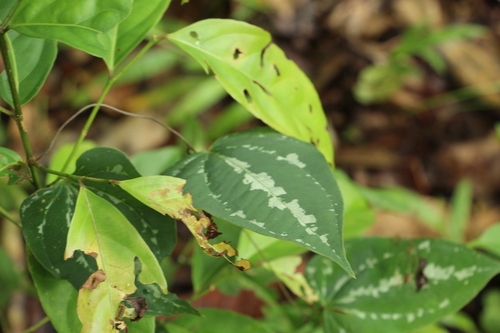
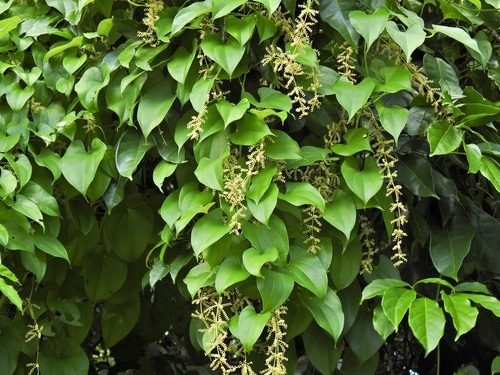
A yam with a long angular vine. It can climb 15 m high. The stems are square and twine to the right around support sticks. The stem does not have spines. It is often coloured green or purple. The leaves are heart shaped and borne in pairs along the vine. The leaves vary is shape, size and colour with different varieties. Leaves can be 10-30 cm long by 5-20 cm wide. The leaf stalk is 6-12 cm long. The flowers occur in the axils of the upper leaves. The male flowers are in small heads along branched stalks. These can be 25 cm long and green. The female flowers are in shorter spikes. Many cultivated varieties do not produce fertile seed. The fruit are 3-winged and 2.5 cm long by 3.5 cm wide. The seeds when they occur have wings right around them. One large but often irregular shaped tuber occurs under the ground. A very large number of different varieties occur. The tubers can vary in shape, size, colour, texture and other ways. Some varieties produce bulbils along the vine. Plants can vary in number of chromosomes.
Nutrition Score: 40/100
| Part | Moisture | kJ | kcal | Protein | Vit A | Vit C | Iron | Zinc |
|---|---|---|---|---|---|---|---|---|
| Tuber | 76.6 | 323 | 77 | 2 | 18 | 10 | 0.8 | 0.39 |
How to Grow
Ceremonial yams have very specialised production techniques. For general food production, use top pieces of the tuber after they have sprouted, use a branched stick for support of the vine, space plants about 1 m apart and choose a smooth round cultivar. Given the large diversity of cultivars of greater yam, for efficient production varieties need to be chosen which have regular rounded tuber shapes for easier harvesting and preparation; also selection needs to be made for varieties with less leaf spot and virus susceptibility and stable yield. Colour, cooking quality, storage ability, texture and other qualities need to be considered to suit the growers demands. In most places the yam growth and maturation is integrated with seasonal rainfall patterns. They are mostly planted just before the first rains where a 8-10 month rainy season exists and give better yields in 6-8 month rainy season areas when planted 3 months before the rains. Earlier planting requires larger sett size to withstand desiccation. Pre germination of tubers which are cut and stored in shady places gives improved yields over tubers left whole then cut into setts at planting. Because yam tubers have a period of dormancy, tubers do not normally commence re-growth for up to 5-6 months. This enhances their storability but delays out of season replanting. Dormancy can be broken using Calcium carbide treatment for 5 hours or by covering tubers with leaves of Croton aromaticus or Averrhoea bilimbi.. Yams are demanding in their nutrient requirements are are therefore often planted first in rotations. They need a fertile free draining soil. They cannot tolerate water logging. It is normally grown from sections of the tubers especially top pieces. In some cultivars, it is also propagated by bulbils. Using staggered plantings of male and female plants and doing hand pollination it is possible to get viable seed set which can be used for establishing plants. It is common practice in many areas to plant the yam piece upside down. The probable reason for this is to give the shoot and roots time to develop and get established away from the sun and wind, so that the plant does not dry out. People in yam areas have their varieties classified as to whether they are planted at the top or the bottom of the hole, and whether the shoot is pointed up or downwards. This is a response to the diversity of tuber shapes and cultivars. A planting depth of 15 cm is optimum. Normally top pieces give higher yields than middle pieces of tubers and these are better than bottom pieces. Varietal differences in this occur. Top pieces give earlier and more reliable germination and mature earlier. They are also the less attractive part of the tuber for eating so are preferred for planting. The larger the sett the earlier the germination and the greater the yield. Increasing the seeding rate and plant density gives greater total yield but the extra planting material required means yield of food available is less. Normally on lighter soils closer spacing is used. Compact soil or hard pans or stones result in tubers being exposed which decreases the yield and needs to be avoided This is related to light as well as physical constraints. Good drainage is essential. Yams must have a well drained soil with plenty of air in the soil. So yams will not normally grow on heavy clay soils or in areas with a lot of soil moisture. The soil can be improved for yam growing by putting leaves and other plant material in the planting hole, by making a mound above the hole, or by planting on a hillside. In some very loose sandy soils yams can just be planted in flat unmounded soils without digging a special yam hole but these situations are not common. Yams should also have sticks to climb up. It is best to have a stick that is twisted or branched because the vine can slip down a very straight stick. Normally a stick 2 metres tall is sufficient. It needs to be a strong stick, firmly fixed in the ground. Yam varieties vary on the type of vine growth they have. This affects where the stick needs to be placed. The fat irregular yams can have the sticks near the mound as a thick clump of vines and leaves soon develops. But if the stick is put beside the mound of one of the long ceremonial yams the vine will often reach the top of the stick before it has produced more than a couple of leaves, and will then fall back down to produce its leaves on the ground. The stick often needs to be put at some distance from the yam hole. The tip can be picked off the vine if branching is wanted earlier. It may be that the long vine yams are more common in forest areas and the shorter branched vines in grassland areas. In some areas yam vines are allowed to creep over the ground and do not have sticks to climb. This method only works satisfactorily in dry places because diseases of the leaves and vine can cause serious damage in wetter places. Where yams do not have sticks to climb plants need to be more widely spaced. Under most circumstances the amount of food produced can be doubled by allowing yam vines to climb up sticks. In drier grassland areas mulching the mounds at planting has been found to improve establishment and yield.
Propagation: Seed is rarely produced in cultivation and is not normally used for propagation. Tubers are propagated by cuttings: small tubers are cut into 2–4 sections and larger ones into 6–8 sections, each with 2–3 dormant buds. Cut tubers are often left in the sun for several hours to encourage wound healing and reduce fungal infection risk. Aerial tubers can also be used and typically produce vigorous plants.
Medicinal Uses
The tuber is grated, mixed with brown stout vinegar, spread onto paper, and placed on the small of a woman's back to prevent or forestall a threatened miscarriage. Although used in folk medicine and available as a dietary supplement, there is no clinical evidence that this species has any therapeutic properties. Supplements may have adverse effects in people taking oestrogens or anticoagulant drugs, or during pregnancy and breastfeeding. The plant has relatively high oxalate levels of 486–781mg per 100g dry matter.
Other Uses
Used as fodder. Grown as an ornamental and as an agroforestry plant. The purple variety's anthocyanin pigments are used as a food colouring agent.
Wikipedia
Source ↗Dioscorea alata – also called ube, ubi, uwhi, purple yam, or greater yam, among many other names – is a species of yam (a tuber). The tubers are usually a vivid violet-purple to bright lavender (hence the common name), but some range from creamy-white to plain white. It is sometimes confused with taro and the Okinawa sweet potato beniimo (紅芋) (Ipomoea batatas 'Ayamurasaki'), however D. alata is also grown in Okinawa. Its origins are in the Asian and Oceanian tropics. Some varieties attain to great size. A "Mambatap" greater yam grown in Maprik, East Sepik District, Papua New Guinea around 1939 was 3.5 m (11 ft) in length.
Production
The time to maturity ranges from 5 months on the coast to 9 or 10 months at higher altitudes. Yams will store well for over 6 months if given a dry, dark, well ventilated shed. Disease - Anthracnose due to the fungus Glomerella cingulata causes early dying off of leaves in many areas and immature death in susceptible varieties under conditions favourable to disease. But anthracnose does not appear to stop yam production in any area. Climatic conditions favouring the disease are hot wet humid conditions and heavy rain. Earlier planting enables plants to be well established at the onset of rains which is the main infection time for the anthracnose fungus. Varieties resistant to anthracnose normally have thicker leaf leaf coatings or cuticles and shorter pores in the stomata or pores in the leaf. The resistant varieties also had higher levels of chemical phenols in the plant. Infected tubers are a main source of the fungus living and transferring between crops.
Other Information
It is a commercially cultivated vegetable. In Papua New Guinea it is a very important ceremonial crop in some areas and a staple food in many seasonally dry areas. It is the staple food for millions of people globally. It is sold in local markets.
Notes
There are about 650 species of Dioscorea. Demo
Names & Synonyms
Aaru sanga, Ambi, Aru kanda, Asiatic yam, Avase, Ba-chhim, Baha, Bahra, Banra, Basa, Batatilla, Bed, Bet, Bilaikand, Bileiy kattala, Bira, Boboyassi, Cao bao me, Cara, Cham aloo, Chupri alu, Cucam, Cucui-mo, Dago, Dagu, Damloong chhiem moen, Dandaba, Daunini, Dei ling liu, Dgro-ton, Dika, Diso, Drun nampi, Dugura, Duok, Dus, Eghen ngencha, Ekwa, Elebo, Ep, Ere, Gbara-gue, Ghar tarul, Goradu, Ha, Hakai san, Hakaisante, Hamanu, Hereu, Huwi, Igname ailea, Ilumbelumbe, Kaavathu, Kachchilkilangu, Kachil, Kaile, Kamo, Kannai, Kap, Katalu, Kath alu, Katula, Kep, Kerisi, Kham, Khamalu, Khambo alu, Khanulu, Khoai-mo, Kinampai, Kiri kondol, Kiseba, Koin, Kumbili, Kwalo kau, Lengu, Lipeta, Luktu, Mach alu, Malli, Mallica, Man bo, Man-sao, Man, Manbuo, Mandi, Mansungu, Mautinsong, Metey alu, Mindi, Minje, Mon, Muranga, Myauk-u, Name, Nandi, Nane, Nangate, Nianan, Nruireu, Obato, Obbi, Oewi, Onthalaigasu, Oo-yama-imo, Oobi, Ovy, Pacala, Pahui, Pandalamu, Perumvalli kizhangu, Pindalu, Pokok ubi, Ractaguranialu, Raja-ala, Rambachim, Ramet, Rata ala, Ratula, Rasavalli, Reng dong, Renta yam, Ruichin, Sakourou, Shen shu, Sumchen, Taai-shue, Tarul, Taw-myauk-u, Telngot, Thaphukhlong, Thaphu sathai, Tung-genasu, Tus, Ubi tiyang, Ubi-kemali, Ubi, Ubi randau, Ufi, Uhi, Uvi, Uwhi, Uwi, Winged yam
References (145)
- Abbiw, D.K., 1990, Useful Plants of Ghana. West African uses of wild and cultivated plants. Intermediate Technology Publications and the Royal Botanic Gardens, Kew. p 26
- Alegado, A. M. & De Guzman, R. B., 2014, Indigenous food crops of the Aetas tribe in the Philippines and their traditional methods of food preparation. in Promotion of Underutilized Indigenous Food Resources for Food Security and Nutrition in Asia and Pacific. FAO. Bangkok p 160
- Ambasta, S.P. (Ed.), 2000, The Useful Plants of India. CSIR India. p 174
- Anderson, E. F., 1993, Plants and people of the Golden Triangle. Dioscorides Press. p 209
- Asprilla-Perea, J., & Diaz-Puente, J.M., 2018, Traditional use of wild edible food in rural territories within tropical forest zones: A case study from the northwestern Colombia. New Trends and Issues Proceedings on Humanities and Social Sciences [Online]. 5(1), 162–181.
- Balkrishna, A., et al, 2022, Indigenous Uses of Plants among Forest-dependent Communities of Seijosa, Arunachal Pradesh. International Journal of Economic Plants 2022, 9(1):064-080
- Bandyopadhyay, S. et al, 2009, Wild edible plants of Koch Bihar district, West Bengal. Natural Products Radiance 8(1) 64-72
- Banerjee, A., et al, 2013, Ethnobotanical Documentation of Some Wild Edible Plants in Bankura District, West Bengal, India. The Journal of Ethnobiology and Traditional Medicine. Photon 120 (2013) 585-590
- Baro, D., Baruah, S. and Borthukar, S. K. 2015, Documentation on wild vegetables of Baksa district, BTAD (Assam). Scholars Research Library. Archives of Applied Science Research, 2015, 7 (9):19-27
- Barrau, J., 1976, Subsistence Agriculture in Polynesia and Micronesia. Bernice P. Bishop Museu, Bulletin 223 Honolulu Hawaii. Kraus reprint. p 45
- Bodner, C. C. and Gereau, R. E., 1988, A Contribution to Bontoc Ethnobotany. Economic Botany, 43(2): 307-369
- Borrell, O.W., 1989, An Annotated Checklist of the Flora of Kairiru Island, New Guinea. Marcellin College, Victoria Australia. p 20
- Bourret, D., 1981, Bonnes-Plantes de Nouvelle-Caledonie et des Loyaute. ORSTOM. p 47
- Brouk, B., 1975, Plants Consumed by Man. Academic Press, London. p 143
- Burkill, H. M., 1985, The useful plants of west tropical Africa, Vol. 1. Kew.
- Burkill, I.H., 1966, A Dictionary of the Economic Products of the Malay Peninsula. Ministry of Agriculture and Cooperatives, Kuala Lumpur, Malaysia. Vol 1 (A-H) p 826
- Call, C. A., et al, 2004, Participatory Rural Appraisal in the Upland Ecosystem of Mt Malindang, Misamis Occidental, Philippines. Biodiversity Research Programme for Development in Mindanao. p 53
- Campbell, D. et al, 2021, Wild Food Harvest in Jamaica. Frontiers in Sustainable Food Systems. Vol. 5 Article 663863
- Cao, Y., et al, 2020, Ethnobotanical study on wild edible plants used by three trans-boundary ethnic groups in Jiangcheng County, Pu’er, Southwest China. Journal of Ethnobiology and Ethnomedicine (2020) 16:66
- Castaneda, H., & Stepp, J. R., 2007, Ecosystems as Sources of Useful Plants for the Guaymi People of Costa Rica. Ethnobotany Journal. 5:249-257
- Castillo, C., 2013, The Archaeobotany of Khao Sam Kaeo and Phu Khao Thong: The Agriculture of Late Prehistoric Southern Thailand. Ph. D. thesis University College, London p 380
- Chai, P. P. K. (Ed), et al, 2000, A checklist of Flora, Fauna, Food and Medicinal Plants. Lanjak Entimau Wildlife Sanctuary, Sarawak. Forestry Malaysia & ITTO. p 159
- Cheifetz, A., (ed), 1999, 500 popular vegetables, herbs, fruits and nuts for Australian Gardeners. Random House p 66
- Cheng, Z., et al, 2022, Ethnobotanical study on wild edible plants used by Dulong people in northwestern Yunnan, China. Journal of Ethnobiology and Ethnomedicine (2022) 18:3
- Chowdery, T., et al, 2014, Wild edible plants of Uttar Dinajpur District, West Bengal. Life Science Leaflets. 47:pp 20-36 http://lifesciencesleaflets.ning.com
- Chowdhury, M. & Mukherjee, R., 2012, Wild Edible Plants Consumed by Local Communities of Maldah of West Bengal, India. Indian J.Sci.Res.3(2) : 163-170
- Cobley, L.S. (rev. Steele, W.M.) 2nd Ed., 1976, An Introduction to the Botany of Tropical Crops. Longmans. p 121
- Cooper, W. and Cooper, W., 2004, Fruits of the Australian Tropical Rainforest. Nokomis Editions, Victoria, Australia. p 151
- Coursey, D.G., 1979, Yams, in Simmonds N.W.,(ed), Crop Plant Evolution. Longmans. London. p 70
- Cundall, P., (ed.), 2004, Gardening Australia: flora: the gardener's bible. ABC Books. p 503
- D'Ambrosio, U., & Puri, R. K., 2016, Foodways in transition: food plants, diet and local perceptions of change in a Costa Rican Ngäbe community. Journal of Ethnobiology and Ethnomedicine (2016) 12:3 p 24
- Dangol, D. R. et al, 2017, Wild Edible Plants in Nepal. Proceedings of 2nd National Workshop on CUAOGR, 2017.
- Davis, S.D., Heywood, V.H., & Hamilton, A.C. (eds), 1994, Centres of plant Diversity. WWF. Vol 1 or 2. p 140 (As Dioscorea atropurpurea)
- Davis, S.D., Heywood, V.H., & Hamilton, A.C. (eds), 1994, Centres of plant Diversity. WWF. Vol 1 or 2. p 140 (As Dioscorea globosa)
- de Polle, E., Plantas Silvestres Comestible de Guatemala. 1(1) Universidad de San Carlos de Guatemala.
- Diarra, N. et al, 2016, Etude ethnobotanique des plantes alimentaires utilisées en période de soudure dans les régions Sud du Mali. Int. J. Biol. Chem. Sci. 10(1): 184-197
- Ding Zhizun, Gilbert, Michael G., DIOSCOREACEAE, shu yu ke, Flora of China,
- Dutta, U., 2012, Wild Vegetables collected by the local communities from the Churang reserve of BTD, Assam. International Journal of Science and Advanced Technology. Vol. 2(4) p 121
- Dutta, B., 2015, Food and medicinal values of certain species of Dioscorea with special reference to Assam. Journal of Pharmacognosy and Phytochemistry. 3(4): 15-18
- Ethnobotany of Karbis. Chapter 4 in p 83
- Facciola, S., 1998, Cornucopia 2: a Source Book of Edible Plants. Kampong Publications, p 91
- Fowler, D. G., 2007, Zambian Plants: Their Vernacular Names and Uses. Kew. p 66
- Fox, F. W. & Young, M. E. N., 1982, Food from the Veld. Delta Books. p 182
- Franklin, J., Keppel, G., & Whistler, W., 2008, The vegetation and flora of Lakeba, Nayau and Aiwa Islands, Central Lau Group, Fiji. Micronesica 40(1/2): 169–225, 2008
- French, B.R., 1986, Food Plants of Papua New Guinea, A Compendium. Asia Pacific Science Foundation p 9
- French, B.R., 2010, Food Plants of Solomon Islands. A Compendium. Food Plants International Inc. p 15
- Gangwar, A. K. & Ramakrishnan, P. S., 1990, Ethnobotanical Notes on Some Tribes of Arunachal Pradesh, Northeastern India. Economic Botany, Vol. 44, No. 1 pp. 94-105
- Gangte, H. E., et al, 2013, Wild Edible Plants used by the Zou Tribe in Manipur, India. International Journal of Scientific and Research Publications, Volume 3, Issue 5
- Gautam, R. S., et al, 2022, Ethnobotanical Review of Wild Edible Plants of Nepal. Journal of Natural History Museum Volume 32, 2021-22 p 112
- Ghorbani, A., et al, 2012, A comparison of the wild food plant use knowledge of ethnic minorities in Naban River Watershed Nature Reserve, Yunnan, SW China. Journal of Ethnobiology and Ethnomedicine; 8:17
- Gillaumin, R., 1954, Les Plantes utiles des Nouvelles-Hebrides (fin et complement) In: Journal d'agriculture tropicale et de botanique appliquee Vol. 1, No. 10-12 pp 453-460
- Guite, C., 2016, A study of wild edible plants associated with the Paite tribe of Manipur, India, International Journal of Current Research. Vol. 8, Issue, 11, pp. 40927-40932
- Hedrick, U.P., 1919, (Ed.), Sturtevant's edible plants of the world. p 271 (Also as Dioscorea atropurpurea and Dioscorea globosa and Dioscorea purpurea and Dioscorea rubella)
- Henderson, C.P. and I.R.Hancock, 1988, A Guide to the Useful Plants of the Solomon Islands. Res. Dept. Min of Ag. & Lands. Honiara, Solomon Islands. p 26
- Hossain, U. & Rahman, A., 2018, Study and quantitative analysis of wild vegetable floral diversity available in Barisal district, Bangladesh. Asian J. Med. Biol. Res. 2018, 4 (4), 362-371
- Hu, Shiu-ying, 2005, Food Plants of China. The Chinese University Press. p 321
- Japanese International Research Centre for Agricultural Science www.jircas.affrc.go.jp/project/value_addition/Vegetables
- Jardin, C., 1970, List of Foods Used In Africa, FAO Nutrition Information Document Series No 2.p 13 (Also as Dioscorea colocasiifolia)
- Joshi, N., et al, 2007, Traditional neglected vegetables of Nepal: Their sustainable utilization for meeting human needs. Tropentag 2007. Conference on International Agricultural Research for Development.
- Kar, A., et al, 2013, Wild Edible Plant Resources used by the Mizos of Mizoram, India. Kathmandu University Journal of Science, Engineering and Technology. Vol. 9, No. 1, July, 2013, 106-126
- Kay, D.E., 1973, Root Crops, Digest 2, Tropical Products Institute, London, p 190, 213
- Kays, S. J., and Dias, J. C. S., 1995, Common Names of Commercially Cultivated Vegetables of the World in 15 languages. Economic Botany, Vol. 49, No. 2, pp. 115-152
- Khanal, R., et al, 2014, Documenting abundance and use of underutilized plant species in the mid hill region of Nepal. ECOPRINT 21: 63-71, 2014
- Kiple, K.F. & Ornelas, K.C., (eds), 2000, The Cambridge World History of Food. CUP p 1877
- Koni, J. M. & Bostein, K., 2008, Noms et usages des plantes utiles chez les Nsong, DR Congo. University of Gothenburg. Department of Oriental and African Languages.
- Kuo, W. H. J., (Ed.) Taiwan's Ethnobotanical Database (1900-2000), http://tk.agron.ntu.edu.tw/ethnobot/DB1.htm (Also as Dioscorea alata var. purpurea)
- Lalfakzuala, R., 2007, Ethnobotanical usages of plants in western Mizoram. Indian Journal of Traditional Knowledge. Vol 6(3) pp 480-493
- Langlois, H. C., 2004, Ethnobotanical analysis of different successional stages as sources of wild edible plants for the Guaymi people in Costa Rica. M. Sc. thesis University of Florida.
- Latham, P., 2004, Useful Plants of Bas-Congo province. Salvation Army & DFID p 110
- Lembaga Biologi Nasional, 1977, Ubi-Ubian, Balai Pustaka, Jakarta. p 102
- Li, S., et al, 2020, Monpa, memory, and change: an ethnobotanical study of plant use in Mêdog County, South-east Tibet, China. Journal of Ethnobiology and Ethnomedicine. (2020) 16:5 p 17
- Lim, T. K., 2015, Edible Medicinal and Non Medicinal Plants. Volume 9, Modified Stems, Roots, Bulbs. Springer p 34
- Low, T., 1992, Bush Tucker. Australia’s Wild Food Harvest. Angus & Robertson. p 16
- Macmillan, H.F. (Revised Barlow, H.S., et al) 1991, Tropical Planting and Gardening. Sixth edition. Malayan Nature Society. Kuala Lumpur. p 339
- Malaisse, F., 1997, Se nourrir en floret claire africaine. Approche ecologique et nutritionnelle. CTA., p 61
- Marandi, R. R. & Britto, S. J., 2015, Medicinal Properties of Edible Weeds of Crop Fields and Wild plants Eaten by Oraon Tribals of Latehar District, Jharkhand. International Journal of Life Science and Pharma Research. Vo. 5. (2) April 2015
- Massal, E and Barrau, J., 1973, Food Plants of the South Sea Islands. SPC Technical Paper No 94. Nounea, New Caledonia. p 12-15
- Masters, T., 2021, Traditional food plants of the upper Aswa River catchment of northern Uganda—a cultural crossroads. Journal of Ethnobiology and Ethnomedicine (2021) 17:24
- May, R. J., 1984, Kaikai Aniani. A Guide to Bush Foods Markets and Culinary Arts of Papua New Guinea. Robert Brown and Associates. p 37, 48
- Medhi, P. and Borthakur, S. K., 2011, Genetic Resources of Root and Tuber Crops from North Cachar Hills of Assam. Journal of Root Crops, Vol. 37No.2 pp. 131-143
- Medhi, P. & Borthakur, S. K., 2012, Phytoresources from North Cachur Hills of Assam -3: Edible plants sold at Hflong market. Indian Journal of Natural Products and Resources. 3(1) pp 84-109
- Medhi, P., Sarma, A and Borthakur, S. K., 2014, Wild edible plants from the Dima Hasao district of Assam, India. Pleione 8(1): 133-148
- Meitei, L. R., et al, 2022, An ethnobotanical study on the wild edible plants used by forest dwellers in Yangoupokpi Lokchao Wildlife Sanctuary, Manipur, India. Ethnobotany Research and Application 23:15
- Mekbib, Y & Deressa, T., 2015, Exploration and collection of root and tuber crops in East Wollega and Ilu Ababora zones: Rescuing declining genetic resources. Indian Journal of Traditional Knowledge. Vol. 15(1), pp. 86-92
- Miguel, E., et al, 1989, A checklist of the cultivated plants of Cuba. Kulturpflanze 37. 1989, 211-357
- Misra, S., 2018, Ethno Botany and Nutritional Status of Some Edible Plants of South Odisha, India. International Journal of Advances in Agricultural Science and Technology, Vol.5 Issue.2, February- 2018, pg. 21-32
- Murtem, G. & Chaudhrey, P., 2016, An ethnobotanical note on wild edible plants of Upper Eastern Himalaya, India. Brazilian Journal of Biological Sciences, 2016, v. 3, no. 5, p. 63-81
- Ochse, J.J. et al, 1931, Vegetables of the Dutch East Indies. Asher reprint. p 229
- Omawale, 1973, Guyana's edible plants. Guyana University, Georgetown p 113
- Onwueme, I.C., 1978, The Tropical Tuber Crops. Wiley, p 5
- Patiri, B. & Borah, A., 2007, Wild Edible Plants of Assam. Geethaki Publishers. p 145 (Also as var. globosa and var. rubella)
- Peekel, P.G., 1984, (Translation E.E.Henty), Flora of the Bismarck Archipelago for Naturalists, Division of Botany, Lae, PNG. p 93, 92
- Peduruhewa, P. S., et al, 2021, Potential of Underutilized Wild Edible Plants as the Food for the Future – A Review. Journal of Food Security, Vol. 9, No. 4, 136-147
- Phangchopi, U., et al, 2015, Diversity of wild edible plants in Marat Longri Wildlife Sanctuary, Assam. Indian Journal of Natural Products and Resources Vol. 6(4), December 2015 pp. 305-313
- Phon, P., 2000, Plants used in Cambodia. © Pauline Dy Phon, Phnom Penh, Cambodia. p 235
- Plants of Haiti Smithsonian Institute http://botany.si.edu/antilles/West Indies
- Pradhan, R., et al, 2020, Potential Wild Edible Plants and its Significance in Livelihood of Indigenous People of Male Mahadeshwara Hills, Karnataka. Economic Affairs Vol. 64, No. 4 pp. 01-14
- Priyadi, H., et al, 2010, Five hundred plant species in Gunung Halimun Salak National Park, West Java. A checklist including Sundanese names, distribution and use. CIFOR, FFPRI, SLU p 48
- Purseglove, J.W., 1972, Tropical Crops. Monocotyledons. Longmans p 100
- Rajapaksha, U., 1998, Traditional Food Plants in Sri Lanka. HARTI, Sri Lanka. p 178
- Recher, P, 2001, Fruit Spirit Botanical Gardens Plant Index. www.nrg.com.au/~recher/ seedlist.html p 2
- Sarma, H., et al, 2010, Updated Estimates of Wild Edible and Threatened Plants of Assam: A Meta-analysis. International Journal of Botany 6(4): 414-423
- Schneider, E., 2001, Vegetables from Amaranth to Zucchini: The essential reference. HarperCollins. p 711
- Sharma, B.B., 2005, Growing fruits and vegetables. Publications Division. Ministry of Information and broadcasting. India. p 238
- Sheikh, N., et al, 2009, Status documentation of Dioscorea L. (Dioscoreaceae) in Meghalaya: an approach towards food security. Pleione 3(1): 74 - 82
- Sillitoe, P. 1995, An Ethnobotanical Account of the Plant Resources of the Wola Region, Southern Highlands Province, Papua New Guinea. J. Ethnobiol. 15(2): 201-235
- Singh, G. K. & Ahirwar, R. K., 2013, An Ethnobotanical Survey for Certain Wild Edible Plants of Chanda Forest District Dindori Central India. International Journal of Science and Research. 6:14
- Smith, A.C., 1979, Flora Vitiensis Nova, Lawaii, Kuai, Hawaii, Volume 1 p 90
- Smith, K., 1998. Growing Uncommon Fruits and Vegetables. New Holland. p 21
- Solomon, C., 2001, Encyclopedia of Asian Food. New Holland. p 413
- Sp. pl. 2:1033. 1753
- Staples, G.W. and Herbst, D.R., 2005, A tropical Garden Flora. Bishop Museum Press, Honolulu, Hawaii. p 658 (Drawing)
- Stone, B. C., 1970, The Flora of Guam. A Manual for the Identification of the Vascular Plants of the Island. Micronesica. Journal of the University of Guam. p 127
- Sujanapal, P., & Sankaran, K. V., 2016, Common Plants of Maldives. FAO & Kerala FRI, p 113
- Sukarya, D. G., (Ed.) 2013, 3,500 Plant Species of the Botanic Gardens of Indonesia. LIPI p 921
- Sukenti, K., et al, 2016, Ethnobotanical study on local cuisine of the Sasak tribe in Lombok Island, Indonesia. Journal of Ethnic Foods. 3 (2016) 189-200 p 198
- Taram, M., et al, 2018, Wild Food Plant Resources of Komkar Adi Tribe of Upper Siang District in Arunachal Pradesh, India. Bulletin of Arunachal Forest Research, Vol. 33(2), 27-35
- Termote, C., et al, 2011, Eating from the wild: Turumbu, Mbole and Bali traditional knowledge of non-cultivated edible plants, District Tshopo, DRCongo, Gen Resourc Crop Evol. 58:585-618
- Teron, R. & Borthakur, S. K., 2016, Edible Medicines: An Exploration of Medicinal Plants in Dietary Practices of Karbi Tribal Population of Assam, Northeast India. In Mondal, N. & Sen, J.(Ed.) Nutrition and Health among tribal populations of India. p 151
- Thaman, R.R., 1976, The Tongan Agricultural System, University of the South Pacific, Suva, Fiji. p 395
- Thaman, R. R, 2016, The flora of Tuvalu. Atoll Research Bulletin No. 611. Smithsonian Institute p 47
- Thapa, L. B., et al, 2014, Wild Edible Plants used by endangered and Indigenous Raji Tribe in Western Nepal. International Journal of Applied Sciences and Biotechnology. Vol 2(3):243-252
- Thitiprasert, W., et al, 2007, Country report on the State of Plant Genetic Resources for Food and Agriculture in Thailand (1997-2004). FAO p 95
- Thorng, R., et al, 2015, Roles of Wild Food Plants in Ethnic Group Communities in Mondulkiri Province, Northeastern Cambodia. Journal of Mekong Societies Vol.11 No.2 May-August 2015 pp. 1-17
- Tindall, H.D., 1983, Vegetables in the Tropics, Macmillan p 203
- Tiwi Plants and Animals. 2001, Aboriginal flora and fauna knowledge from Bathurst and Melville Islands, northern Australia. Northern Territory Botanical Bulletin; No. 24 p 43
- Torre, de la, L., et al, 2008, Enciclopedia de las Plantas Útiles del Ecuador. Herbario QCA. Pontificia Universidad Católica del Ecuador. p 308
- Trimanto, & Hapsari L., 2016, Botanical survey in thirteen montane forests of Bawean Island Nature Reserve, East Java Indonesia: Conservation status, bioprospecting and potential tourism. Biodiversitas 17: 832-846.
- Tsering, J., et al, 2017, Ethnobotanical appraisal on wild edible plants used by the Monpa community of Arunchal Pradesh. Indian Journal of Traditional Knowledge. Vol 16(4), October 2017, pp 626-637
- USDA, ARS, National Genetic Resources Program. Germplasm Resources Information Network - (GRIN). [Online Database] National Germplasm Resources Laboratory, Beltsville, Maryland. Available: www.ars-grin.gov/cgi-bin/npgs/html/econ.pl (10 April 2000)
- Vickery, M.L. and Vickery, B., 1979, Plant Products of Tropical Africa, Macmillan. p 15
- von Katja Rembold, 2011, Conservation status of the vascular plants in East African rain forests. Dissertation Universitat Koblenz-Landau p 165
- Walter, A. & Lebot, V., 2007, Gardens of Oceania. ACIAR Monograph No. 122 p. 71
- Whistler, W. A., 1988, Ethnobotany of Tokelau: The Plants, Their Tokelau Names, and Their Uses. Economic Botany 42(2): 155-176
- Wiersema, J. H. & Leon, B., 2013, World Economic Plants. A Standard Reference CRC Press. 2nd Ed. p 248
- Wilkin, P., 2001, Dioscoreaceae of South-Central Africa. Kew Bulletin, Vol. 56, No. 2 (2001), pp 361-404
- Wilkin, P. et al, 2007, A new edible yam (Dioscorea L.) species endemic to Mayotte, new data on D. comorensis R. Knuth and a key to the yams of the Comoro Archipelago. Adansonia ser. 3, 29(2): 215-228
- Woodward, P., 2000, Asian Herbs and Vegetables. Hyland House. p 65
- World Checklist of Useful Plant Species 2020. Royal Botanic Gardens, Kew
- Xu, You-Kai, et al, 2004, Wild Vegetable Resources and Market Survey in Xishuangbanna, Southwest China. Economic Botany. 58(4): 647-667.
- Yuncker, T. G., 1943, The Flora of Niue Island. Bernice P. Bishop Museum Bulletin 178 p 35
- Yuncker, T.G., 1959, Plants of Tonga, Bernice P. Bishop Museum, Hawaii, Bulletin 220. p 82
- Zaldivar, M. E., et al, 2002, Species Diversity of Edible Plants Grown in Homegardens of Chibehan Amerindians from Costa Rica. Human Ecology, Vol. 30, No. 3, pp. 301-316
- Zeven, A. C. & de West, J. M. J., 1982, Dictionary of cultivated plants and their regions of diversity. Wageningen. p 52, p 124 (As Dioscorea colocasiifolia)
- Zizka, G., 1991, Flowering Plants of Easter Island. Palmarum Hortus Francofurtensis