Dioscorea pubera
Blume

Royal Botanic Garden Edinburgh

The Trustees of the Natural History Museum, London

The Trustees of the Natural History Museum, London
What to Eat
Edible parts: Tuber, Root, Bulbils
The tubers, roots, and bulbils are edible; tubers are traditionally boiled with salt. It is used as a famine food.
Where to Find It
A tropical plant.
Asia, Bhutan, Himalayas, India, Indonesia, Myanmar, Nepal, Northeastern India, SE Asia,
How to Identify
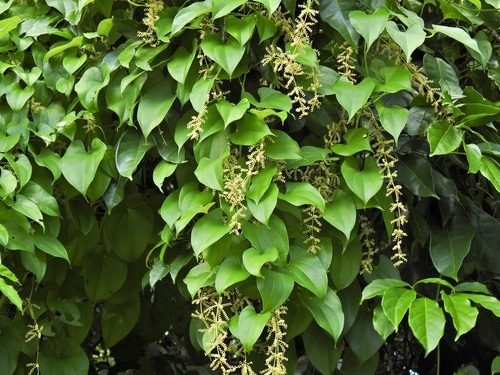
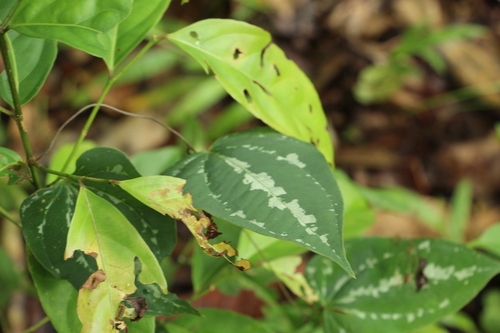
A yam. It keeps growing from year to year by sprouting from tubers. It is softly hairy. The stems have raised spots but not thorns. The stems twine to the right. There are 1-2 tubers each year. The tubers are 2 m deep in the soil on long stalks. The tubers are 8 cm across. The skin colour is orange. The flesh is yellow and fibrous. It has large bulbils. The leaves are usually alternate. The leaf stalk is as long as the blade. The blade is oval or heart shaped and 12-24 cm long by 9-20 cm wide. The lower leaf surface is always hairy. The male flowering stalks occur as 1-2 together and are 18 cm long. The female flowering stalks are 15 cm long and have 40 flowers. The capsules have wings.
How to Grow
Plants can be grown from seeds, bulbils and tibers.
Medicinal Uses
None mentioned.
Other Information
It is a famine food.
Notes
There are about 650 species of Dioscorea.
Names & Synonyms
Danga-alu, Dumpa, Kakalu, Kasa-alu, Kukui sanga, Kukuralu, Panglang, Pangla torul, Panglung, Peramuruthen, Ranmomnaru, Ruichelong, Rui-chilong, Savida
References (22)
- Ambasta, S.P. (Ed.), 2000, The Useful Plants of India. CSIR India. p 175
- Behera K. K., et al, 2008, Wild Edible Plants of Mayurbhanj District, Orissa, India. J. Econ. Taxon. Bot. Vol. 32 (Suppl.) pp 305-314
- Binu, S., 2010, Wild edible plants by the tribals in Pathanamthitta district, Kerala. Indian Journal of Traditional Knowledge. 9(2): 309-312 (As Dioscorea anguina)
- Dutta, B., 2015, Food and medicinal values of certain species of Dioscorea with special reference to Assam. Journal of Pharmacognosy and Phytochemistry. 3(4): 15-18
- Flora Malesiana Vol 13 p 333
- Gangwar, A. K. & Ramakrishnan, P. S., 1990, Ethnobotanical Notes on Some Tribes of Arunachal Pradesh, Northeastern India. Economic Botany, Vol. 44, No. 1 pp. 94-105 (As Dioscorea anguina)
- Ghosh, C. & Das A. P., 2011, Some useful and poisonous tea garden weeds from the Darjiling District of West Bengal, India. Pleione 5(1): 91 - 114 (As Dioscorea anguina)
- Jha, P. K., et al, 1996, Plant genetic resources of Nepal: A guide for plant breeders of agricultural, horticultural and forestry crops. Euphytica 87:189-210
- Kar, A., & Borthakur, S. K., 2008, Wild vegetables of Karbi - Anglong district, Assam, Natural Product Radiance, Vol. 7(5), pp 448-460
- Lim, T. K., 2015, Edible Medicinal and Non Medicinal Plants. Volume 9, Modified Stems, Roots, Bulbs. Springer p 34
- Lim, T. K., 2015, Edible Medicinal and Non Medicinal Plants. Volume 9, Modified Stems, Roots, Bulbs. Springer p 37
- Misra, R. C., et al, 2013, Genetic resources of wild tuberous food plants traditionally used in Similipal Biosphere Reserve, Odisha, India. Genetic Resources and Crop Evolution. Vol. 60 No. 2. Springer
- Misra, S., 2020, Survey of edible plants for human consumption in south Odisha, India. Journal of Emerging Technologies and Innovative Research (JETIR) Vol. 7, Issue 12 p 278
- Mukhia, P.K., et al, 2013, Wild plants as Non Wood Forest Products used by the rural community of Dagana, a southern foothill district of Bhutan, SAARC Journal, 27 pages
- Prafulla, S., 2017, Wild Food Diversity of Nawegaon-Nagzira Tiger Reserve in Gondia-Bhandara district of Maharashtra, India. Int. J. of Life Sciences, 2017, Vol. 5 (4): 620-626
- PROSEA handbook Volume 9 Plants yielding non-seed carbohydrates. p 174
- Sheikh, N., et al, 2009, Status documentation of Dioscorea L. (Dioscoreaceae) in Meghalaya: an approach towards food security. Pleione 3(1): 74 - 82
- Singh, H.B., Arora R.K.,1978, Wild edible Plants of India. Indian Council of Agricultural Research, New Delhi. p 13
- Singh, G. & Kumar, J., 2015, Diversity of Wild Edible Yams and its Traditional Knowledge Among Munda Tribe of District Khunti, Jharkhand, India. International Journal of Bioassays. 4.10: 4440-4442
- Teron, R. & Borthakur, S. K., 2016, Edible Medicines: An Exploration of Medicinal Plants in Dietary Practices of Karbi Tribal Population of Assam, Northeast India. In Mondal, N. & Sen, J.(Ed.) Nutrition and Health among tribal populations of India. p 151
- WATT (As Dioscorea anguina)
- Wild edible plants of Himachal Pradesh