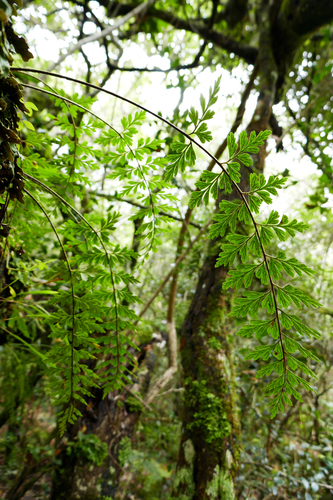
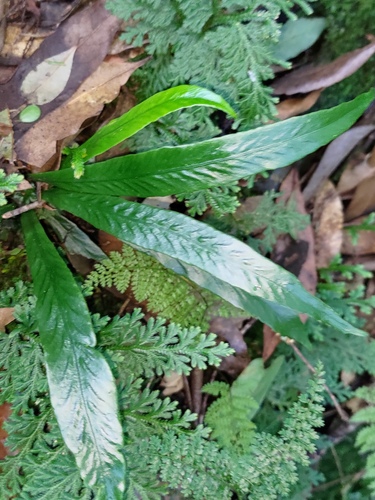
Asplenium nidus
L.
Bird’s Nest Fern, Crows Nest fern
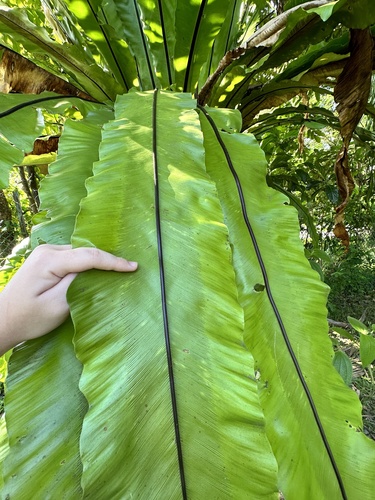
(c) scallions, some rights reserved (CC BY), uploaded by scallions

(c) Steve Fitzgerald, some rights reserved (CC BY-SA), uploaded by Steve Fitzgerald
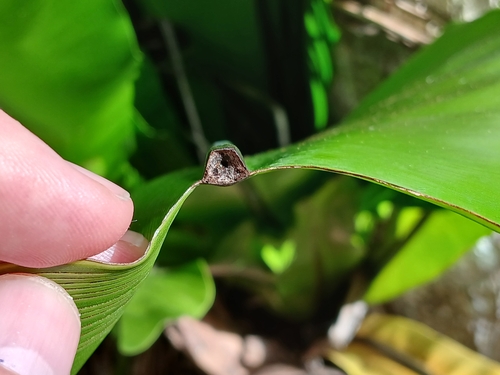
(c) Leon Perrie, some rights reserved (CC BY), uploaded by Leon Perrie
What to Eat
Edible parts: Leaves, Fronds
Young leaves and fronds are used for soup in the Caroline Islands, Marshall Islands, and India. They serve as an emergency food during famines in China.
Known Hazards
Where to Find It
It is a tropical plant. It grows in well drained moist soils. It prefers a well protected partly shaded position but not heavy shade. It is drought and frost tender. It occurs on many atolls. It suits hardiness zones 10-12. Mt Cootha Botanical Gardens. In Brisbane Botanical Garden as Asplenium antiquum.
Africa, American Samoa, Asia, Australia, British Indian Ocean Terr., BIOT, Canada, Caroline Is, China, Christmas Island, Chuuk, East Africa, East Timor, Fiji, French Polynesia, FSM, Guam, Hawaii, Indochina, Indonesia, Kiribati, Korea, Kosrae, Laos, Madagascar, Malaysia, Mariana Islands, Marshall Islands, Micronesia, Nauru, Niue, North America, Pacific, Palau, Papua New Guinea, PNG, Philippines, Pohnpei, Rotuma, Samoa, SE Asia, Slovenia, Solomon Islands, Tahiti, Taiwan, Tasmania, Timor-Leste, Tokelau, Tuvalu, Tonga, USA, Vietnam, Yap,
How to Identify
An evergreen fern. It grows to 1.5 m high and spreads 3 m across. It can grow by feeding on other plants. It forms nest like bowls on the upper side of branches. The underground thickened horizontal stem is dark brown and short. It is covered with blackish scales. The roots are hairy. The fronds grow out from a central point so that the fern forms rounded tussocks. The fronds are simple and entire and sword shape. The fronds can be 2 m long and up to 20 cm wide. They are dark or yellowish green. They have a raised, bluntly rounded mid vein.
How to Grow
Plants can be grown from spores. It can also be grown from rhizome cuttings.
Propagation: Seed - Division.
Medicinal Uses
With a minimum temperature of 10 °C (50 °F), Asplenium nidus is widely cultivated in temperate regions as a houseplant. However, many plants sold as A. nidus are actually the related Asplenium australasicum. Asplenium nidus has gained the Royal Horticultural Society's Award of Garden Merit. Asplenium nidus has been used locally in folk medicine for asthma, sores, weakness, and halitosis. The sprouts of A. nidus are eaten in Taiwan, known as 山蘇, pronounced shansu. (山 meaning "mountain", as in mountain vegetables). They may be stir-fried or boiled and are a traditional aboriginal vegetable, now popular enough to appear even on the menus of chain restaurants. The young fronds are eaten in the Polynesian islands, known as Luku in Niue, Laukatafa in Tuvalu and Laumea in Tokelau where it is often cooked together and eaten with coconut cream. The large fronds are also used in the wrapping and cooking of food.
Wikipedia
Source ↗Asplenium nidus is an epiphytic species of fern in the family Aspleniaceae, native to tropical southeastern Asia, eastern Australia, Hawaii (ʻēkaha in Hawaiian), Polynesia, Christmas Island, India, and eastern Africa. It is known by the common names bird's-nest fern (a name shared by some other aspleniums) or simply nest fern.
Other Information
It is not known if it is used for food in Papua New Guinea.
Notes
There are over 600-700 Asplenium ferns. They are mostly tropical and subtropical.
Names & Synonyms
Beluve, Chath, Daun semum, Dovidovitaneia, Ekaha, Galak, Gnezdnati sršaj, Kadaka, Kardoap, Karedep, Kartop, Kukulufi, Lau gadaha, Laugapapa, Laukatafa, Laukatapa, Laulu, Lau mea, Luku, Mihlihklihk, Nnuk, Pakis sarang burung, Paku langsuyarm, Paku pandan, Paku sarang burung, Rajang, Rumah langsuyar, Sehlik, Selimbur, Simbar merah, Tehnlik
References (47)
- Amoroso, V. B., et al., 2017, Bringing back the Lost Value of Philippine EdibleFerns: Their Antioxidant, Proteins and Utilization. International Journal of Advanced research. 5(4), 757-770
- Andrews, S.B., 1990, Ferns of Queensland. A handbook to the ferns and fern allies. Queensland DPI p 60
- AVRDC website. (As Asplenium australasicum)
- Barrau, J., 1961 (1976 reprint), Subsistence Agriculture in Polynesia and Micronesia. Bernice P. Bishop Museum Bulletin 223, Honolulu, Hawaii, p 57
- Bodkin, F., 1991, Encyclopedia Botanica. Cornstalk publishing, p 111
- Borrell, O.W., 1989, An Annotated Checklist of the Flora of Kairiru Island, New Guinea. Marcellin College, Victoria Australia. p 1
- Brickell, C. (Ed.), 1999, The Royal Horticultural Society A-Z Encyclopedia of Garden Plants. Convent Garden Books. p 147
- Burkill, I.H., 1966, A Dictionary of the Economic Products of the Malay Peninsula. Ministry of Agriculture and Cooperatives, Kuala Lumpur, Malaysia. Vol 2 (I-Z) p 1568 (As Neottopteris nidis)
- Chaffey, C.H., 1999, Australian Ferns. Growing them successfully. Kangaroo Press. p 95
- Chai, P. P. K. (Ed), et al, 2000, A checklist of Flora, Fauna, Food and Medicinal Plants. Lanjak Entimau Wildlife Sanctuary, Sarawak. Forestry Malaysia & ITTO. p 159
- Chin, W.Y., 1998, Ferns in the Tropics. Kangaroo. p 96
- Cundall, P., (ed.), 2004, Gardening Australia: flora: the gardener's bible. ABC Books. p 198
- CURREY
- Elliot, W.R., & Jones, D.L., 1982, Encyclopedia of Australian Plants suitable for cultivation. Vol 2. Lothian. p 241
- Facciola, S., 1998, Cornucopia 2: a Source Book of Edible Plants. Kampong Publications, p 32
- Famine foods
- Flora of Solomon Islands
- Goudey, C.J., 1988, A Handbook of Ferns for Australia and New Zealand. Lothian. p 61
- Heyne, K., 1927, p 100
- Hibbert, M., 2002, The Aussie Plant Finder 2002, Florilegium. p 34 (As Asplenium australasicum)
- Hu, Shiu-ying, 2005, Food Plants of China. The Chinese University Press. p 274 (As Neottopteris)
- Islam, M., 1983, Utilisation of Certain Ferns and Fern Allies in the North-Eastern Region, India. J.Econ. Tax. Bot. Vol.4.No.3 pp 861-
- Kuhnlein, H. V., et al, 2009, Indigenous Peoples' food systems. FAO Rome p 120
- Kuo, W. H. J., (Ed.) Taiwan's Ethnobotanical Database (1900-2000), http://tk.agron.ntu.edu.tw/ethnobot/DB1.htm (Also as Asplenium antiquum)
- Liu, Y., et al, 2012, Food uses of ferns in China: a review. Acta Societatis Botanicorum Poloniae 84(4): 263-270 (As Neottopteris nidus)
- Lord, E.E., & Willis, J.H., 1999, Shrubs and Trees for Australian gardens. Lothian. p 93
- Marinelli, J. (Ed), 2004, Plant. DK. p 314
- McClatchey, W., Thaman, R. & Vodonaivalu, S., 2000, A Preliminary Checklist of the Flora of Rotuma with Rotuman Names. Pacific Science Bol. 54, no 4:345-363
- Nurfadilah, S., et al, 2017, Species richness, conservation status, and potential uses of plants in Segara Anakan Area of Sempu Island, East Java, Indonesia. BIODIVERSITAS. Volume 18, Number 4
- Parham, B. E. V., 1972, Plants of Samoa. New Zealand Department of Scientific and Industrial Research. Information Series. No. 85 p 60
- Parham, B. E. V., 1971, The Vegetation of the Tokelau Islands with special reference to the Plants of Nukunonu Atoll. New Zealand Journal of Botany. 9:4, 576-609
- Pham-Hoang Ho, 1999, An Illustrated Flora of Vietnam. Nha Xuat Ban Tre. p 144
- Piggott, A. G. 1988, Ferns of Malaysia in Colour. Tropical press, Malaysia. p 267
- Sp. pl. 2:1079. 1753
- Staples, G.W. and Herbst, D.R., 2005, A tropical Garden Flora. Bishop Museum Press, Honolulu, Hawaii. p 28
- Sukarya, D. G., (Ed.) 2013, 3,500 Plant Species of the Botanic Gardens of Indonesia. LIPI p 855
- Thaman, R. R., et al, 1994, The Flora of Nauru. Atoll Research Bulletin No. 392. Smithsonian Institute p 44
- Thaman, R. R, 2016, The flora of Tuvalu. Atoll Research Bulletin No. 611. Smithsonian Institute p 30
- Thaman, R. R., 1992, Batiri Kei Baravi: The Ethnobotany of Pacific Island Coastal Plants. Atoll Research Bulletin. No. 361.
- Topp, J. M. W., 1988, An Annotated Check List of the Flora of Diego Garcia, British Ocean Territory. Atoll Research Bulletin No. 313
- Townsend, K., 1994, Across the Top. Gardening with Australian Plants in the tropics. Society for Growing Australian Plants, Townsville Branch Inc. p 89
- Vander Velde, N, 2003, The Vascular Plants of Majuro Atoll, Republic of the Marshall Islands. Atoll research Bulletin. No. 503. Smithsonian Institute
- Whistler, W. A., 1988, Ethnobotany of Tokelau: The Plants, Their Tokelau Names, and Their Uses. Economic Botany 42(2): 155-176
- World Checklist of Useful Plant Species 2020. Royal Botanic Gardens, Kew
- www.eFloras.org Flora of China
- Yuncker, T. G., 1943, The Flora of Niue Island. Bernice P. Bishop Museum Bulletin 178 p 17
- Yuncker, T.G., 1959, Plants of Tonga, Bernice P. Bishop Museum, Hawaii, Bulletin 220. p 33