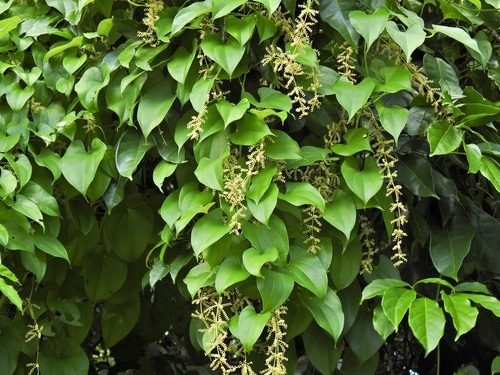
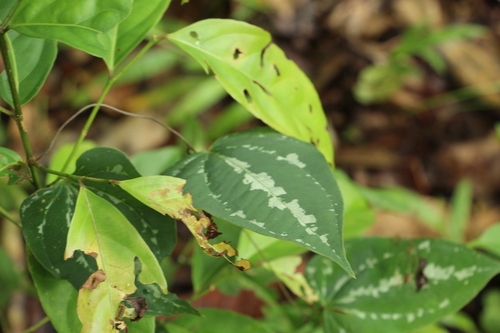
Dioscorea fordii
Prain & Burkill

(c) biobank-lantauhk, some rights reserved (CC BY-NC), uploaded by biobank-lantauhk
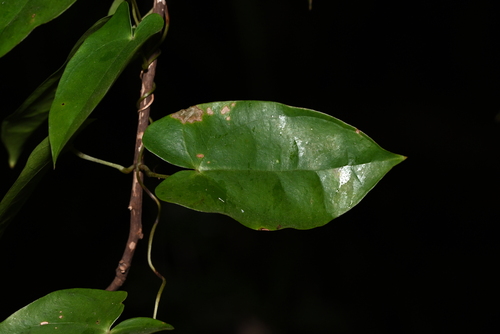
(c) johnchau, some rights reserved (CC BY-NC)
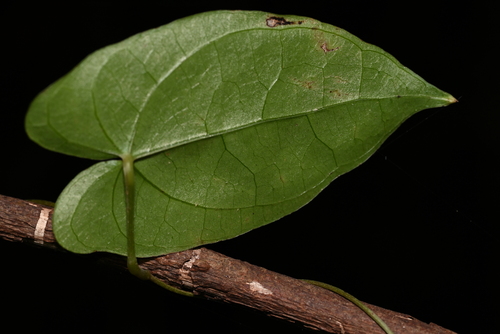
(c) johnchau, some rights reserved (CC BY-NC)
What to Eat
Edible parts: Tuber, Root
The root tuber is cooked and eaten.
Where to Find It
A tropical plant. It grows in mixed forests and along rivers from near sea level to 1,200 m above sea level in China.
Asia, China,
How to Identify
A yam. The tubers are vertical and cylinder shaped. The stems twine to the right. They are prickly at the base. The leaves are alternate near the base and opposite higher up. They are simple and oval and 4-14 cm long by 2-8 cm wide.
Wikipedia
Source ↗Dioscorea fordii is a herbaceous vine with oppositely arranged leaves and large, starchy rhizomes which grow vertically into the soil. It is indigenous to the Fujian, Guangdong, Guangxi, Hunan, and Zhejiang provinces of China, where it is typically found in forest areas or on disturbed ground beside roads or rivers. The species is cultivated in China for food and as use in traditional Chinese medicine. Compared with the well known Chinese yam, Dioscorea polystachya, D. fordii exhibits a higher starch content, but a lower protein content. Nutrient composition of the rhizome of the plant was conducted, revealing that it contains approximately 76.5% starch, 9.9% protein, and 1.03% fiber by dry weight.
Other Information
It is sold in local markets.
Notes
There are about 650 species of Dioscorea.
Names & Synonyms
Le lan gun, Man nei, Me ka
References (2)
- Altschul, S.V.R., 1973, Drugs and Foods from Little-known Plants. Notes in Harvard University Herbaria. Harvard Univ. Press. Massachusetts. no. 420 (As Dioscorea hainanensis)
- Cao, Y., et al, 2020, Ethnobotanical study on wild edible plants used by three trans-boundary ethnic groups in Jiangcheng County, Pu’er, Southwest China. Journal of Ethnobiology and Ethnomedicine (2020) 16:66