Dioscorea glabra
Roxb.
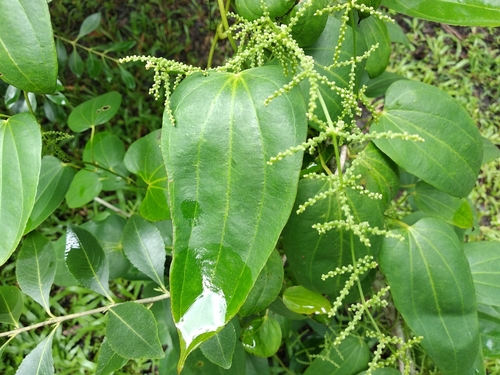
(c) TotoWS, some rights reserved (CC BY-NC), uploaded by TotoWS
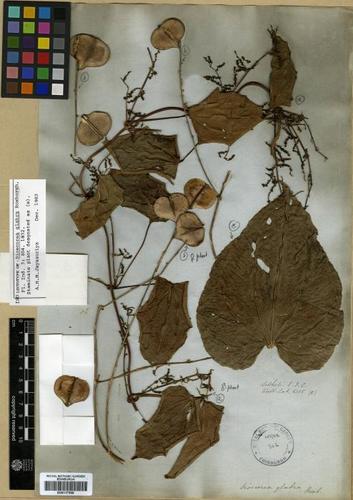
(c) Royal Botanic Garden Edinburgh, some rights reserved (CC BY-NC)
What to Eat
Edible parts: Tubers, Root
The root tubers are cooked and eaten as a vegetable, either boiled or roasted. It is used as a famine food.
Where to Find It
A tropical plant. It grows in evergreen broad-leaved forests and on mountain slopes and valley sides between 200-1,500 m above sea level. In Yunnan.
Andamans, Asia, Bhutan, Cambodia, China, Himalayas, India, Indochina, Indonesia, Laos, Malaysia, Myanmar, Nepal, Northeastern India, SE Asia, Sikkim, Thailand, Vietnam,
How to Identify
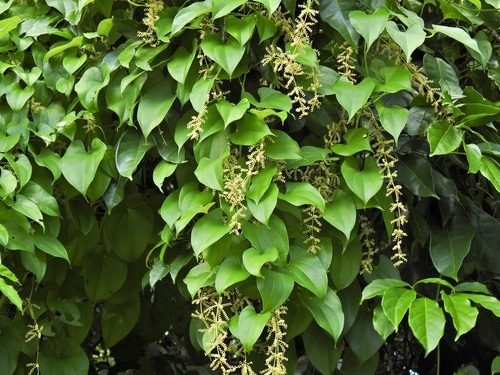
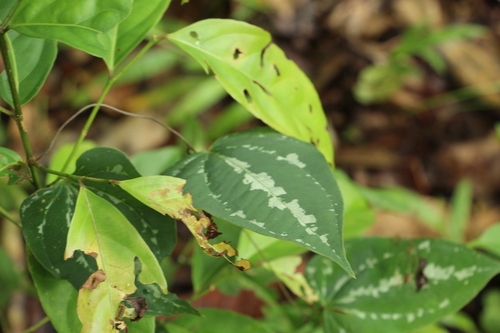
A yam. It keeps growing from year to year by sprouting from the tubers. The stem has thorns near the base. It twines to the right. The vine can be 8 m long. The tubers usually occur singly and are deep in the soil on a long stalk. They are 50 cm long by 4 cm wide. They have white flesh. The leaves are simple and can be opposite or alternate. The leaf stalk is 4-5 cm long. The leaf blade is a long heart shape. It can be 14 cm long by 16 cm wide with rounded ear shaped bases. The male flowers occur as 1-4 together and on branches 70 cm long. Female flower stalks occur singly or in pairs. They can be 40 cm long and with 50 flowers. (It is similar to Dioscorea nummularia).
Other Information
It is a famine food.
Notes
There are about 650 species of Dioscorea.
Names & Synonyms
Eghen ngentak, Hakaingou, Hakaingoute, Kanta-alu, Koti-alu, Luntak, Mandei alu, Man-dong, Man-sai, Myauk-nwe, Nara tega, Panglang buk, Panglang lahara, Panja sanga, Onotong sanga, Tayo-nwe, Teetakorel, Tha borchuk, That
References (23)
- Ambasta, S.P. (Ed.), 2000, The Useful Plants of India. CSIR India. p 175
- Arora, K., Indigenous Forest Management in the Andaman and Nicobar Islands, India.
- Behera K. K., et al, 2008, Wild Edible Plants of Mayurbhanj District, Orissa, India. J. Econ. Taxon. Bot. Vol. 32 (Suppl.) pp 305-314
- Castillo, C., 2013, The Archaeobotany of Khao Sam Kaeo and Phu Khao Thong: The Agriculture of Late Prehistoric Southern Thailand. Ph. D. thesis University College, London p 378
- Deb, D., et al, 2013, Wild Edible Plants and Their Utilization in Traditional Recipes of Tripura, Northeast India. Advances in Biological Research 7(5):203-211
- Bandyopadhyay, S., et al, 2012, A Census of Wild Edible Plants from Howrah District, West Bengal, India. Proceedings of UGC sponsored National Seminar 2012
- Bhargava, N., 1983, Ethnobotanical Studies of the Tribes of Andaman and Nicobar Islands, India. 1. Onge. Economic Botany 37(1): 110-119
- Castillo, C., 2013, The Archaeobotany of Khao Sam Kaeo and Phu Khao Thong: The Agriculture of Late Prehistoric Southern Thailand. Ph. D. thesis University College, London p 378
- Gangwar, A. K. & Ramakrishnan, P. S., 1990, Ethnobotanical Notes on Some Tribes of Arunachal Pradesh, Northeastern India. Economic Botany, Vol. 44, No. 1 pp. 94-105
- Gangte, H. E., et al, 2013, Wild Edible Plants used by the Zou Tribe in Manipur, India. International Journal of Scientific and Research Publications, Volume 3, Issue 5
- Guite, C., 2016, A study of wild edible plants associated with the Paite tribe of Manipur, India, International Journal of Current Research. Vol. 8, Issue, 11, pp. 40927-40932
- Jha, P. K., et al, 1996, Plant genetic resources of Nepal: A guide for plant breeders of agricultural, horticultural and forestry crops. Euphytica 87:189-210
- Lim, T. K., 2015, Edible Medicinal and Non Medicinal Plants. Volume 9, Modified Stems, Roots, Bulbs. Springer p 35
- Mareenoon, K. et al, 2008, Ethnobotany of Dioscorea L. (Dioscoreaceae), a Major Food Plant of the Sakai Tribe at Banthad Range, Peninsular Thailand. Ethnobotany Reaearch & Applications 6:385-394
- Misra, R. C., et al, 2013, Genetic resources of wild tuberous food plants traditionally used in Similipal Biosphere Reserve, Odisha, India. Genetic Resources and Crop Evolution. Vol. 60 No. 2. Springer
- Misra, S., 2020, Survey of edible plants for human consumption in south Odisha, India. Journal of Emerging Technologies and Innovative Research (JETIR) Vol. 7, Issue 12 p 278
- Murtem, G. & Chaudhrey, P., 2016, An ethnobotanical note on wild edible plants of Upper Eastern Himalaya, India. Brazilian Journal of Biological Sciences, 2016, v. 3, no. 5, p. 63-81
- Phangchopi, U., et al, 2015, Diversity of wild edible plants in Marat Longri Wildlife Sanctuary, Assam. Indian Journal of Natural Products and Resources Vol. 6(4), December 2015 pp. 305-313
- PROSEA handbook Volume 9 Plants yielding non-seed carbohydrates. p 172
- Savita, et al, 2006, Studies on wild edible plants of ethnic people in east Sikkim. Asian J. of Bio Sci. (2006) Vol. 1 No. 2 : 117-125
- Sheikh, N., et al, 2009, Status documentation of Dioscorea L. (Dioscoreaceae) in Meghalaya: an approach towards food security. Pleione 3(1): 74 - 82
- Singh, G. & Kumar, J., 2015, Diversity of Wild Edible Yams and its Traditional Knowledge Among Munda Tribe of District Khunti, Jharkhand, India. International Journal of Bioassays. 4.10: 4440-4442
- Wild edible plants of Himachal Pradesh (As Dioscorea siamensis)