Dioscorea orbiculata
Hook.f.

(c) ruddy2410, some rights reserved (CC BY-NC)

(c) ruddy2410, some rights reserved (CC BY-NC)

(c) ruddy2410, some rights reserved (CC BY-NC)
What to Eat
Edible parts: Tubers, Root
The tubers are boiled well before eating. This species serves as a famine food and is significant in Peninsula Thailand.
Where to Find It
A tropical plant.
Asia, Himalayas, India, Indochina, Indonesia, Malaysia, Northeastern India, SE Asia, Thailand,
How to Identify
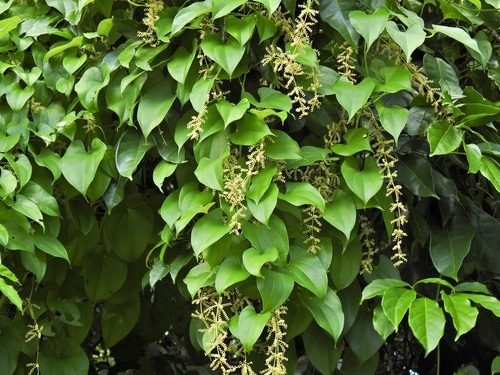
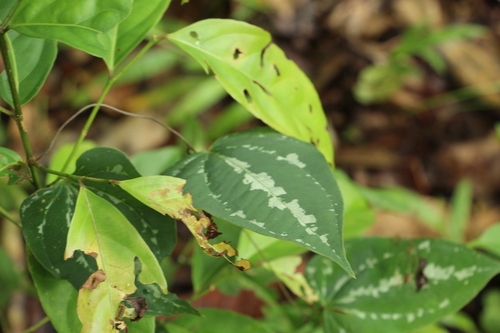
A yam. The stems have a few thorns at the base. It twines to the right. The vines can be 10 m long. They are slightly hairy. Plants produce several tubers. They are on stalks 2 m long. The flesh is white. They do not have bulbils. The leaves are simple and usually opposite. The leaf stalk is 10 cm long. The leaf blade is rounded and 18 cm long by 14 cm wide. It tapers to a long tip. Male flowers occur as 1-6 together. They are on branches 70 cm long. Female flowers occur singly and are 15 cm long. The capsule has wings.
Other Information
It is a famine food. It is significant in Peninsula Thailand.
Notes
There are about 650 species of Dioscorea.
Names & Synonyms
Akar kakop, Eghen yeb, Hubi akob, Hubi garam, Janggut kelonak, Man-tayong, Takob, Thaphu-rhemin, Thapurhemin, Ubi gara
References (10)
- Burkill, I.H., 1966, A Dictionary of the Economic Products of the Malay Peninsula. Ministry of Agriculture and Cooperatives, Kuala Lumpur, Malaysia. Vol 1 (A-H) p 835
- Castillo, C., 2013, The Archaeobotany of Khao Sam Kaeo and Phu Khao Thong: The Agriculture of Late Prehistoric Southern Thailand. Ph. D. thesis University College, London p 378
- Dutta, B., 2015, Food and medicinal values of certain species of Dioscorea with special reference to Assam. Journal of Pharmacognosy and Phytochemistry. 3(4): 15-18
- Flora Malesiana Vol 13 p 334
- Lim, T. K., 2015, Edible Medicinal and Non Medicinal Plants. Volume 9, Modified Stems, Roots, Bulbs. Springer p 36
- Mareenoon, K. et al, 2008, Ethnobotany of Dioscorea L. (Dioscoreaceae), a Major Food Plant of the Sakai Tribe at Banthad Range, Peninsular Thailand. Ethnobotany Reaearch & Applications 6:385-394
- Medhi, P. and Borthakur, S. K., 2011, Genetic Resources of Root and Tuber Crops from North Cachar Hills of Assam. Journal of Root Crops, Vol. 37No.2 pp. 131-143
- Murtem, G. & Chaudhrey, P., 2016, An ethnobotanical note on wild edible plants of Upper Eastern Himalaya, India. Brazilian Journal of Biological Sciences, 2016, v. 3, no. 5, p. 63-81
- PROSEA handbook Volume 9 Plants yielding non-seed carbohydrates. p 173
- World Checklist of Useful Plant Species 2020. Royal Botanic Gardens, Kew