Dioscorea polyclados
Hook.f.
Kedut
(c) HP Lim, some rights reserved (CC BY-NC)
(c) HP Lim, some rights reserved (CC BY-NC)
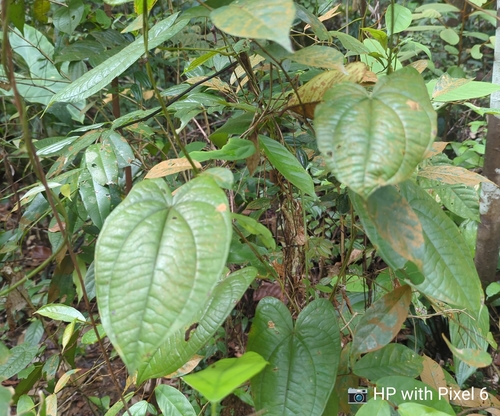
(c) HP Lim, some rights reserved (CC BY-NC)
What to Eat
Edible parts: Tubers, Root
The tubers are boiled several times or baked before eating.
Where to Find It
A tropical plant. It grows in lower hill forest up to 700 m altiitude.
Asia, Cambodia, Indochina, Indonesia, Malaysia, SE Asia,
How to Identify
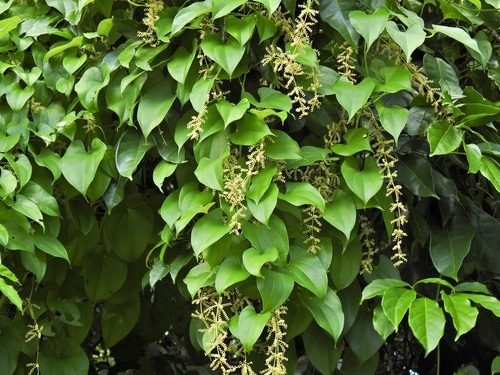
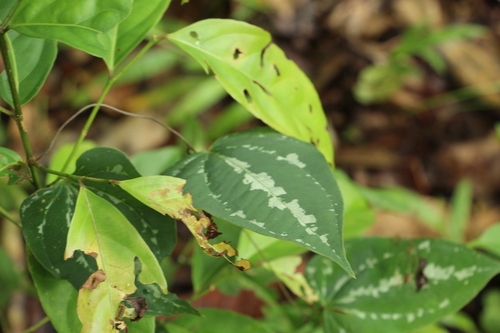
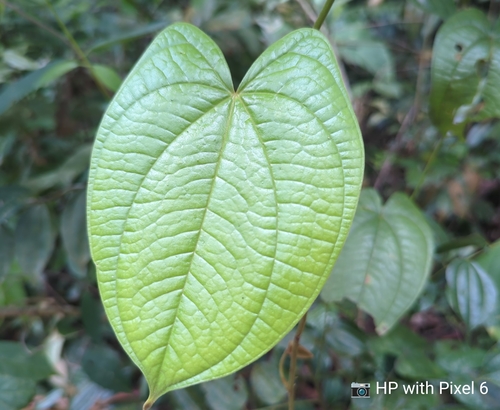
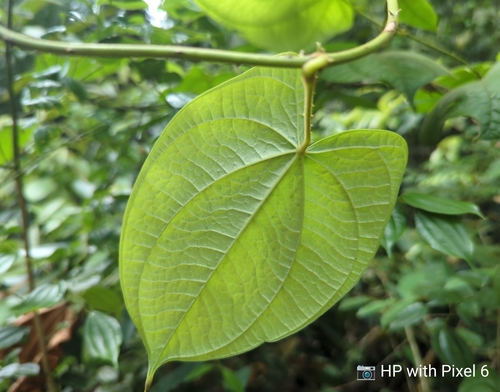
A yam. It keeps growing from year to year by sprouting from tubers. It is hairy. The vines are 30 m long and twine to the right. The tubers are produced from a woody corm. They can be 2.5 m deep in the soil. They occur as swollen ends on long stalks. The flesh is white. The leaves are simple and opposite. The leaf stalk is 6 cm long. It often has prickles. The leaf blade is 12-25 cm long by 12-22 cm wide. The male flowering stalks are 30 cm long and occur as 1-4 together. The female flowering stalks are 20 cm long. The capsule has wings.
Notes
There are about 650 species of Dioscorea.
Names & Synonyms
Domlong romeat, Kedut
References (6)
- Burkill, I.H., 1966, A Dictionary of the Economic Products of the Malay Peninsula. Ministry of Agriculture and Cooperatives, Kuala Lumpur, Malaysia. Vol 1 (A-H) p 836
- Flora Malesiana Vol 13 p 334
- Lim, T. K., 2015, Edible Medicinal and Non Medicinal Plants. Volume 9, Modified Stems, Roots, Bulbs. Springer p 37
- PROSEA handbook Volume 9 Plants yielding non-seed carbohydrates. p 174
- Turreira Garcia, N., et al, 2017, Ethnobotanical knowledgeof the Kuy and Khmer people in Prey Lang, Cambodia. Cambodian Journal of Natural History 2017 (1): 76-101
- World Checklist of Useful Plant Species 2020. Royal Botanic Gardens, Kew