Dioscorea pyrifolia
Kunth
Marsh benzoin climber
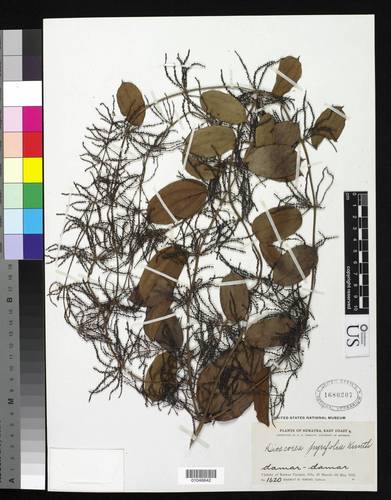
(c) Smithsonian Institution, National Museum of Natural History, Department of Botany, some rights reserved (CC BY-NC-SA)
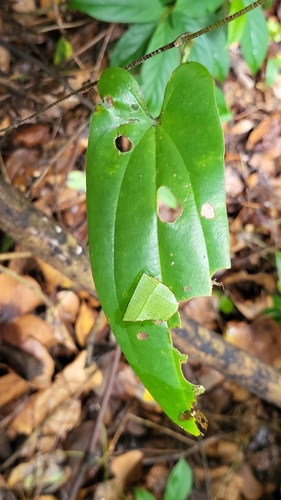
(c) Cheongweei Gan, some rights reserved (CC BY)
What to Eat
Edible parts: Tubers, Root
The tubers are baked or boiled in 2-3 changes of water before eating.
Where to Find It
A tropical plant. It grows in fairly humid climates in wet sunny locations. It grows up to 700 m altitude.
Asia, Himalayas, India, Indochina, Indonesia, Laos, Malaysia, Myanmar, Northeastern India, SE Asia, Thailand,
How to Identify
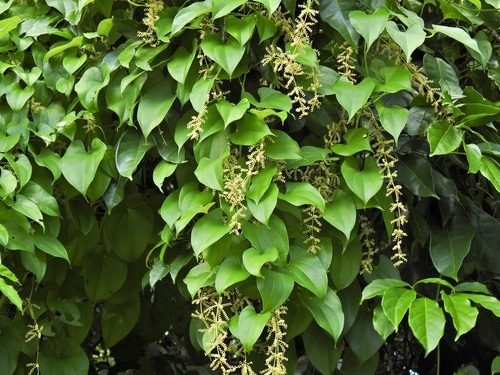
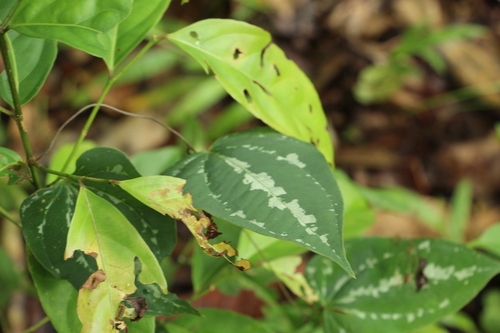
A yam. It keeps growing from year to year by sprouting from tubers. The stems have many spines at the base. Stems twine to the right. Stems can be 10 m long. The tubers are produced from a woody corm. There is more than one per year. They are 2.5 m deep in the soil on long stalks. The flesh is white. It does not have bulbils. The leaves are simple and usually opposite. The leaf stalk is 4.5 cm long. The leaf is 11 cm long by 8 cm wide. It is softly hairy. The male flowers are on leafless branches 5 cm long. The female flowering branches are 24 cm long. The flowers have a smell of benzoin.
Notes
There are about 650 species of Dioscorea.
Names & Synonyms
Akar kemenyan paya, Badak, Eghen ngenro, Hngo, Huwi upas, Ilus, Ubi babi
References (5)
- Burkill, I.H., 1966, A Dictionary of the Economic Products of the Malay Peninsula. Ministry of Agriculture and Cooperatives, Kuala Lumpur, Malaysia. Vol 1 (A-H) p 837
- Lim, T. K., 2015, Edible Medicinal and Non Medicinal Plants. Volume 9, Modified Stems, Roots, Bulbs. Springer p 37
- Mareenoon, K. et al, 2008, Ethnobotany of Dioscorea L. (Dioscoreaceae), a Major Food Plant of the Sakai Tribe at Banthad Range, Peninsular Thailand. Ethnobotany Reaearch & Applications 6:385-394
- Murtem, G. & Chaudhrey, P., 2016, An ethnobotanical note on wild edible plants of Upper Eastern Himalaya, India. Brazilian Journal of Biological Sciences, 2016, v. 3, no. 5, p. 63-81
- PROSEA handbook Volume 9 Plants yielding non-seed carbohydrates. p 174