Melanthera biflora
(L.) Willd.
Beach sunflower, Sea daisy
no rights reserved
no rights reserved
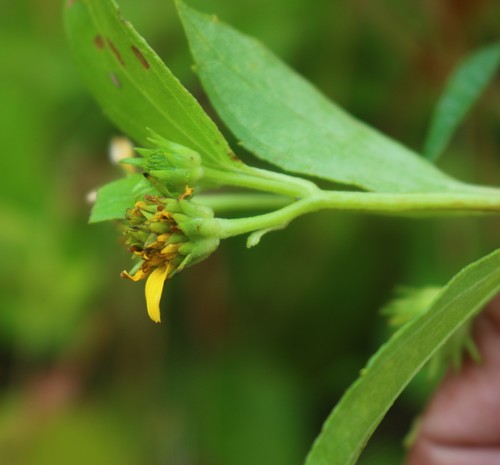
(c) Shiwalee Samant, some rights reserved (CC BY-NC)
What to Eat
Edible parts: Leaves, Spice
The leaves are used for wrapping food, imparting a flavour when the food is baked. They are stuffed with grated coconut, rolled and then boiled or steamed. A tea is made from the leaves and roots.
Where to Find It
A tropical plant. It grows from sea level to about 500 m above sea level. It is common near sea coasts.
Africa, American Samoa, Asia, Australia, British Indian Ocean Terr., BIOT, China, Cook Islands, East Africa, East Timor, Fiji, India, Indochina, Indonesia, Japan, Kenya, Malaysia, Micronesia, Mozambique, Myanmar, Pacific, Samoa, SE Asia, Solomon Islands, Southern Africa, Sri Lanka, Taiwan, Tanzania, Thailand, Timor-Leste,
How to Identify
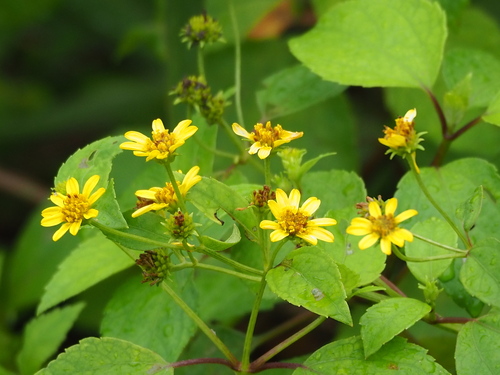
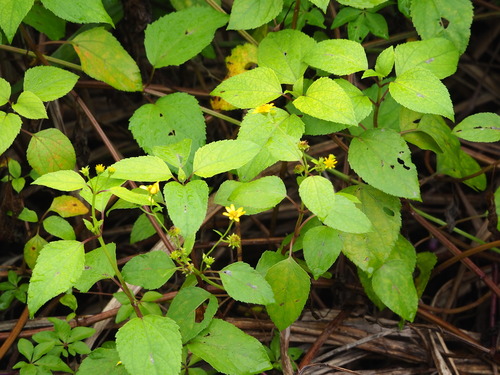
A herb or shrub. It can be 1-2 m tall. The stems are 4 angled. The leaf blades are 2-10 cm long by 1-4 cm wide. There are irregular teeth along the edge. The flower heads are about 1 cm across. The fruit are in dense heads. The nuts are 3 sided and 2-3 mm long.
How to Grow
Plants can be grown from cuttings.
Medicinal Uses
Despite the rough appearance of the plant, the leaves are edible. In Malaysian cuisine the shoots are eaten cooked as a leaf vegetable and in Langkawi they are eaten raw with chilli and sambal shrimp paste. Leaves also have traditional medicinal uses as poultice or as decoction. Wollastonia biflora has traditionally been used as a medicinal plant in many cultures, including in Marovo in the Solomon Islands. Leaves are especially valued against stomachache. In Fiji the leaves are used to treat acne. Root extracts have anthelmintic properties and flowers can be used as a purgative. This plant is also used as fodder for rabbits.
Notes
It has been used in medicine.
Names & Synonyms
Seruni laut
References (6)
- Cowie, I, 2006, A Survey of Flora and vegetation of the proposed Jaco-Tutuala-Lore National Park. Timor-Lests (East Timor) www.territorystories.nt/gov.au p 45
- Franklin, J., Keppel, G., & Whistler, W., 2008, The vegetation and flora of Lakeba, Nayau and Aiwa Islands, Central Lau Group, Fiji. Micronesica 40(1/2): 169–225, 2008
- Prodr. 5:546. 1836
- PROSEA handbook Volume 13 Spices. p 280
- Sukarya, D. G., (Ed.) 2013, 3,500 Plant Species of the Botanic Gardens of Indonesia. LIPI p 1141 (As Wedelia biflora)
- Topp, J. M. W., 1988, An Annotated Check List of the Flora of Diego Garcia, British Ocean Territory. Atoll Research Bulletin No. 313