Dioscorea wallichii
Hook.f.
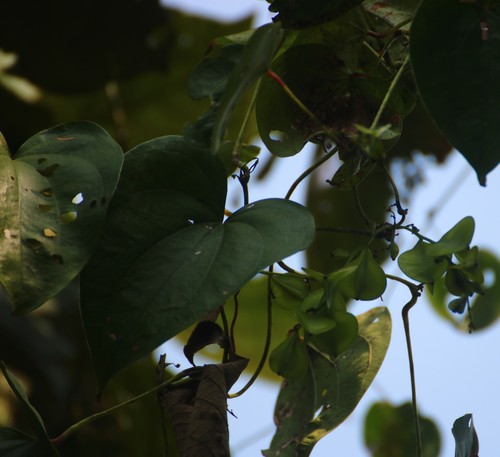
(c) Shiwalee Samant, some rights reserved (CC BY-NC), uploaded by Shiwalee Samant
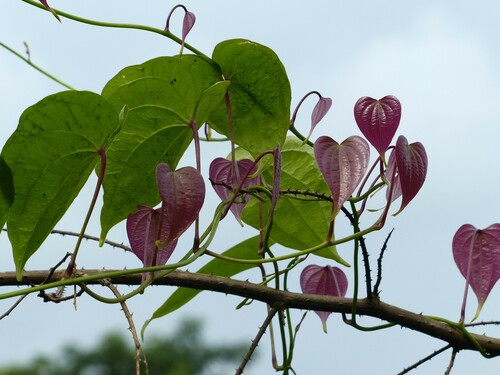
(c) Radha Veach, some rights reserved (CC BY-NC)
What to Eat
Edible parts: Tubers, Root
The tubers can be eaten after boiling and washing.
Where to Find It
A tropical plant. It grows in mixed deciduous and evergreen forests. In southern China it grows on mountain slopes between 900-1,300 m above sea level. In Yunnan.
Asia, Bangladesh, China, Himalayas, India, Indochina, Laos, Malaysia, Myanmar, Northeastern India, SE Asia, Thailand,
How to Identify
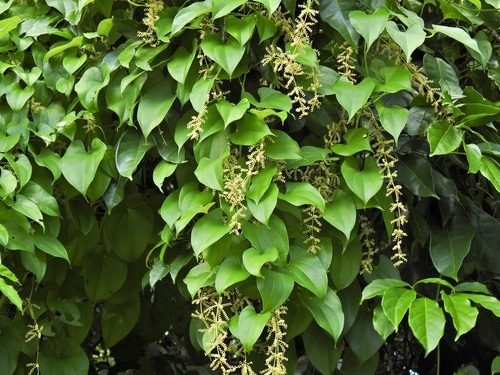
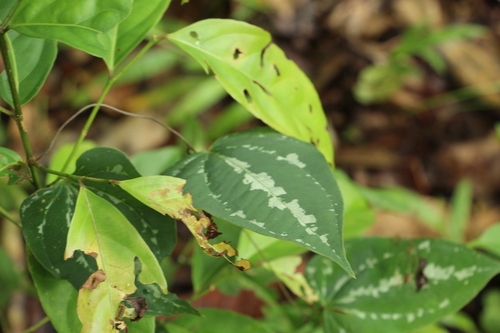
A yam. The stem has prickles near the base. The stems twine in a right handed direction. The stems can be 20 m long. The tuber is up to 1 m long and 6 cm wide and deeply buried in the soil. The flesh is white. The leaves are a rounded heart shape. Plants are separately male and female.
Wikipedia
Source ↗Dioscorea wallichii is a type of climbing tuberous geophyte of the family Dioscoreaceae. It is native to Bangladesh, China, India, Malaysia, Myanmar, and Thailand. It has one edible cylindrical tuber that is about 1 meter long and 3-6 centimeters wide. The tuber is white when young, becoming yellow and stringy once aged.
Other Information
It is a significant food plant in S. Thailand.
Notes
There are about 650 species of Dioscorea.
Names & Synonyms
Benne, Chaydu, Cherenga alu, Eghen ngeyuk, Han-alu, Kadat, Kruo, Pitalu, Purakilangu, Rang sanga, Rui nihang, Taw-thinbaw, Tunga kand, Yarex
References (15)
- Chauhan, S. H., et al, 2018, Consumption patterns of wild edibles by the Vasavas: a case study from Gujarat, India. Journal of Ethnobiology and Ethnomedicine (2018) 14:5
- Flora Malesiana Vol 13 p 328
- Ibrahim, N., 1994, Trace metals in tropical yam species: Dioscorea spp. Food Chemistry 51:5-6 (As Dioscorea wallichiana)
- Harisha, R. P. & Padmavathy, S., 2013, Knowledge and Use of Wild Edible Plants in Two Communities in Malai Madeshwara Hills, Southern India. International Journal of Botany 9(2): 64-72.
- Kahlon, L. K. & Singh, R., 2019, Traditional knowledge & Dynamics of edible plants of primitive tribal group ‘Paudi Bhuyan’ with changing demography migration patterns in Northern Odisha. Indian Journal of Traditional Knowledge Vol 18(1), pp 7-15
- Kew, Plants of the World on Line
- Lim, T. K., 2015, Edible Medicinal and Non Medicinal Plants. Volume 9, Modified Stems, Roots, Bulbs. Springer p 38
- Mareenoon, K. et al, 2008, Ethnobotany of Dioscorea L. (Dioscoreaceae), a Major Food Plant of the Sakai Tribe at Banthad Range, Peninsular Thailand. Ethnobotany Reaearch & Applications 6:385-394
- Misra, R. C., et al, 2013, Genetic resources of wild tuberous food plants traditionally used in Similipal Biosphere Reserve, Odisha, India. Genetic Resources and Crop Evolution. Vol. 60 No. 2. Springer
- Misra, S., 2020, Survey of edible plants for human consumption in south Odisha, India. Journal of Emerging Technologies and Innovative Research (JETIR) Vol. 7, Issue 12 p 278
- Murtem, G. & Chaudhrey, P., 2016, An ethnobotanical note on wild edible plants of Upper Eastern Himalaya, India. Brazilian Journal of Biological Sciences, 2016, v. 3, no. 5, p. 63-81
- Pradhan, R., et al, 2020, Potential Wild Edible Plants and its Significance in Livelihood of Indigenous People of Male Mahadeshwara Hills, Karnataka. Economic Affairs Vol. 64, No. 4 pp. 01-14
- Ramachandran, V.S. and Nair, V.J., 1981, Ethnobotanical studies in Cannanore District, Kerala State (India). J Econ. Tax. Bot. Vol 2 pp 65-72
- Sheikh, N., et al, 2009, Status documentation of Dioscorea L. (Dioscoreaceae) in Meghalaya: an approach towards food security. Pleione 3(1): 74 - 82
- Wild edible plants of Himachal Pradesh