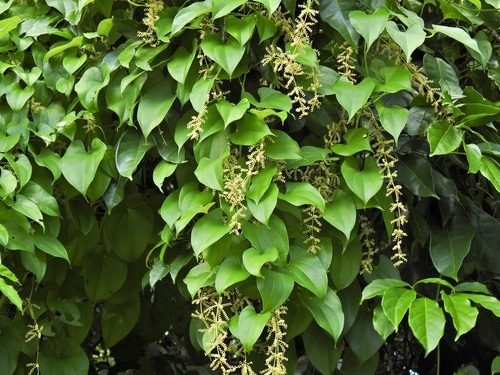
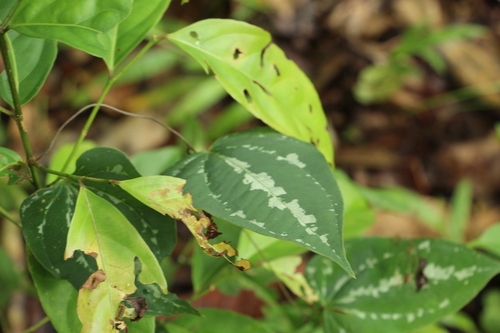
Dioscorea kamoonensis
Kunth

(c) Homemountain/Shan Gui, some rights reserved (CC BY-NC), uploaded by Homemountain/Shan Gui
What to Eat
Edible parts: Tubers, Root, Bulbil
The tubers are eaten cooked. Plants produce a number of small, globular tubers.
Known Hazards
Where to Find It
It is a subtropical plant. It grows in secondary scrub forests between 500-2,900 m above sea level. In Sichuan and Yunnan.
Asia, Bhutan, China, Himalayas, India, Nepal, Northeastern India, SE Asia, Sikkim, Thailand, Tibet, Vietnam,
How to Identify
A yam. The tubers are usually almost oval. The stem twines to the left. They have brown hairs when young. There are bulbils on the stem. The leaves are alternate and have 3 to 5 leaflets arranged like fingers on a hand. They are more pale underneath. The leaf stalks are 2-10 cm long. The leaflets are oval and 2-14 cm long by 1-5 cm wide.
How to Grow
We have very little information on this species and do not know if it will be hardy in Britain. It is unlikely to succeed in any but the mildest areas. The following notes are based on the general needs of the genus. Easily grown in a fertile well-drained soil in a sunny position or light shade. Prefers a rich light soil. Plants produce tubercles (small tubers that are formed in the leaf axils of the stems), and can be propagated by this means. A climbing plant that supports itself by twining around the branches of other plants. Dioecious. Male and female plants must be grown if seed is required.
Propagation: Sow seed in March to April in a sunny position in a warm greenhouse, barely covered. Germination takes 1–3 weeks at 20°C. Prick out seedlings once large enough to handle and grow on in the greenhouse for their first year, then plant out in late spring as new growth begins. Basal stem cuttings can be taken in summer. Divide in the dormant season only — never when in growth. The plant often produces several shoots; the top 5–10cm of root below each shoot can be potted up as a new plant, while the lower portion of the root can be eaten. Tubercles forming in the leaf axils are harvested in late summer to early autumn when approximately pea-sized and detaching freely. Pot up immediately into individual containers in a greenhouse or cold frame and plant out in early summer when actively growing.
Medicinal Uses
Like most or all members of this genus, the roots contain diosgenin, which is widely used in modern medicine to manufacture progesterone and other steroid drugs. These are employed as contraceptives and in treating disorders of the genital organs, as well as conditions such as asthma and arthritis.
Other Uses
None known.
Wikipedia
Perennial climber growing to 2.5m tall. Flowers September to October. Dioecious species; both male and female plants needed for seed production. Not self-fertile. Tolerates light sandy, medium loamy, and heavy clay soils with preference for well-drained conditions. Grows in mildly acid to basic soils. Requires full sun; cannot grow in shade. Prefers moist soil.
Notes
There are about 650 species of Dioscorea.
Names & Synonyms
Gli, Jia dohsew, Rani vyakur, Tyaguna
References (10)
- Bastakoti, R., et al, 2008, Food Insecurity and dependency of Chepang Communities on Wild Edible Plants. Sustainable Forest Management and Poverty Alleviation: Roles of Traditional Forest-related Knowledge IUFRO World Series Volume 21
- Castillo, C., 2013, The Archaeobotany of Khao Sam Kaeo and Phu Khao Thong: The Agriculture of Late Prehistoric Southern Thailand. Ph. D. thesis University College, London p 380
- Dangol, D. R. et al, 2017, Wild Edible Plants in Nepal. Proceedings of 2nd National Workshop on CUAOGR, 2017.
- Gautam, R. S., et al, 2022, Ethnobotanical Review of Wild Edible Plants of Nepal. Journal of Natural History Museum Volume 32, 2021-22 p 112
- Jha, P. K., et al, 1996, Plant genetic resources of Nepal: A guide for plant breeders of agricultural, horticultural and forestry crops. Euphytica 87:189-210
- Kumar, Y J. et al, 1987, Further Contribution to the Ethnobotany of Meghalaya: Plants used by "War jaintia" of Jaintia Hill District. Econ. Tax. Bot. Vol 11 No. 1 pp 65- (As Dioscorea kumaonensis Hook.f.)
- Miya, M. S. & Gautum, D., 2021, Checklist of floral species at the Institute of Forestry, Pokhara Campus, Pokhara, Nepal. Journal of Institute of Forestry, Nepal 18 (2021) 133-177
- Plants for a Future database, The Field, Penpol, Lostwithiel, Cornwall, PL22 0NG, UK. http://www.scs.leeds.ac.uk/pfaf/ (As Dioscorea fargesii)
- Savita, et al, 2006, Studies on wild edible plants of ethnic people in east Sikkim. Asian J. of Bio Sci. (2006) Vol. 1 No. 2 : 117-125
- Thapa, L. B., et al, 2014, Wild Edible Plants used by endangered and Indigenous Raji Tribe in Western Nepal. International Journal of Applied Sciences and Biotechnology. Vol 2(3):243-252