Baccaurea macrophylla
(Meull.-Arg.) Muell.Arg.
Little-leaf Rambai tree
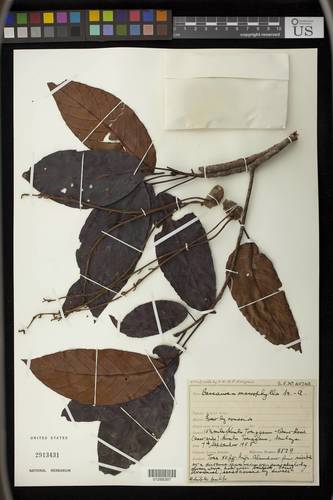
(c) Smithsonian Institution, National Museum of Natural History, Department of Botany, some rights reserved (CC BY-NC-SA)

President and Fellows of Harvard College
What to Eat
Edible parts: Fruit
Fruit - eaten out of hand. The taste of the flesh is sweet with some sourness. The yellowish-brown fruit is an ellipsoid capsule that is about 4 - 5cm in diameter.
Where to Find It
A tropical plant. It grows in forest and swamp forest. It grows from sea level to 650 m altitude.
Asia, Australia, Indochina, Indonesia, Malaysia, SE Asia, Singapore, Thailand,
How to Identify
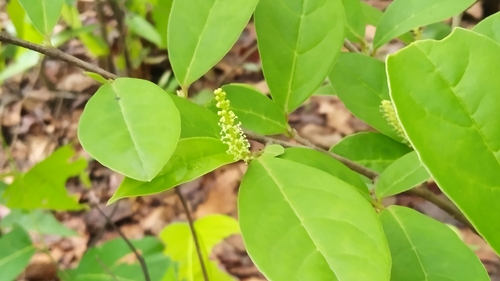
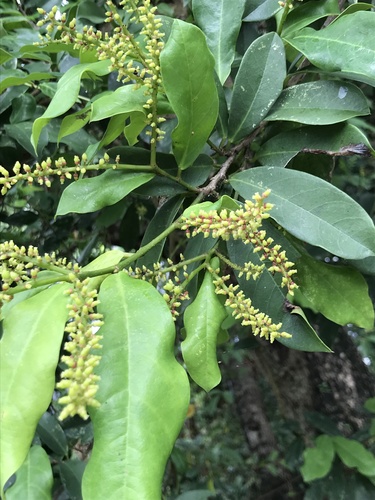
A large tree. It grows 27 m tall. The leaves are oval and 10-33 cm long by 5-14 cm wide. Male and female flowers are on separate trees. Flowers are small on long branches. There are 10-16 fruit in a group. They are 10-15 mm across. The fruit are yellow. The flesh is orange.
How to Grow
Plants can be grown by seeds, air-layering, and grafting,
Propagation: Seed - when sown fresh it usually germinates in a few days. Grafting
Medicinal Uses
We have no specific information on this species, but the bark of several members of this genus is used to relieve eye inflammation.
Other Uses
We have no specific information for this species, but the bark of several members of this genus is used, along with other ingredients, as a dyestuff to colour silk yellow, red or mauve, using the dyeing process known as 'pekan' in Malay. The timber is used for posts, planks, house beams. In common with other trees that produce their flowers and fruits on the trunk of the tree, members of this genus are generally considered to be good support trees for the climbing rattan palms, which are grown to provide material for basket making, weaving into furniture, making ropes etc.
Notes
There are about 80 Baccaurea species.
Names & Synonyms
Lang khae, Pohon rambai lanang, Tampoi bunga, Tampoi tungau
References (11)
- Bircher, A. G. & Bircher, W. H., 2000, Encyclopedia of Fruit Trees and Edible Flowering Plants in Egypt and the Subtropics. AUC Press. p 51
- Burkill, I.H., 1966, A Dictionary of the Economic Products of the Malay Peninsula. Ministry of Agriculture and Cooperatives, Kuala Lumpur, Malaysia. Vol 1 (A-H) p 281
- Chai, P. P. K. (Ed), et al, 2000, A checklist of Flora, Fauna, Food and Medicinal Plants. Lanjak Entimau Wildlife Sanctuary, Sarawak. Forestry Malaysia & ITTO. p 167
- Chai, P.P.K., 2000, Development of the Lanjak Entimau Wild life sanctuary. Final report. ITTO and Sarawak Forestry. p 19
- Giesen, W., 2013, Paludiculture: sustainable alternatives on degraded peat land in Indonesia (revised draft)
- Milow, P., et al, 2013, Malaysian species of plants with edible fruits or seeds and their evaluation. International Journal of Fruit Science. 14:1, 1-27
- Sukarya, D. G., (Ed.) 2013, 3,500 Plant Species of the Botanic Gardens of Indonesia. LIPI p 145
- Suwardi, A. B., et al, 2020, Wild edible fruits generate substantial income for local people of the Gunung Leuser National Park, Aceh Tamiang Region. Ethnobotany Research & Applications 20:11
- Suwardi, A. B., et al, 2020, Ethnobotany and conservation of indigenous edible fruit plants in South Aceh, Indonesia. Biodiversitas Vol. 21, No. 5, pp 1850-1860
- World Checklist of Useful Plant Species 2020. Royal Botanic Gardens, Kew
- www.nationalherbarium.nl/thaueuph/ Flora of Thailand.