Dioscorea spicata
Roth.
DioscoreaceaeRoots

wikimedia · cc0
Wikimedia Commons - Alston, A. H. G.; Hooker, Joseph Dalton; Trimen, Henry
Wikimedia Commons - Alston, A. H. G.; Hooker, Joseph Dalton; Trimen, Henry
What to Eat
Edible parts: Roots, Tubers
The tubers are use as a food source.
Where to Find It
It is a tropical plant. It grows in semi-evergreen forests.
Asia, Himalayas, India, Northeastern India, Sri Lanka*,
Countries: United Arab Emirates, Afghanistan, Armenia, Azerbaijan, Bangladesh, Bahrain, Brunei, Bhutan, China, Georgia, Indonesia, Israel, India, Iraq, Iran, Jordan, Japan, Kyrgyzstan, Cambodia, North Korea, South Korea, Kuwait, Kazakhstan, Laos, Lebanon, Sri Lanka, Myanmar, Mongolia, Maldives, Malaysia, Nepal, Oman, Philippines, Pakistan, Qatar, Saudi Arabia, Singapore, Syria, Thailand, Tajikistan, Timor-Leste, Turkmenistan, Turkey, Taiwan, Uzbekistan, Vietnam, Yemen
How to Identify
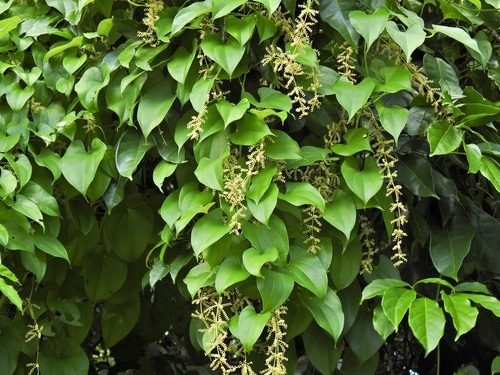
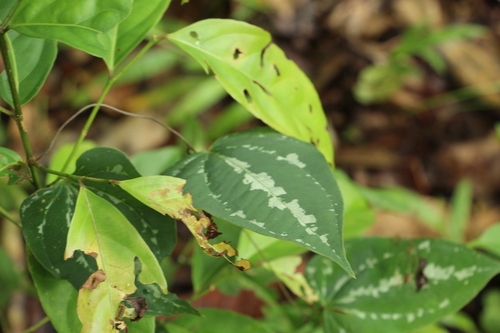
A yam. It has a twining vine. The stem can be 7 m long and is very slender. The tubers are 60-100 cm long by 6 cm wide. The leaves are opposite and 10 cm long by 5 cm wide. They vary in shape and are oval or sword shaped. The male flowers are in clusters with spikes 25 cm long in the axils of leaves. The female flower spikes occur singly and are drooping and 15-30 cm long.
Wikipedia
Source ↗Dioscorea spicata is a herbaceous perennial in the family Dioscoreaceae.
Names & Synonyms
Arathikizhzngu, Athikizhangu, Eghen ngenchi, Gonala, Kavalakizhzngu
Dioscorea nummularia var. glauca Prain & BurkillDioscorea spicata var. anamallayana Prain & BurkillDioscorea spicata var. parvifolia Prain & BUrkill
References (4)
- Hedrick, U.P., 1919, (Ed.), Sturtevant's edible plants of the world. p 275
- Mohan, V. R. & Kalidass, C., 2010, Nutritional and Antinutritional Evaluation of some Unconventional Wild Edible Plants. Tropical and Subtropical Agroecosystems, 12 (2010): 495- 506
- Murtem, G. & Chaudhrey, P., 2016, An ethnobotanical note on wild edible plants of Upper Eastern Himalaya, India. Brazilian Journal of Biological Sciences, 2016, v. 3, no. 5, p. 63-81
- Rajapaksha, U., 1998, Traditional Food Plants in Sri Lanka. HARTI, Sri Lanka. p 182