Staphylea colchica
Steven
Cochis bladder-nut
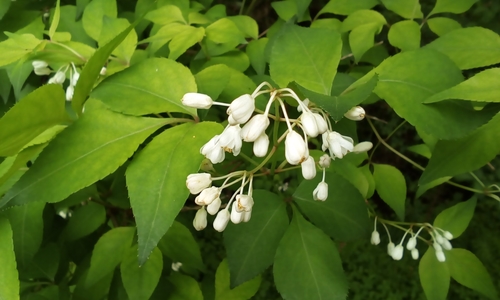
(c) Алина Мигалина, some rights reserved (CC BY-NC), uploaded by Алина Мигалина

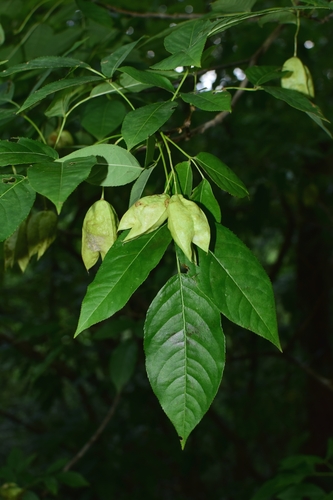
(c) shumkovaoa, some rights reserved (CC BY-NC)

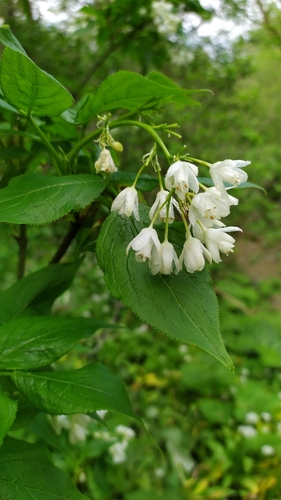
(c) Jon Mortin, some rights reserved (CC BY)
What to Eat
Edible parts: Leaves, Buds, Flowers
Flower buds are edible, though no further details are given. An oil from the seed tastes like pistachio nuts but is purgative.
Where to Find It
It is a temperate plant. It needs moist, rich, well-drained soils in either full sun or light shade. Melbourne Botanical garden. It suits hardiness zone 6.
Australia, Caucasus, Central Asia, Georgia*, Iran, Mediterranean, Middle East,
How to Identify
A shrub or small tree. It grows 4 m tall. It loses its leaves during the year.
How to Grow
Tolerant of a wide range of soils so long as they are not too dry, it prefers a rich loamy soil in full sun or semi-shade. Prefers a neutral to acid soil but tolerates some alkalinity. A very ornamental plant, it is hardy to about -20°c. Fairly fast-growing when young, but slowing with age. Flowers best in years that follow hot summers. Plants in this genus are notably resistant to honey fungus.
Propagation: Seed can be very slow to germinate, sometimes taking 18 months or more. Sow as soon as ripe in a cold frame for the best chance of spring germination. Stored seed should be sown as early in the year as possible with cold stratification, and may not germinate until the following spring. Prick out seedlings into individual pots when large enough to handle and grow on in light shade in the greenhouse through their first winter, then plant out early the following summer. Cuttings of half-ripe wood, 5–8cm with a heel, taken July/August in a frame give a fair to good success rate. Layering in July/August takes 15 months and gives a good percentage.
Medicinal Uses
The plant is purgative.
Other Uses
An oil extracted from the seed tastes like pistachio nuts but has purgative properties. No other uses for the oil were reported.
Wikipedia
Source ↗Staphylea colchica, the Caucasian bladdernut, Colchis bladdernut, or Georgian: ჯონჯოლი, jonjoli or djondjoli, is an ornamental shrub in the Staphyleaceae family. It is native to western Georgia. Its binomial name is derived from the western Georgian kingdom of Colchis. This small tree (6–10 feet) is a rapidly growing deciduous species. It grows best in well-drained and partly shaded locations. Although it produces fragrant flowers and fruit, it spreads often by suckers. Its buds, preserved in brine and seasoned with raw onion and vegetable oil, are a common dish in Georgia.
Production
It grows rapidly.
Other Information
They are sold in local markets.
Names & Synonyms
Dzhondzholi, Jonjoli
References (6)
- Bull. Soc. Imp. Naturalistes Moscou 21(3):276. 1848
- Bussman, R. W., et al, 2016, A comparative ethnobotany of Khevsureti, Samtskhe-Javakheti, Tusheti, Svaneti, and Racha-Lechkhumi, Republic of Georgia (Sakartvelo), Caucasus. Journal of Ethnobiology and Ethnomedicine.
- Bussman, R. W. et al, 2017, Ethnobotany of Samtskhe-Javakheti, Sakartvelo (Republic of Georgia), Caucasus. Indian Journal of Traditional Knowledge Vol. 16(1) pp 7-24
- Bussman, R. W., et al, 2021, Unity in diversity—food plants and fungi of Sakartvelo (Republic of Georgia), Caucasus. Journal of Ethnobiology and Ethnomedicine (2021) 17:72 p 15
- Facciola, S., 1998, Cornucopia 2: a Source Book of Edible Plants. Kampong Publications, p 238
- Rivera, D. et al, 2006, Gathered Mediterranean Food Plants - Ethnobotanical Investigations and Historical Development, in Heinrich M, Müller WE, Galli C (eds): Local Mediterranean Food Plants and Nutraceuticals. Forum Nutr. Basel, Karger, 2006, vol 59, pp 18–74
More from Staphyleaceae