Staphylea trifolia
L.
American bladder nut, Eastern Bladdernut

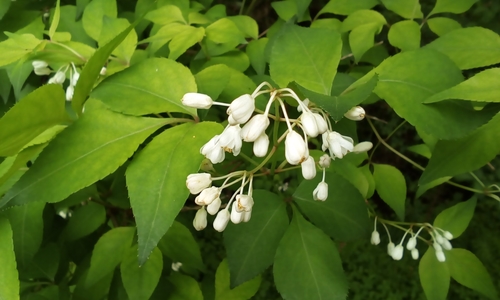
(c) Heather Holm, some rights reserved (CC BY-NC), uploaded by Heather Holm
(c) Sequoia Janirella Wrens, some rights reserved (CC BY-NC)
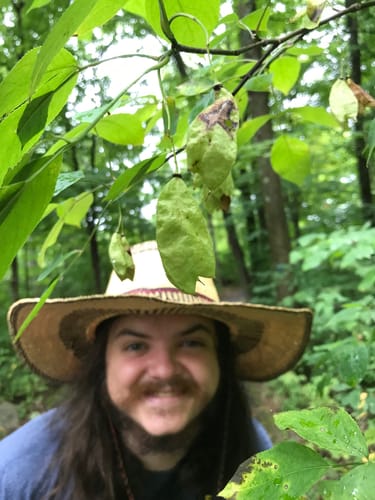
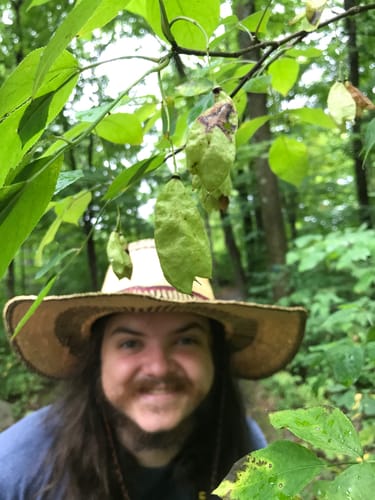
(c) Sequoia Janirella Wrens, some rights reserved (CC BY-NC)
What to Eat
Edible parts: Seeds, Seeds - oil, Nut.
Seeds can be eaten raw or cooked, and are used like pistachios. They can also substitute for walnuts in making chocolate-chip cookies. A sweet edible oil pressed from the seed is used for cooking.
Where to Find It
It is a temperate plant. It suits hardiness zones 5-9.
Australia, Canada, North America, USA,
How to Identify
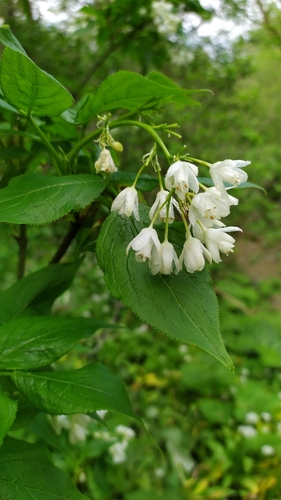
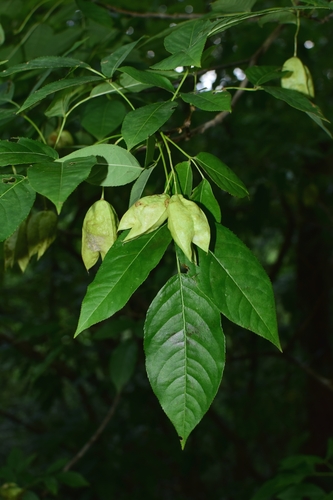
A shrub. The leaves have 3 leaflets and these are 5-8 cm long. The leaflets have fine points and sharp teeth. There are fine hairs underneath the leaves. The leaves change colour in autumn. The flowers are white and 35 mm long. They are in short panicles. The fruit has 3 lobes.
How to Grow
Tolerant of a wide range of soils so long as they are not too dry, it prefers a rich loamy soil in full sun or semi-shade. A fast-growing but short-lived tree in the wild. The plants flower best in years that follow hot summers. Plants in this genus are notably resistant to honey fungus.
Propagation: Seed can be very slow to germinate, sometimes taking 18 months or more. Sow as soon as ripe in a cold frame for the best chance of spring germination. Stored seed should be sown as early in the year as possible with cold stratification, and may not germinate until the following spring. Prick out seedlings into individual pots when large enough to handle and grow on in light shade in the greenhouse through their first winter, then plant out early the following summer. Cuttings of half-ripe wood, 5–8cm with a heel, taken July/August in a frame give a fair to good success rate. Layering in July/August takes 15 months and gives a good percentage.
Medicinal Uses
An infusion of powdered bark has been used as a wash for sore faces.
Other Uses
A sweet oil is obtained from the seed. The plants have dense underground root systems that make them useful for erosion control.
Wikipedia
Source ↗Staphylea trifolia, the American bladdernut, is native to eastern North America, from southern Ontario and southwestern Quebec west to Nebraska and Arkansas, and south to Florida. It is sometimes used as an ornamental plant. It is a medium-sized shrub growing to 3.5 m (11 ft) tall. Its growth rate is medium to fast. The leaves are opposite and divided into three leaflets, each leaflet 4.5–13 cm (2–5 in) long and 5 cm (2 in) broad, with a serrated margin. The leaves are bright green in the spring, turning dark green in the summer. S. trifolia produces pendant white flowers in spring, which mature into bladder-like, teardrop-shaped fruits that contain 1-3 brown popcorn-like seeds. Some sources consider these "nuts" to be edible.
References (10)
- Beckstrom-Sternberg, Stephen M., and James A. Duke. "The Foodplant Database." http://probe.nalusda.gov:8300/cgi-bin/browse/foodplantdb.(ACEDB version 4.0 - data version July 1994)
- Cundall, P., (ed.), 2004, Gardening Australia: flora: the gardener's bible. ABC Books. p 1369
- Facciola, S., 1998, Cornucopia 2: a Source Book of Edible Plants. Kampong Publications, p 238
- Hedrick, U.P., 1919, (Ed.), Sturtevant's edible plants of the world. p 634
- Kermath, B. M., et al, 2014, Food Plants in the Americas: A survey of the domesticated, cultivated and wild plants used for Human food in North, Central and South America and the Caribbean. On line draft. p 837
- Krochmal, A. & Krochmal, C., 1982, Uncultivated Nuts of The United States. United States Department of Agriculture Forest Service. p 73
- Little, E.L., 1980, National Audubon Society Field Guide to North American Trees. Alfred A. Knopf. p 568
- Menninger, E.A., 1977, Edible Nuts of the World. Horticultural Books. Florida p 71
- Plants for a Future database, The Field, Penpol, Lostwithiel, Cornwall, PL22 0NG, UK. http://www.scs.leeds.ac.uk/pfaf/
- Wickens, G.E., 1995, Edible Nuts. FAO Non-wood forest products. FAO, Rome. p154