Staphylea pinnata
Linn.
European Bladder-nut, False pistachio

(c) brunodovere, some rights reserved (CC BY-NC)
(c) thomasweird, some rights reserved (CC BY-NC)

(c) lukaszpiechnik, some rights reserved (CC BY-NC)
What to Eat
Edible parts: Seeds, Kernels, Nuts, Flowers
Seeds are eaten raw and are said to taste like pistachios; they are commonly eaten by children in Germany.
Where to Find It
A temperate plant. It suits hardiness zones 6-9.
Armenia, Asia, Australia, Azerbaijan, Britain, Caucasus, Europe, Georgia, Germany, Hungary, Italy, Mediterranean, San Marino,
How to Identify
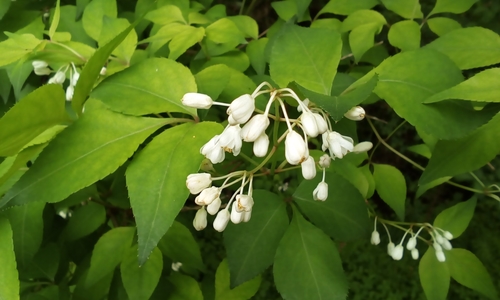
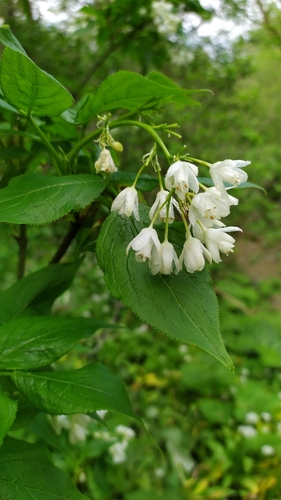
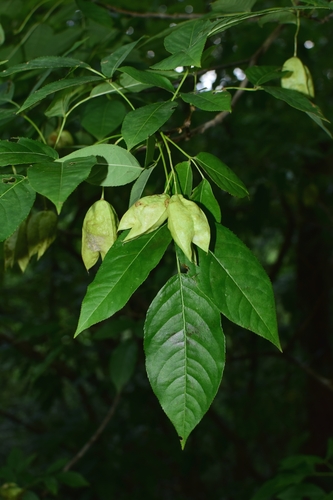
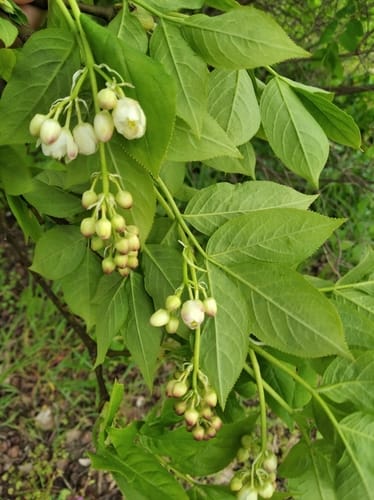
A shrub. It grows 4.5 m high and spreads 4.5 m wide. The leaves have 3-7 leaflets which taper to a fine point. There are teeth along the edge. They are waxy underneath. The flowers are white with red tips on the sepals. The fruit are pods 25 mm wide.
How to Grow
Tolerant of a wide range of soils so long as they are not too dry, it prefers a rich loamy soil in full sun or semi-shade. Prefers a neutral to acid soil but tolerates some alkalinity. A very ornamental plant, it is hardy to about -20°c. The plants flower best in years that follow hot summers. Plants in this genus are notably resistant to honey fungus.
Propagation: Seed can be very slow to germinate, sometimes taking 18 months or more. Sow as soon as ripe in a cold frame for the best chance of spring germination. Stored seed should be sown as early in the year as possible with cold stratification, and may not germinate until the following spring. Prick out seedlings into individual pots when large enough to handle and grow on in light shade in the greenhouse through their first winter, then plant out early the following summer. Cuttings of half-ripe wood, 5–8cm with a heel, taken July/August in a frame give a fair to good success rate. Layering in July/August takes 15 months and gives a good percentage. Plants sometimes produce suckers, which can be removed during the dormant season and planted out.
Medicinal Uses
None known
Other Uses
None known
Wikipedia
Source ↗Staphylea pinnata, the European bladdernut, is a species of bladdernut native to Europe and naturalized in Britain.
Other Information
The seeds are eaten especially by children. It is sold in local markets.
Names & Synonyms
Jonjoli, Klokocs, Navadni kloček, Nezcoupe
References (18)
- Bodkin, F., 1991, Encyclopedia Botanica. Cornstalk publishing, p 948
- Brickell, C. (Ed.), 1999, The Royal Horticultural Society A-Z Encyclopedia of Garden Plants. Convent Garden Books. p 979
- Bussman, R, W, et al, 2016, A comparative ethnobotany of Khevsureti, Samtskhe-Javakheti, Tusheti, Svaneti, and Racha-Lechkhumi, Republic of Georgia (Sakartvelo), Caucasus. Journal of Ethnobiology and Ethnomedicine 12:43
- Chemonics International Inc., 2000, Biodiversity Assessment of Georgia. USAID Contract.
- Cundall, P., (ed.), 2004, Gardening Australia: flora: the gardener's bible. ABC Books. p 1369
- Denes, A., et al, 2012, Wild plants used for food by Hungarian ethnic groups living in the Carpathian Basin. Acta Societatis Botanicorum Poloniae 81 (4): 381-396
- Facciola, S., 1998, Cornucopia 2: a Source Book of Edible Plants. Kampong Publications, p 238
- Hearne, D.A., & Rance, S.J., 1975, Trees for Darwin and Northern Australia. AGPS, Canberra p 105, Pl 32
- Hedrick, U.P., 1919, (Ed.), Sturtevant's edible plants of the world. p 633
- Hibbert, M., 2002, The Aussie Plant Finder 2002, Florilegium. p 294
- http://www.botanic-gardens-ljubljana.com/en/plants
- Kremer, B.P., 1995, Shrubs in the Wild and in Gardens. Barrons. p 173
- Luczaj, L. et al, 2017, Comfrey and Buttercup Eaters: Wild Vegetables of the Imereti Region in Western Georgia, Caucasus. Economic Botany, 71(2), 2017, pp. 188–193
- Menninger, E.A., 1977, Edible Nuts of the World. Horticultural Books. Florida p 71
- Plants for a Future database, The Field, Penpol, Lostwithiel, Cornwall, PL22 0NG, UK. http://www.scs.leeds.ac.uk/pfaf/
- Rivera, D. et al, 2006, Gathered Mediterranean Food Plants - Ethnobotanical Investigations and Historical Development, in Heinrich M, Müller WE, Galli C (eds): Local Mediterranean Food Plants and Nutraceuticals. Forum Nutr. Basel, Karger, 2006, vol 59, pp 18–74
- Sp. pl. 1:270. 1753
- Wickens, G.E., 1995, Edible Nuts. FAO Non-wood forest products. FAO, Rome. p154