Aloe maculata
All.
Common soap aloe, African aloe
(c) zaca, some rights reserved (CC BY-NC), uploaded by zaca

(c) Vilseskogen, some rights reserved (CC BY-SA), uploaded by Vilseskogen
(c) Richard Breisch, some rights reserved (CC BY-NC), uploaded by Richard Breisch
What to Eat
Edible parts: Heart, Growing tip, Leaves, Flowers
The clear inner gel of Aloe maculata can be used similarly to Aloe vera gel in small amounts. Traditionally, it has been added to foods or diluted in water to make cooling drinks, particularly in arid regions, valued for its mild flavour and potential digestive benefits. Extraction requires care: only the transparent inner gel should be used, carefully separated from the outer skin and the yellow latex beneath it. That latex contains saponins and anthraquinones — compounds that act as a strong laxative and can cause stomach cramps, diarrhoea, and potential poisoning if consumed in large quantities. Prolonged or excessive ingestion may lead to serious harm, including liver or kidney damage. Only thoroughly rinsed inner gel, completely free of yellow sap, should ever be consumed, and then only sparingly and with full knowledge of how to process the plant safely.
Known Hazards
Where to Find It
It grows in warm temperate places. It can grow in arid places. In Brisbane Botanical gardens.
Africa, Asia, Australia, Eswatini, India, Lesotho, Mauritius, Mexico, New Zealand, North America, South Africa, Southern Africa, Swaziland, Tasmania,
How to Identify
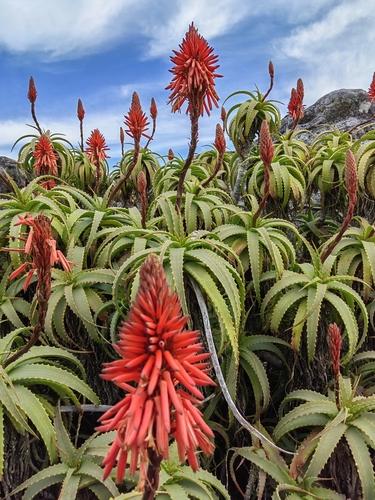
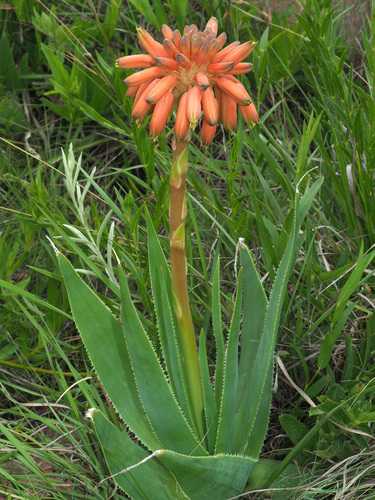
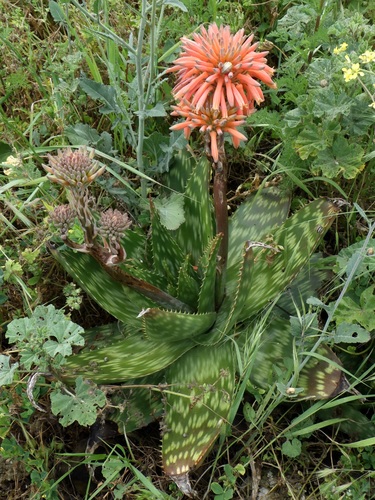
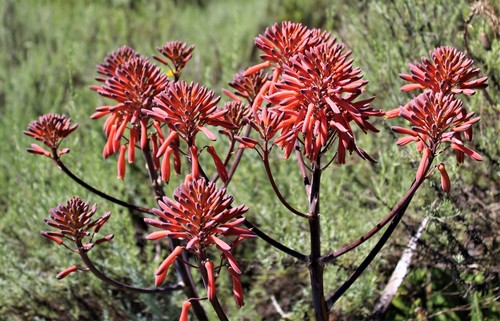
A shrub. It does not have a stem. It grows in a ring. The main ring can be 40 cm tall. The leaves are thick and succulent and 25 cm long. There are sharp dark brown teeth along the edge. The leaves have white freckles. The flowers are tube shaped and red, orange or yellow.
How to Grow
Aloe maculata, also known as Soap Aloe, is naturally found in subtropical and semi-arid regions of South Africa. Rocky slopes and outcrops typically characterise their habitat. It often grows on hillsides and rocky terrain with good drainage. It also grows in Open Grasslands, where it receives plenty of sunlight. Bushveld and savanna: Bushveld and savanna are common in dry shrublands and savanna ecosystems. Thrives in areas with seasonal rainfall, tolerating both summer and winter rainfall patterns. It is drought-tolerant and suited to warm, sunny climates but can survive occasional frost. Soil Texture: It prefers light (sandy) or medium soils. It can tolerate some clay if it is well-drained. Soil Moisture: It thrives in dry to moderately moist soil. Once established, it is drought-tolerant but does not do well in overly wet conditions. Drainage: It requires well-drained soil to prevent root rot. Soil pH: Adaptable to a range of soil pH levels: acid, neutral, or alkaline. Saline Tolerance: Can tolerate saline conditions, making it suitable for coastal gardens. Tolerance of Poor Soil: can thrive in poor, nutrient-deficient soils. Light Requirements: Prefers full sun but can also tolerate semi-shade (though flowering may be reduced in lower light conditions). Height: Grows to about 30–60 cm (1–2 feet) in height, with a similar spread. Pollination: Pollinated by birds (especially sunbirds or hummingbirds in their native range), bees, and other insects. Temperature: It is frost-tender and should be protected in areas with freezing temperatures. Plants are damaged by temperatures below 32 °F (0 °C) but recover quickly. Ideal for USDA zones 8–12. Pest and Disease Resistance: Generally pest-resistant but can occasionally attract aphids or scale insects. Aloe leaves can be harvested year-round, but mature leaves are generally harvested in late spring to summer when the plant is most vigorous for specific products like aloe vera gel. Many aloe species are not self-fertile and require cross-pollination with other plants for successful seed production. Aloe species typically flower in late winter to early spring, depending on the species and local climate conditions. Aloe species are not self-fertile and often require cross-pollination with other plants for successful seed production. Aloe leaves can be harvested year-round, but mature leaves are generally harvested in late spring to summer when the plant is most vigorous for specific products like aloe vera gel. Aloe species typically flower in late winter to early spring, depending on the species and local climate conditions. Growth rates can vary among species, but generally, aloe plants are considered moderate to slow growers, with many species taking several years to reach maturity. The native range of this species is S. Africa. It is a succulent subshrub and grows primarily in the subtropical biome. Aloe maculata is native to Cape Provinces, Free State, Kwa. Zulu-Natal, Lesotho, and Northern Provinces. It has been introduced into Argentina Northeast, Baleares, Corse, Italy, Mauritius, Mexico Central, Mexico Northeast, New South Wales (Australia), New Zealand North, New Zealand South, Norfolk Is., Portugal, Queensland (Australia), Réunion, Sicilia, South Australia, Spain, St.Helena, and Tasmania (Australia).
Propagation: Easily propagated from offsets or seeds.
Medicinal Uses
The leaf gel is traditionally applied to cuts, burns, sores, insect bites, and sunburns for its cooling, soothing, and mild antimicrobial and antifungal effects, which may help prevent infection in minor wounds. In some traditional practices, plant extracts were also used in small amounts as a laxative or to address stomach ailments, though this requires caution given the potential toxicity of the latex and anthraquinone-containing compounds at higher doses. The yellowish sap near the leaf base may irritate skin or mucous membranes. Although Aloe maculata has not been as extensively studied as Aloe vera, its phytochemical composition suggests it likely shares similar anti-inflammatory, antimicrobial, and soothing properties. Medicinal use remains primarily traditional and topical.
Other Uses
Aloe maculata works well as a drought-resistant ground cover for xeriscaping and erosion control, helping stabilise soil and support soil health. It produces tubular orange, red, or yellow flowers on tall stalks, mainly in winter and spring, which are rich in nectar and attract pollinators including bees and hummingbirds. The dense foliage can provide some shelter for small animals. The plant does not produce meaningful leaf litter or reliable overwintering sites for invertebrates, and its scent is not known to confuse or deter pests, though its sap may have some deterrent effect.
Wikipedia
Source ↗Aloe maculata (syn. Aloe saponaria), the soap aloe or zebra aloe, is a Southern African species of aloe. Local people in South Africa know it informally as the Bontaalwyn in Afrikaans, or lekhala in the Sesotho language.
Notes
Also put in the family Aloaceae. Also put in the family Asphodelaceae.
Names & Synonyms
Emahala, Lihala
References (8)
- Long, C., 2005, Swaziland's Flora - siSwati names and Uses http://www.sntc.org.sz/flora/
- Ogle & Grivetti, 1985,
- Peters, C. R., O'Brien, E. M., and Drummond, R.B., 1992, Edible Wild plants of Sub-saharan Africa. Kew. p 9
- Royal Botanic Gardens, Kew (1999). Survey of Economic Plants for Arid and Semi-Arid Lands (SEPASAL) database. Published on the Internet; http://www.rbgkew.org.uk/ceb/sepasal/internet [Accessed 24th March 2011]
- Ruiters-Welcome, A. K., 2019, Food plants of southern Africa. Ph.D. thesis. Univ. of Johannesburg p 31
- Tasmanian Herbarium Vascular Plants list p 58
- Welcome, A. K. & Van Wyk, B.-E., 2019, An inventory and analysis of the food plants of southern Africa. South African Journal of Botany 122 (2019) 136–179
- World Checklist of Useful Plant Species 2020. Royal Botanic Gardens, Kew