Breynia discigera
Muell.-Arg.
Saga monyit, Katut selayer, Semelit jekok
PhyllanthaceaeLeaves
iNaturalist · cc-by-nc
(c) Royal Botanic Garden Edinburgh, some rights reserved (CC BY-NC)
(c) Royal Botanic Garden Edinburgh, some rights reserved (CC BY-NC)
iNaturalist · cc-by-nc
(c) Steven Chong, some rights reserved (CC BY-NC)
(c) Steven Chong, some rights reserved (CC BY-NC)
What to Eat
Edible parts: Leaves
The leaves are eaten.
Where to Find It
A tropical plant. It grows between 30-300 m above sea level.
Asia, Indochina, Indonesia, Malaysia, SE Asia, Singapore, Thailand,
Countries: United Arab Emirates, Afghanistan, Armenia, Azerbaijan, Bangladesh, Bahrain, Brunei, Bhutan, China, Georgia, Indonesia, Israel, India, Iraq, Iran, Jordan, Japan, Kyrgyzstan, Cambodia, North Korea, South Korea, Kuwait, Kazakhstan, Laos, Lebanon, Sri Lanka, Myanmar, Mongolia, Maldives, Malaysia, Nepal, Oman, Philippines, Pakistan, Qatar, Saudi Arabia, Singapore, Syria, Thailand, Tajikistan, Timor-Leste, Turkmenistan, Turkey, Taiwan, Uzbekistan, Vietnam, Yemen
How to Identify
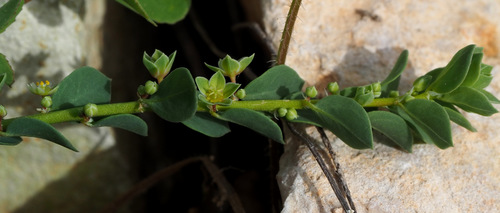
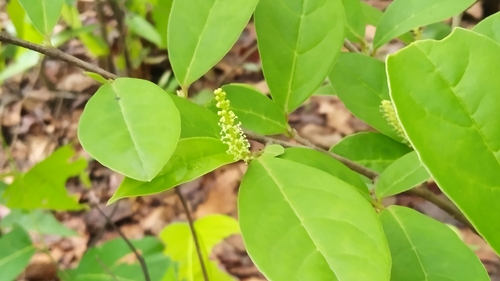
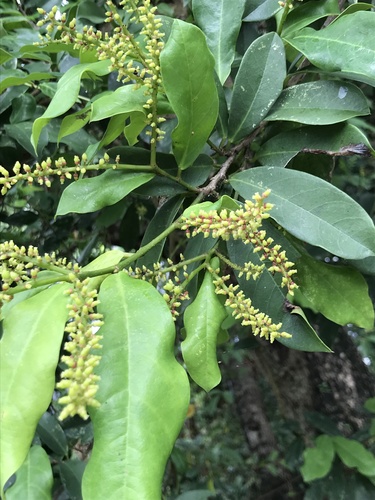
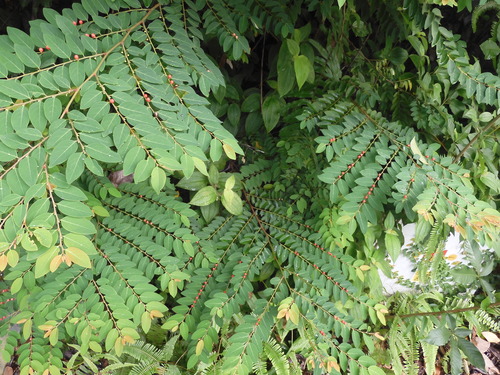
A shrub or small tree. It grows 2 m tall. It is hairy. The leaves are narrowly oval. They are 1-4 cm long by 1-2 cm wide. The edges curve back. The leaves are dark green above and light green underneath. The fruit are red and 7 mm long by 6.5 mm wide. The seed is 4 mm by 2 mm.
How to Grow
Found in the wild in sandy and alluvial soils.
Medicinal Uses
The plant is used in traditional medicine.
Notes
There are about 25 Breynia species. It is used in medicine. Also put in the family Euphorbiaceae.
Names & Synonyms
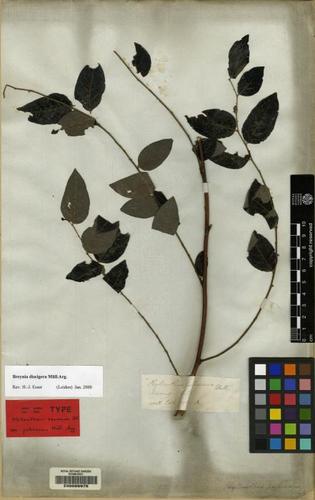
Breynia rhamnoides var. pubescens (Müll.Arg.) Müll.Arg.
Melanthesa racemosa var. pubescens Müll.Arg.
Melanthesa rhamnoides var. pubescens Müll.Arg.
References (2)
- Burkill, I.H., 1966, A Dictionary of the Economic Products of the Malay Peninsula. Ministry of Agriculture and Cooperatives, Kuala Lumpur, Malaysia. Vol 1 (A-H) p 367
- Martin, F.W. & Ruberte, R.M., 1979, Edible Leaves of the Tropics. Antillian College Press, Mayaguez, Puerto Rico. p 191