Bridelia stipularis
(L.) Blume
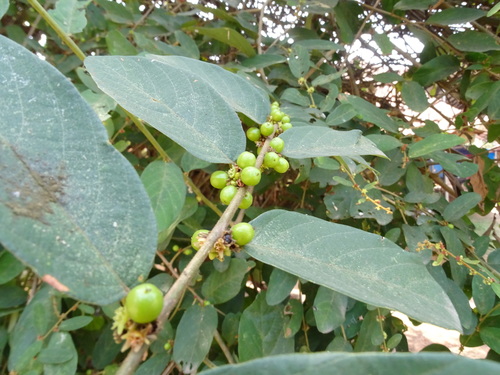
no rights reserved, uploaded by Ajit Ampalakkad
no rights reserved, uploaded by Ajit Ampalakkad

(c) Vijay Anand Ismavel, some rights reserved (CC BY-NC-SA)
What to Eat
Edible parts: Fruit
The ripe fruit are eaten raw or used to make pickles.
Known Hazards
Where to Find It
It is a tropical plant. It is common in some areas of the Philippines. In NE India it grows up to 500 m altitude. In southern China it grows near rivers from 100-1,500 m above sea level. In Yunnan.
Africa, Asia, Bangladesh, Bhutan, Brunei, Cambodia, East Timor, Himalayas, India, Indochina, Indonesia, Laos, Malaysia, Myanmar, Nepal, Northeastern India, Pacific, Philippines, SE Asia, Singapore, Taiwan, Thailand, Timor-Leste, Vietnam,
How to Identify
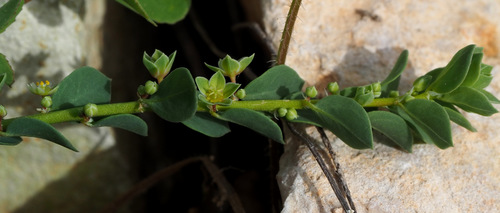
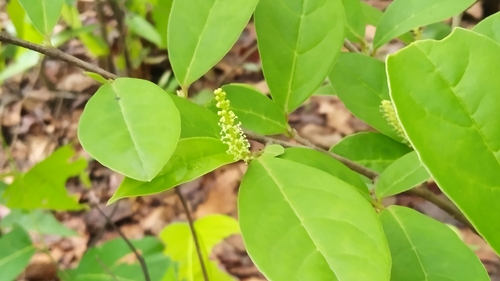
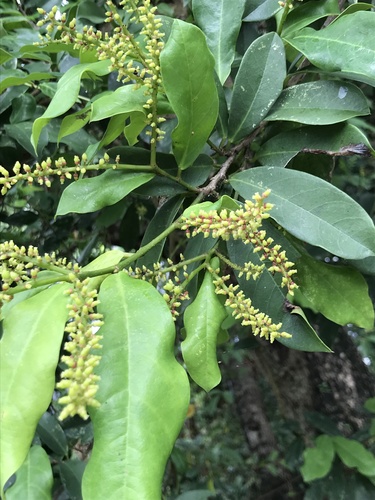
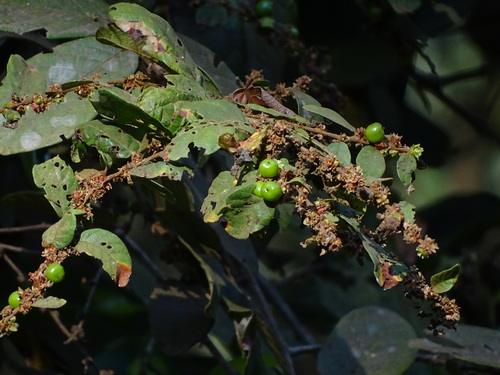
A shrub that often lies over. The branches are slender, hang down and are covered with soft brown hairs. The leaves are many and thin. They are carried alternately and the end ones are much smaller. They are covered with fine soft hairs. The flowers are in small compact more or less rounded clusters in the axils of leaves. The fruit are nearly black when ripe and have an enlarged group of outer leaves which stay on the fruit.
Medicinal Uses
The bark is used as a medicine against intestinal worms. A decoction of the bark is used as a treatment for cough, fever, and asthma. In tests the bark has shown hypotensive and hypoglycaemic activity. An infusion of the leaves is used as a treatment against colic and jaundice. The seeds possess haemaglutinating properties. An infusion of the boiled root is used in the treatment of thrush and in postpartum treatment.
Other Uses
The twigs are used in basketry. The bark is a source of tannins. The fruits yield a black colouring matter. A fatty oil is obtained from the seeds. The greyish-brown wood is moderately hard. It is only used for fuel.
Wikipedia
Source ↗Bridelia stipularis is a perennial evergreen climber grows over hedges and bushes and sometimes on bigger trees. It is native to Southeast Asia, southern China, and the Indian subcontinent. Used as medicines in Malaysia and the Philippines. Bridelia stipularis, as other Bridelia species, used as food plants by the larvae of some Lepidoptera species including Endoclita malabaricus.
Production
In India plants flower and fruit September to March.
Notes
There are about 60 Bridelia species.
Names & Synonyms
Asana, Babu janga, Bisalballi, Chenderai gajah, Cheruka, Cherukapanachi, Gaurkarsi, Harinhara, Hatsakun pi, Hlekan, Hom homali, Kandri kebo, Kangiabel, Kanyere aroi, Kanyere badak, Kenidai babi, Kenidai samak, Kerenan, Khaji, Kolia lata, Koto-koto, Kutki, Lahpawkru, Lota mandi, Lubalub, Mouhilika, Mou silikha, Mulluvenga, Panachi, Pat khowi, Risan-um, Sagol laderi, Sepaph, Thebhi
References (20)
- Ambasta S.P. (Ed.), 2000, The Useful Plants of India. CSIR India. p 87
- Bandyopadhyay, S. et al, 2009, Wild edible plants of Koch Bihar district, West Bengal. Natural Products Radiance 8(1) 64-72
- Baishya, S. Kr., et al, 2013, Survey of Wild Edible Fruits of Dhubri District, Assam, India. Plant Archives Vol 13 (1): 155-158
- Bijdr. 597. 1825
- Burkill, I.H., 1966, A Dictionary of the Economic Products of the Malay Peninsula. Ministry of Agriculture and Cooperatives, Kuala Lumpur, Malaysia. Vol 1 (A-H) p 370
- Chakraborty, S. & Chaturbedi, H. P., 2014, Some Wild Edible Fruits of Tripura- A Survey. Indian Journal of Applied research. (4) 9
- Dey, A. & Mukhererjee, A., 2015, Living and Survival Amidst Hunger: Wild Edible Botanicals as a Prime Forest Productivity in the Rural Purulia District, West Bengal, India from Colonial to Present. Research Journal of Forestry 9(3): 71-86
- Dobriyal, M. J. R. & Dobriyal, R., 2014, Non Wood Forest Produce an Option for Ethnic Food and Nutritional Security in India. Int. J. of Usuf. Mngt. 15(1):17-37
- Jeeva, S., 2009, Horticultural potential of wild edible fruits used by the Khasi tribes of Meghalaya. Journal or Horticulture and Forestry Vol. 1(9) pp. 182-192
- Majumdar, K and Datta, N., 2009, Traditional wild edible fruits for the forest dwellers of Tripura, India. Pleione 3(2) 167-178
- Monsalud, M.R., Tongacan, A.L., Lopez, F.R., & Lagrimas, M.Q., 1966, Edible Wild Plants in Philippine Forests. Philippine Journal of Science. p 468
- Pasha, M. K. & Uddin, S. B., 2019, Minor Edible Fruits of Bangladesh. Bangladesh J. Plant Taxon. 26(2): 299–313
- Patiri, B. & Borah, A., 2007, Wild Edible Plants of Assam. Geethaki Publishers. p 127
- Ramachandran, V.S. and Nair, V.J., 1981, Ethnobotanical studies in Cannanore District, Kerala State (India). J Econ. Tax. Bot. Vol 2 pp 65-72 (As Bridelia scandens)
- Ramachandran, V.S., 1987, Further Notes on the Ethnobotany of Cannanore District, Kerala. J. Econ. Tax. Bot. Vol. 11 No. 1 pp 47- (As Bridelia scandens)
- Ramakrishna, N. & Singh, DSR, R., 2020, Ethno-Botanical Studies of Edible Plants Used by Tribal Women in Nirmal District. IJSRSET p 309
- Sarma, H., et al, 2010, Updated Estimates of Wild Edible and Threatened Plants of Assam: A Meta-analysis. International Journal of Botany 6(4): 414-423
- Sawian, J. T., et al, 2007, Wild edible plants of Meghalaya, North-east India. Natural Product Radiance Vol. 6(5): p 413
- Singh, H.B., Arora R.K.,1978, Wild edible Plants of India. Indian Council of Agricultural Research, New Delhi. p 50
- Wild edible plants of Himachal Pradesh