Dioscorea cirrhosa
Lour.
Dyeing yam, Cu nau, Cu mao

(c) Connie Lin, some rights reserved (CC BY-NC)

(c) Connie Lin, some rights reserved (CC BY-NC)

(c) Allen Chen, some rights reserved (CC BY-NC)
What to Eat
Edible parts: Root, Tuber
Dioscorea cirrhosa has historically been used as a source of dye. The plant's tuber was once traded internationally for its dyeing properties, making it an important economic resource in certain regions.
Where to Find It
It is a tropical plant. It grows in secondary forest. In southern China it grows up to 1,500 m above sea level. In Sichuan and Yunnan.
Asia, China, Indochina, Laos, Philippines, SE Asia, Taiwan, Thailand, Tibet, Vietnam,
How to Identify
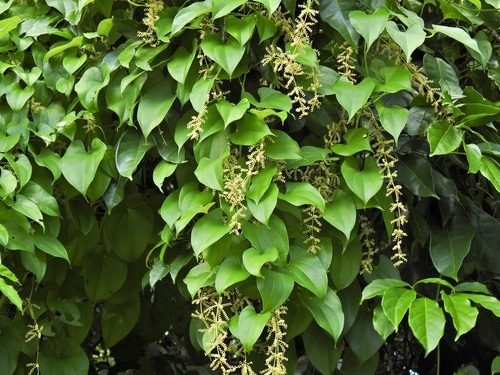
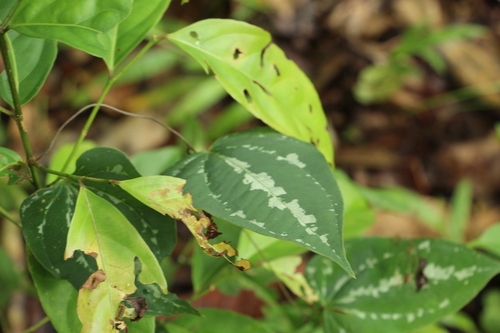
A yam. It is a vine. It keeps growing from year to year. It has a large underground tuber. The tubers can vary in shape. This produces annual stems that are scrambling or twining. The stems twine to the right. They can be 20 m long. They are prickly at the base. The leaves are whitish underneath. They are oval and 5-20 cm long by 1-14 cm wide.
Other Uses
The tubers contain 6 - 13% tannin. This is used for preserving nets and leather as well as for colouring clothes made from ramie, silk and cotton a brown colour. The tubers are harvested when about 3 years old, the harvesting taking place in the dry season when the red flesh has a high tannin content. The tubers should be harvested with care to ensure that they are not broken or bruised. They should be protected against desiccation because they lose much of their colouring properties when desiccated. For dyeing and tanning purposes, the tuber are peeled and the flesh is rasped. About 3 litres of water is added to 1 kg of rasped flesh, and clothes or nets are dipped in the hot or cold solution remaining after filtering, and afterwards dried in the sun. This handling is repeated several times, until the desired reddish-brown colour is attained. The dye rapidly loses its activity, and best results are obtained with fresh solutions. Mordants such as alum, aluminium acetate and bichromate are often added to the solution, but sometimes leaves of Psidium guajava L. and Piper betle L., or mud (in China) replace the mordant.
Wikipedia
Source ↗Dioscorea cirrhosa, commonly known as the dyeing yam, is a species of flowering plant in the family Dioscoreaceae. It is a perennial, dioecious climbing vine native to Southeast Asia.
Other Information
It is a famine food.
Notes
It was cultivated for its dye. The tubers are high in tannin.
Names & Synonyms
Ai la ma a si, Cu'nau, Huoyilong, Khoai leng, Shu liang
References (8)
- Castillo, C., 2013, The Archaeobotany of Khao Sam Kaeo and Phu Khao Thong: The Agriculture of Late Prehistoric Southern Thailand. Ph. D. thesis University College, London p 382
- Fern, K., 2012, Tropical Species Database http://theferns.info/tropical/
- Luo, B., et al, 2019, Wild edible plants collected by Hani from terraced rice paddy agroecosystem in Honghe Prefecture, Yunnan, China. Journal of Ethnobiology and Ethnomedicine 15:56
- Mansfeld's Encyclopedia of Agrocultural and Horticultural Crops. Hanelt, P. (ed) p 2164
- Ogle, B. M., et al, 2003, Food, Feed or Medicine: The Multiple Functions of Edible Wild Plants in Vietnam. Economic Botany 57(1): 103-117
- Slik, F., www.asianplant.net
- Van Sam, H. et al, 2008, Uses and Conservation of Plant Species in a National Park. A case study of Ben En, Vietnam. Economic Botany 62:574-593
- Xu, You-Kai, et al, 2004, Wild Vegetable Resources and Market Survey in Xishuangbanna, Southwest China. Economic Botany. 58(4): 647-667.