Caesia parviflora
R. Br.
Pale grass lily, Blue grass-lily
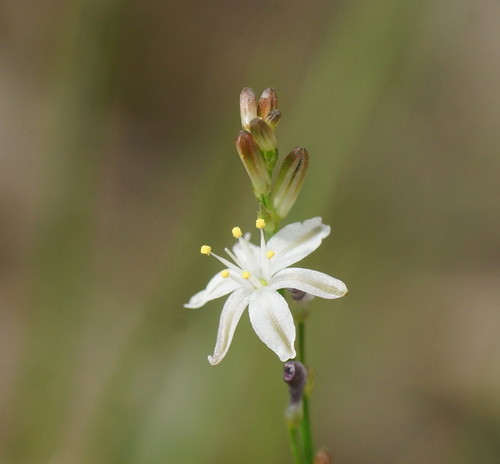
(c) Reiner Richter, some rights reserved (CC BY-NC-SA), uploaded by Reiner Richter
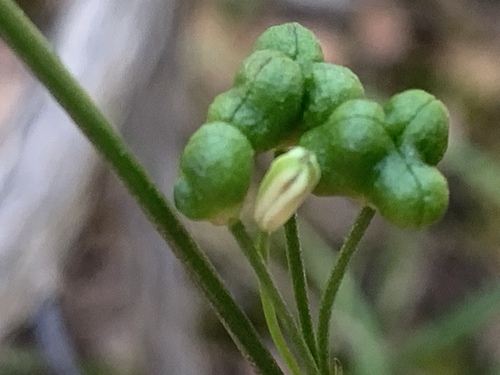
(c) SBERRY, some rights reserved (CC BY-NC), uploaded by SBERRY

(c) Petra Holland, some rights reserved (CC BY), uploaded by Petra Holland
What to Eat
Edible parts: Tubers, Root
Edible Parts: Root Edible Uses: Root. We have no more details other than that the roots are slightly fleshy.
Where to Find It
It is a temperate plant. They grow in heaths and woodlands. It grows in poor, dry soils in open forests. It is resistant to drought and frost. Tasmanian Herbarium.
Australia*, Tasmania*,
How to Identify
A lily which keeps growing from year to year. It is a grass-like herb. It grows 10-25 cm high and spreads 10-25 cm wide. The roots are slightly fleshy. The leaves are grass-like. They are 25 cm long and slender. They occur in tufts. They are less than 5 mm wide. The flower has slender petals 3-10 mm long. They can be white, pink or blue. They are white with bluish-grey veins. The flowers are on leafless stems and are in the axils of bracts. They have white stamens with yellow anthers. After flowering they form a twisted shape.
How to Grow
We have very little information on this species and do not know if it will be hardy in this country. It tolerates temperatures down to -7°c in Australian gardens but, because of our cooler summers and longer, colder and wetter winters this cannot be directly translated to British gardens. This plant is widespread in Australia so it is possible that some provenances will succeed here. Plants are likely to require a well-drained soil in a sunny position and some sort of protection in the winter.
Propagation: Seed - we have no details on this species but suggest that it can be sown as soon as it is ripe in a warm greenhouse. Stored seed should be sown in the spring in a warm greenhouse. Sow the seed thinly and grow the plants on in the seed pot for their first year, giving liquid feeds if necessary. Pot the plants up into individual pots in early spring and grow them on in the greenhouse for a second year before planting them out in early summer. Division.
Medicinal Uses
None known
Other Uses
None known Special Uses
Wikipedia
Source ↗Caesia parviflora, the pale grass lily, is a species of flowering plant in the family Asphodelaceae, subfamily Hemerocallidoideae, native to Australia, being found in New South Wales, Queensland, Victoria, Tasmania, South Australia and Western Australia. This is a small plant up to 50 centimeters tall, found in heath, woodland and dry sclerophyll forest, usually near grasses. It often grows on sandstone-based soils. The lily-like flower is about 1.2 centimeters wide and has three grey or purple stripes on each petal. Flowering occurs in spring and summer. The original specimen was collected in Sydney, dated 16 October 1803. In 1810, the species appeared in Prodromus Florae Novae Hollandiae, authored by the prolific Scottish botanist, Robert Brown. The generic name honours Federico Cesi, a 17th-century Italian naturalist. The specific epithet parviflora translates to "small flowered". At least three subspecies are recognised: Caesia parviflora var. parviflora, with white flowers Caesia parviflora var. vittata, with blue flowers Caesia parviflora var. minor, less than 20 cm tall, with blue or white flowers. This subspecies is considered endangered.
Notes
There are 7 Caesia species. It has also been put in the family Liliaceae and Anthericaceae.
Names & Synonyms
References (17)
- Bindon, P., 1996, Useful Bush Plants. Western Australian Museum. p 62
- Bodkin, F., 1991, Encyclopedia Botanica. Cornstalk publishing, p 182
- Caton, J.M. & Hardwick, R. J., 2016, Field Guide to Useful Native Plants from Temperate Australia. Harbour Publishing House. p 280
- Cherikoff V. & Isaacs, J., The Bush Food Handbook. How to gather, grow, process and cook Australian Wild Foods. Ti Tree Press, Australia p 151, 194
- Curtis, W.M., & Morris, D.I., 1994, The Student's Flora of Tasmania. Part 4B St David's Park Publishing, Tasmania, p 386
- Elliot, W.R., & Jones, D.L., 1982, Encyclopedia of Australian Plants suitable for cultivation. Vol 2. Lothian. p 402
- Gilfedder, L et al, 2003, The Nature of the Midlands. Midlands Bushweb. PO Box 156 Longford, Tasmania. p 68
- Hibbert, M., 2002, The Aussie Plant Finder 2002, Florilegium. p 48
- Lazarides, M. & Hince, B., 1993, Handbook of Economic Plants of Australia, CSIRO. p 41
- Lim, T. K., 2015, Edible Medicinal and Non Medicinal Plants. Volume 9, Modified Stems, Roots, Bulbs. Springer p 19
- Low, T., 1991, Wild Food Plants of Australia. Australian Nature FieldGuide, Angus & Robertson. p 103
- Low, T., 1992, Bush Tucker. Australia’s Wild Food Harvest. Angus & Robertson. p 116
- Minchin, R.F., Tasmanian Wildflowers. A Field Guide. Volume one. Regal Publications, Launceston p 70
- Morley, B.D., & Toelken, H.R., (Eds), 1983, Flowering Plants in Australia. Rigby. p 329
- Plants for a Future database, The Field, Penpol, Lostwithiel, Cornwall, PL22 0NG, UK. http://www.scs.leeds.ac.uk/pfaf/
- Tasmanian Herbarium Vascular Plants list p 69
- Whiting, J. et al, 2004, Tasmania's Natural Flora. Tasmania's Natural Flora Editorial Committee PO Box 194, Ulverstone, Tasmania, Australia 7315 p 350