Phyllanthus casticum
Willemet
Leaf-flower

(c) linah, some rights reserved (CC BY-NC), uploaded by linah
(c) Mamy Tiana RAJAONAH, some rights reserved (CC BY-NC)
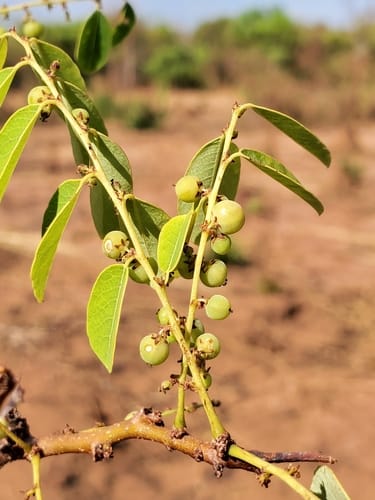
(c) feno, some rights reserved (CC BY-NC)
What to Eat
Edible parts: Fruit
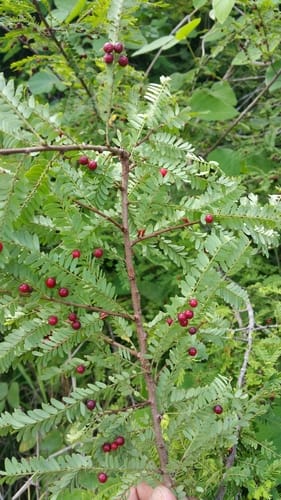
A decoction of the branches and leaves is taken as a refreshing drink. The fruits are edible and have a sour taste; they are also slightly antipyretic. They are used to make an alcoholic drink of inferior quality. The red to black fruit is a fleshy, globose berry 6 - 9mm in diameter, containing six seeds.
Where to Find It
It is a tropical plant. It grows from sea level to 1,600 m altitude.
Africa, Comoros, East Africa, Madagascar, Mauritius,
How to Identify
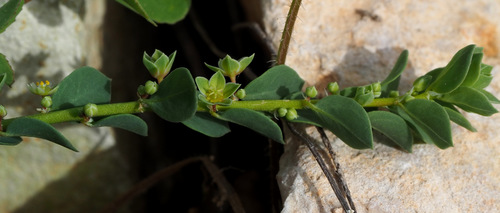
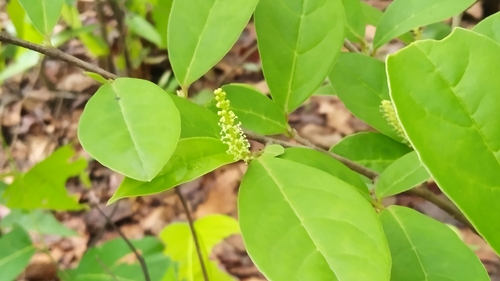
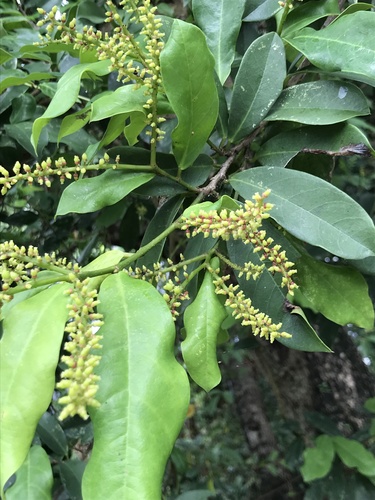
A shrub or small tree. It grows 5 m tall. The trunk can be 15 cm across. The bark is brown-grey. The twigs are hairy. The leaves are alternate. They are in 2 rows and crowded along the twigs. The leaf blade is oblong and 7-25 mm long by 3-12 mm wide. The base is unequal. The flowers are in small groups in the axils of leaves. Male and female flowers are separate. They are dark red. The fruit is a round fleshy berry. It is 6-9 mm across and is green but turn red then black. It has 6 seeds.
Medicinal Uses
In the traditional medicine of the islands of the Indian Ocean a twig, stem bark or powdered wood decoction is considered astringent and taken to treat severe diarrhoea, dysentery, amoebic dysentery, colic, ulcers, jaundice and infections of the urogenital tract. The powdered bark and the pulp of the fresh branches or crushed young leaves are applied as a poultice to treat wounds, abscesses, eczema and syphilitic ulcers. A twig decoction is gargled to treat a sore throat, toothache and infections in the mouth. A leaf decoction is drunk to treat asthma and malaria. The crushed leaves are applied topically to eczema and wounds. A leaf decoction is used to massage swollen limbs and is applied as a lotion or taken in baths to reduce oedema caused by sprains. A plant infusion is taken to induce menstruation in cases of irregular menstruation as well as for treatment of haemorrhoids and gastric ulcers. A decoction of the root is considered stimulant and is drunk to improve endurance during hard physical work, and is also used as an aphrodisiac. The root decoction is also taken to treat tiredness after severe diarrhoea, and to treat nervous depressions, syphilis and impotence. The crushed roots are applied as a poultice to furuncles and abscesses. The powdered root is applied to the forehead of children suffering from dizziness and fainting. The bark contains proanthocyanidol, saponosides and traces of terpenes. The leaves contain polyphenols, flavonoids, proanthocyanidol, steroids, 2-deoxysugars, phyllanthin, hypophyllanthin and traces of alkaloids. The flavonoids quercetin-3-O-β-D-glucopyranosyl(1–4)-α-L-rhamnopyranoside and 3,5,7,4’-tetrahydroxyflavone were isolated from the aerial parts. The roots contain the alkaloids securinine and allosecurinine.
Other Uses
The leaves are sometimes used for dyeing basketry and cloth, but the colours are not stable. The twigs are used as disinfecting toothbrushes. The twigs are used as dental sticks for keeping the teeth clean and maintaining healthy gums. The flexible branches are used in wickerwork and to make large fishing nets. The wood is used locally for fuel[.
Names & Synonyms
References (2)
- Alvarez Cruz, N.S., 2008. Phyllanthus casticum Willemet. [Internet] Record from Protabase. Schmelzer, G.H. & Gurib-Fakim, A. (Editors). PROTA (Plant Resources of Tropical Africa), Wageningen, Netherlands. < http://database.prota.org/search.htm>. Accessed 21 October 200919 October 2009.
- World Checklist of Useful Plant Species 2020. Royal Botanic Gardens, Kew