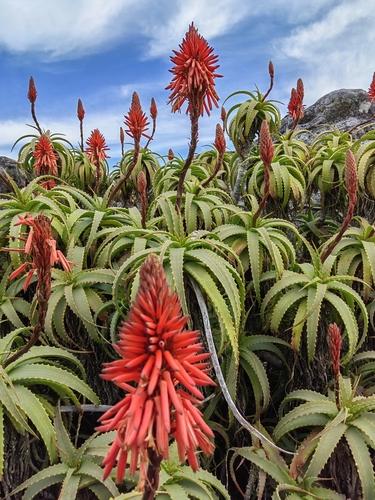
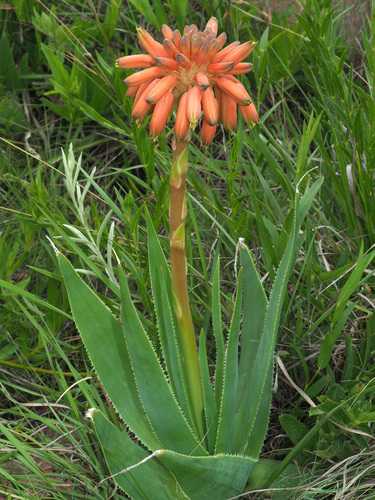
Aloe parvibracteata
Schonland

(c) Craig Peter, some rights reserved (CC BY-NC), uploaded by Craig Peter

(c) maddyo, some rights reserved (CC BY-NC)

no rights reserved, uploaded by lallen
What to Eat
Edible parts: Leaves
The fleshy leaf layer is soaked in running water to remove bitterness and then eaten as a famine food.
Known Hazards
Where to Find It
Brisbane Botanical Garden. It grows in seasonally waterlogged soils. It grows below 200 m above sea level. It can grow in arid places.
Africa, Australia, East Africa, Eswatini, Mozambique, South Africa, Southern Africa, Swaziland,
How to Identify
A herb. It keeps growing from year to year. It does not have a stem. It develops suckers to form clumps.
How to Grow
Aloe species follow the Crassulacean acid metabolism (CAM). CAM plants can fix carbon dioxide at night and photosynthesize with closed stomata during the day, thus minimizing water loss. This, plus their succulent leaves and stems, and the presence of a thick cuticle, makes them well adapted to dry conditions.
Propagation: Seed - we have no specific information on this species - in general Aloes are sown in a sandy, well-drained potting soil in a warm, shady position in standard seed trays. Germination takes about three weeks. Cover the seed with a thin layer of sand (1 - 2mm), keep moist. The seedlings can be planted out in individual bags or containers as soon as they are large enough to handle.
Medicinal Uses
The distinctive constituents in Aloe leaves are phenolic compounds, including chromone, anthraquinone or anthrone derivatives. Some of the compounds are found in many species, whereas others occur in only a few.
Other Uses
A yellow dye is obtained from the roots.
Other Information
It is a famine food.
Notes
Also put in the family Aloaceae. Also put in the family Asphodelaceae.
Names & Synonyms
Emahala, Manga
References (6)
- Fox, F. W. & Young, M. E. N., 1982, Food from the Veld. Delta Books. p 256
- Long, C., 2005, Swaziland's Flora - siSwati names and Uses http://www.sntc.org.sz/flora/
- Royal Botanic Gardens, Kew (1999). Survey of Economic Plants for Arid and Semi-Arid Lands (SEPASAL) database. Published on the Internet; http://www.rbgkew.org.uk/ceb/sepasal/internet [Accessed 24th March 2011]
- Ruiters-Welcome, A. K., 2019, Food plants of southern Africa. Ph.D. thesis. Univ. of Johannesburg p 31
- Welcome, A. K. & Van Wyk, B.-E., 2019, An inventory and analysis of the food plants of southern Africa. South African Journal of Botany 122 (2019) 136–179
- World Checklist of Useful Plant Species 2020. Royal Botanic Gardens, Kew