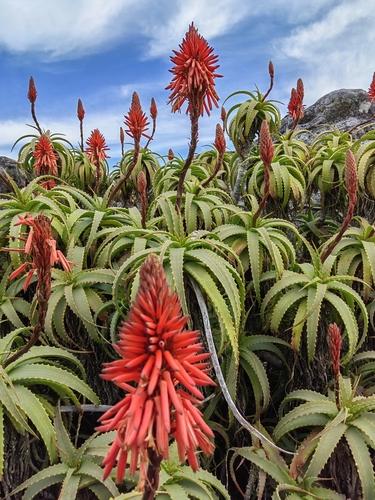
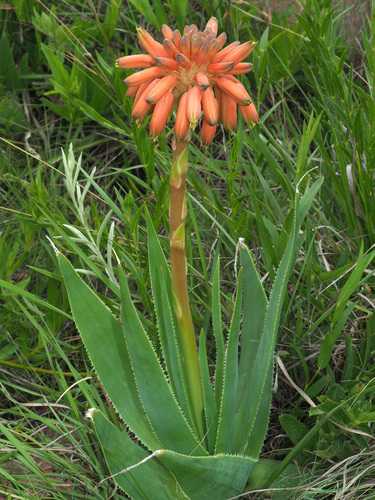
Aloe macrocarpa
Todaro
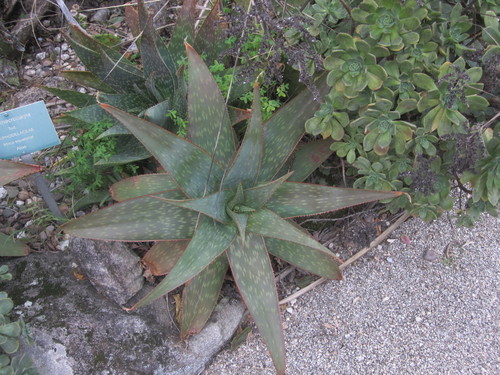
(c) Duarte Frade, some rights reserved (CC BY), uploaded by Duarte Frade
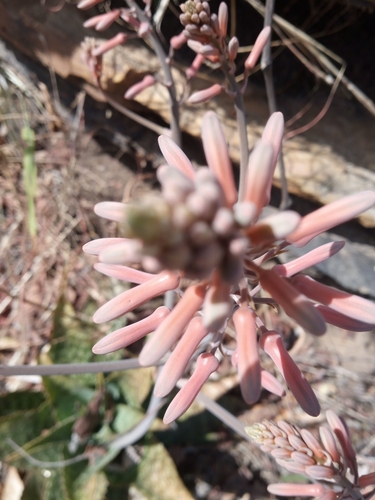
(c) malikibio, some rights reserved (CC BY-NC)
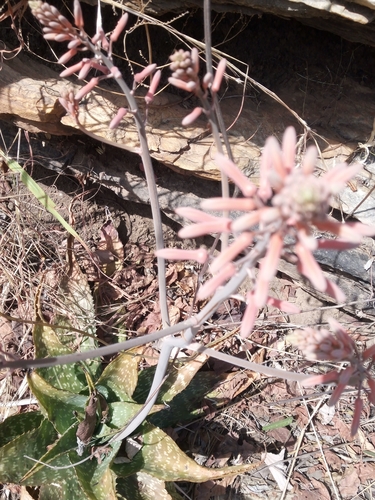
(c) malikibio, some rights reserved (CC BY-NC)
What to Eat
Edible parts: Flowers, Vegetable
The flowers and leaves are eaten as vegetables.
Known Hazards
Where to Find It
It is a tropical plant.
Africa, Benin, Burkina Faso, East Africa, Ethiopia, Nigeria, West Africa,
How to Identify
A herb that keeps growing from year to year. The leaves are fleshy and about 40 cm long. There are teeth along the edge.
How to Grow
Succeeds in light shade. Established plants are drought tolerant. Aloe species follow the Crassulacean acid metabolism (CAM). CAM plants can fix carbon dioxide at night and photosynthesize with closed stomata during the day, thus minimizing water loss. This, plus their succulent leaves and stems, and the presence of a thick cuticle, makes them well adapted to dry conditions.
Propagation: Seed - we have no specific information on this species - in general Aloes are sown in a sandy, well-drained potting soil in a warm, shady position in standard seed trays. Germination takes about three weeks. Cover the seed with a thin layer of sand (1 - 2mm), keep moist. The seedlings can be planted out in individual bags or containers as soon as they are large enough to handle. Suckers
Medicinal Uses
The leaf exudate is used medicinally. The distinctive constituents in Aloe leaves are phenolic compounds, including chromone, anthraquinone or anthrone derivatives. Some of the compounds are found in many species, whereas others occur in only a few.
Other Uses
The plant is grown along soil contours to prevent erosion.
Notes
Also put in the family Aloaceae. Also put in the family Asphodelaceae.
References (6)
- Bircher, A. G. & Bircher, W. H., 2000, Encyclopedia of Fruit Trees and Edible Flowering Plants in Egypt and the Subtropics. AUC Press. p 21 (As Aloe barteri/Aloe edulis)
- Burkill, H. M., 1985, The useful plants of west tropical Africa, Vol. 3. Kew.
- Chevalier,
- Gallagher, D. E., 2010, Farming beyond the escarpment: Society, Environment, and Mobility in Precolonial Southeastern Burkina Faso. PhD University of Michigan.
- Grubben, G. J. H. and Denton, O. A. (eds), 2004, Plant Resources of Tropical Africa 2. Vegetables. PROTA, Wageningen, Netherlands. p 559
- World Checklist of Useful Plant Species 2020. Royal Botanic Gardens, Kew