Capsicum chinense
Jacq.
Bonnet pepper, Squash pepper

(c) Stefano, some rights reserved (CC BY-NC-SA)
(c) majomendezco, some rights reserved (CC BY-NC)

(c) Brian Tun, some rights reserved (CC BY-NC)
What to Eat
Edible parts: Fruit, Vegetable
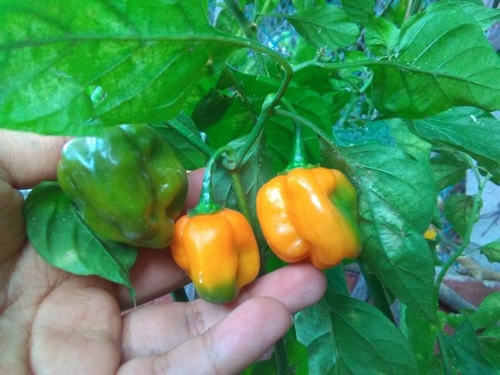
The fruits are extremely hot and pungent and are widely used as a flavouring in savoury dishes. They are well known for exceptional heat and distinctive flavour. Fruit size and shape varies considerably, from smooth, rounded forms about 6mm in diameter to wrinkled, elongated fruits up to 10cm long.
Known Hazards
Where to Find It
A tropical plant. In the Andes it grows from sea level to 1,600 m above sea level. It suits hardiness zones 10-12. They need a temperature above 4-13°C depending on cultivar. At ECHO, Florida.
Africa, Amazon, Andes, Argentina, Asia, Australia, Belize, Bolivia, Brazil, Burkina Faso, Caribbean, Central America, Colombia, Cook Islands, Cuba, Ghana, India, Jamaica, Mexico, Nicaragua, Nigeria, North America, Pacific, Peru, Puerto Rico, Sikkim, South America, USA, West Africa, West Indies,
How to Identify
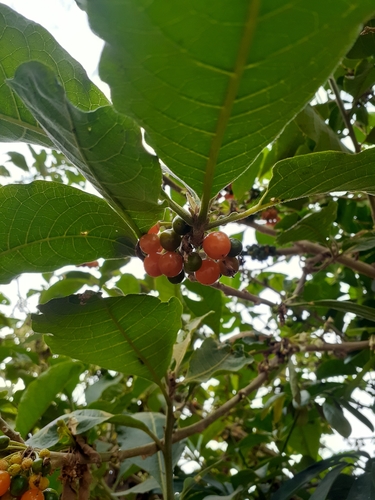
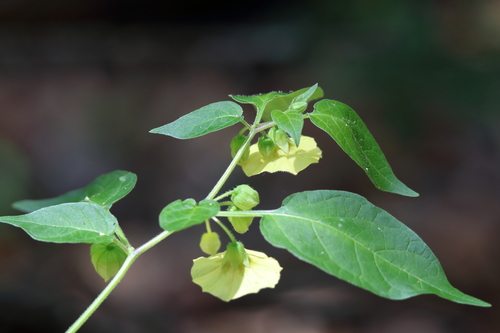
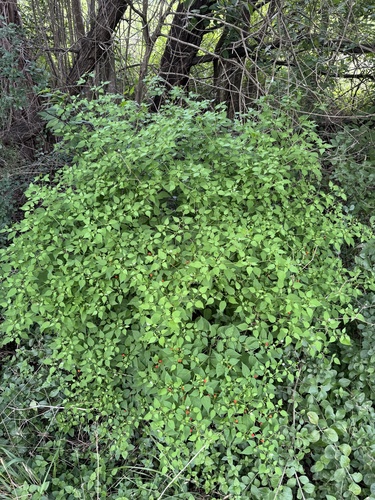
A herb. It grows 70-80 cm high. The leaves are compound. They have 3 leaflets. These are 3-5 cm long by 2.5 cm wide. The leaf is entire and unequal. The taper to the tip. The flowers occur singly or in clusters of 2. They are in the axils of leaves. The fruit are 5-7 cm long and they hang down. They look like a collapsed bell pepper. They can be red, green, orange or yellow.
How to Grow
The plant is often cultivated as an annual in the tropics and subtropics. It grows best in areas where annual daytime temperatures are within the range 20 - 26°c, but can tolerate 15 - 32°c. It is not tolerant of frosts. It succeeds with a mean annual rainfall in the range 600 - 1,250mm, but tolerates 500 - 1,500mm. Requires a very warm sunny position and a humus-rich, fertile, well-drained loam. Prefers a light sandy soil that is slightly acid. Prefers a pH in the range of 5.5 - 5.6, but tolerates 4.3 to 8.3. Another report says that it prefers a pH in the range 6 - 6.5, tolerating 5.3 - 7. When grown as an annual, the plant takes 120 - 150 days from sowing to first harvest of the fruit. There are many named varieties.
Propagation: Propagate from seed. In cooler climates this species does not usually survive winter, but it will readily germinate from the previous year's seed in the following growing season.
Medicinal Uses
The pungent fruit has tonic and antiseptic properties. It stimulates the circulatory and digestive systems, increases perspiration, irritates tissues to increase local blood supply, and reduces sensitivity to pain. Internally it is used in the treatment of the cold stage of fevers, debility in convalescence or old age, varicose veins, asthma, and digestive problems. Externally it is applied for sprains, unbroken chilblains, neuralgia, and pleurisy.
Other Uses
Capsicum chinense can be integrated into permaculture systems as a companion plant, potentially repelling pests and attracting beneficial insects. It is also grown as an ornamental for its bright, colourful fruit. The flowers produce nectar and pollen that attract pollinators including bees. Birds eat the fruit and disperse seeds, though the plant is not typically significant for shelter or nesting. Capsaicin in the fruit can deter some herbivores.
Wikipedia
Source ↗Capsicum chinense, commonly known as a "habanero-type pepper", is a species of chili pepper native to the Americas. C. chinense varieties are well known for their unique flavors and, in many cases, exceptional heat. The hottest peppers in the world are members of this species, with a Scoville heat unit score of 2.69 million measured in the C. chinense cultivar Pepper X in 2023. Some taxonomists consider C. chinense to be within the species C. annuum, and they are a member of the C. annuum complex; however, C. chinense and C. annuum pepper plants can sometimes be distinguished by the number of flowers or fruit per node – two to five for C. chinense and one for C. annuum – though this method is not always accurate. The two species can also hybridize and generate inter-specific hybrids. C. frutescens may be the ancestor to the C. chinense species.
Other Information
It is a commercially cultivated vegetable. It is a cultivated plant.
Notes
There are 10 Capsicum species.
Names & Synonyms
Aji, Aji dulce, Aji picante, Ati, Habanero, Jolokia, Pimenta-vermelha, Scotch Bonnet peppers, Yellow lantern chili
References (24)
- Brazil: Biodiversity for Food and Nutrition. http://www.b4fn.org/countries/brazil/
- Brown, D., 2002, The Royal Horticultural Society encyclopedia of Herbs and their uses. DK Books. p 154
- Burkill, H. M., 1985, The useful plants of west tropical Africa, Vol. 5. Kew.
- Castillo, R. O., 1995, Plant Genetic Resources in the Andes: Impact, Conservation, and Management. Crop Science 35:355-360
- Coe, F. G., and Anderson, G. J., 1996, Ethnobotany of the Garifuna of Eastern Nicaragua. Economic Botany 50(1) pp 71-107
- Coe, F. G. and Anderson, G. J., 1999, Ethnobotany of the Sumu (Ulwa) of Southeastern Nicaragua and Comparisons with Miskitu Plant Lore. Economic Botany Vol. 53. No. 4. pp. 363-386
- Cundall, P., (ed.), 2004, Gardening Australia: flora: the gardener's bible. ABC Books. p 327
- Esperanca, M. J., 1988. Surviving in the wild. A glance at the wild plants and their uses. Vol. 1. p 182
- Facciola, S., 1998, Cornucopia 2: a Source Book of Edible Plants. Kampong Publications, p 232
- Heiser, C.B., 1979, Peppers, in Simmonds, N.W., (ed), Crop Plant Evolution. Longmans. London. p 265
- Herklots,
- Hermandez Bermejo, J.E., and Leon, J. (Eds.), 1994, Neglected Crops. 1492 from a different perspective. FAO Plant Production and Protection Series No 26. FAO, Rome. p 13
- Hort. bot. vindob. 3:38, t. 67. 1777
- Kays, S. J., and Dias, J. C. S., 1995, Common Names of Commercially Cultivated Vegetables of the World in 15 languages. Economic Botany, Vol. 49, No. 2, pp. 115-152
- Kiple, K.F. & Ornelas, K.C., (eds), 2000, The Cambridge World History of Food. CUP p 1714, 1783
- Macmillan, H.F. (Revised Barlow, H.S., et al), 1991, Tropical Planting and Gardening. Sixth edition. Malayan Nature Society. Kuala Lumpur. p 376
- Roa, J. A. G. & Boada, D. S. G., 2018, Fundación para el Fortalecimiento de la Fruticultura y Plantas Alimenticias no Convencionales en Colombia.
- Samuels, J., 2015, Biodiversity of Food Species of the Solonaceae Family: A Preliminary Taxonomic Inventory of Subfamily Solanoideae. Resources 2015, 4. 277-322
- Seidemann J., 2005, World Spice Plants. Economic Usage, Botany, Taxonomy. Springer. p 83
- Small, E., 2009, Top 100 Food Plants. The world's most important culinary crops. NRC Research Press. p 177
- Torre, de la, L., et al, 2008, Enciclopedia de las Plantas Útiles del Ecuador. Herbario QCA. Pontificia Universidad Católica del Ecuador. p 581
- Vasquez, Roberto Ch. & Coimbra, German S., 1996, Frutas Silvestres Comestibles de Santa Cruz. p 220
- Wiersema, J. H. & Leon, B., 2013, World Economic Plants. A Standard Reference CRC Press. 2nd Ed. p 141
- World Checklist of Useful Plant Species 2020. Royal Botanic Gardens, Kew