Aloe nuttii
Baker
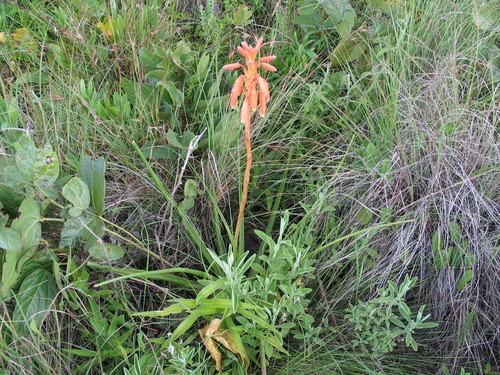
(c) Berit Gehrke, some rights reserved (CC BY-NC), uploaded by Berit Gehrke
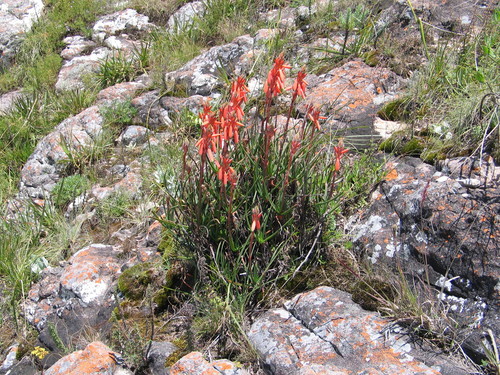
(c) Berit Gehrke, some rights reserved (CC BY-NC), uploaded by Berit Gehrke

(c) Bart Wursten, some rights reserved (CC BY-NC)
What to Eat
Edible parts: Flowers, Vegetable
Flowers - cooked and eaten as a vegetable. The mature flowers are washed and cooked alone or with other vegetables such as peas or pumpkin leaves. Then either cooking oil, coconut milk or groundnut paste is added and the dish eaten with ugali or rice.
Known Hazards
Where to Find It
It is a tropical plant. In Tanzania it grows in mountain grassland often on rocky slopes. It grows between 1,600-2,700 m above sea level.
Africa, Angola, Central Africa, Congo, East Africa, Malawi, Tanzania, Zambia,
How to Identify
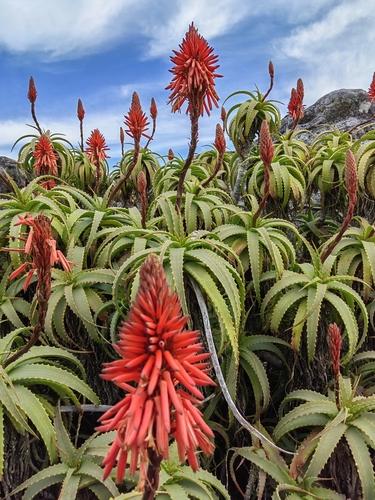
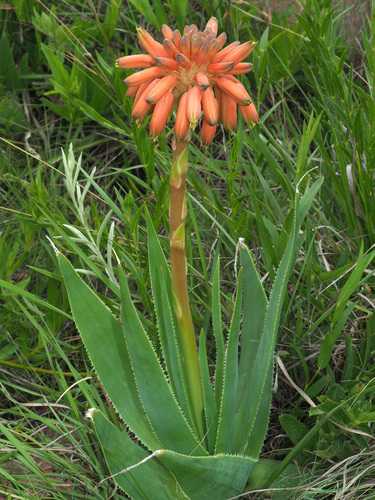
A herb. It has a short thick stem. This is 20 cm long and 3 cm thick. It can have 3 rings of leaves at the base. The leaves are erect and bright green. They are 50 cm long by 8 cm wide. The upper surface is concave. There are white spots underneath. The edges of the leaves have small white teeth about 1 mm long. The flowers are in a spike about 75 cm long. There are large bracts that are orange to brown. These wrap around the stem. The flowers are near each bract. The fruit is an oval capsule. It is pale brown and 2.5 cm long. There are many dark brown seeds.
How to Grow
It can be grown by seeds or suckers.
Propagation: Seed - we have no specific information on this species - in general Aloes are sown in a sandy, well-drained potting soil in a warm, shady position in standard seed trays. Germination takes about three weeks. Cover the seed with a thin layer of sand (1 - 2mm), keep moist. The seedlings can be planted out in individual bags or containers as soon as they are large enough to handle. Suckers.
Medicinal Uses
A decoction of the leaves is drunk in the treatment diarrhoea. The leaves are also used to treat heart pains and spleen problems. The juice of leaves is rubbed on the skin to treat ringworm. The roots are boiled, honey added and the decoction drunk as a treatment for kidney problems and as an aphrodisiac. The distinctive constituents in Aloe leaves are phenolic compounds, including chromone, anthraquinone or anthrone derivatives. Some of the compounds are found in many species, whereas others occur in only a few.
Wikipedia
Source ↗Aloe nuttii is a species of aloe native to Tanzania and neighboring countries. It is an erect perennial herb with bright green grass-like leaves, 50 cm (20 in), which produces a flower spike up to 75 cm (30 in) long with tubular flowers somewhere in the orange-red or pink region of the color spectrum. The mature flowers are cooked and used as a vegetable, often in combination with peas or pumpkin leaves.
Production
Flowers are collected at the end of the rainy season.
Notes
Also put in the family Aloaceae. Also put in the family Asphodelaceae.
Names & Synonyms
Ikori, Ikuri, Iratune, Itembwe, Kidingulio, Kongokowe, Kisimamleo, Litembwetembwe, Mshumbili, Msubili
References (2)
- Grubben, G. J. H. and Denton, O. A. (eds), 2004, Plant Resources of Tropical Africa 2. Vegetables. PROTA, Wageningen, Netherlands. p 559
- Ruffo, C. K., Birnie, A. & Tengnas, B., 2002, Edible Wild Plants of Tanzania. RELMA p 120