Dioscorea deltoidea
Wall. ex Griseb.
Nepal yam

(c) Ramnarayan K, some rights reserved (CC BY), uploaded by Ramnarayan K

(c) Ramnarayan K, some rights reserved (CC BY)
What to Eat
Edible parts: Root, Tuber, Bulbils
The tuber is eaten cooked and has a slightly bitter flavour. It is usually boiled with some wood ash to remove the bitterness. Some caution is advised given the plant's toxicity and its other uses related to the root.
Known Hazards
Where to Find It
A tropical and subtropical plant. It grows in broad leafed forest between 2000 and 3100 m altitude in Southern China. They grow throughout Nepal from 300-3000 m altitude. They grow in moist open places. In Yunnan.
Asia, Bhutan, China, Himalayas, India, Indochina, Indonesia, Myanmar, Nepal, Northeastern India, Pakistan, SE Asia, Sikkim, Thailand, Vietnam,
How to Identify
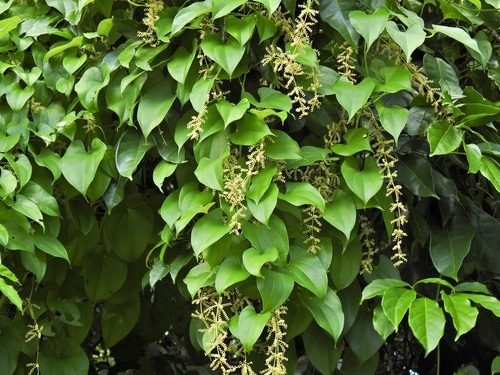
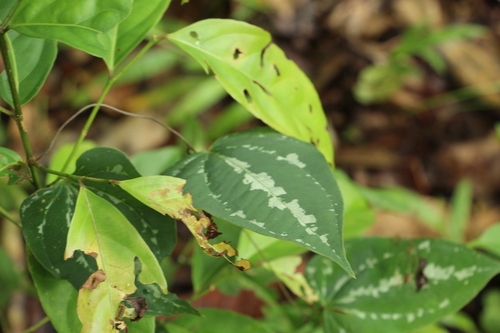
A yam. It is a climbing herb. The rhizome lies horizontal and is ginger shaped. It is 1.2-1.5 cm thick. The stem winds left. The leaves are alternate. They are 6-12 cm long by 5.5-10 cm wide. They are broadly oval to heart shaped. They are long pointed. There are 5-7 veins. The male flowers are single, small and white. The female flowers are single and slender. The fruit is a capsule.
How to Grow
We have very little information on this species and do not know if it will be hardy in Britain. It is unlikely to succeed in any but the mildest areas. It is cultivated for its edible root in India. The following notes are based on the general needs of the genus. Easily grown in a fertile well-drained soil in a sunny position or light shade. Prefers a rich light soil. Plants produce tubercles (small tubers that are formed in the leaf axils of the stems), and can be propagated by this means. A climbing plant that supports itself by twining around the branches of other plants. Dioecious. Male and female plants must be grown if seed is required.
Propagation: Sow seed in March to April in a sunny position in a warm greenhouse, just barely covered. Germination takes 1–3 weeks at 20°C. Prick out seedlings as soon as they are large enough to handle and grow on in the greenhouse for their first year. Plant out in late spring as new growth begins. Basal stem cuttings can be taken in summer. Divide in the dormant season only — never when in growth. The plant often produces multiple shoots; the top 5–10cm of root beneath each shoot can be potted up to form a new plant, while the lower portion may be eaten. Tubercles forming in the leaf axils are harvested in late summer to early autumn when approximately pea-sized and detaching easily. Pot them up immediately into individual containers in a greenhouse or cold frame, then plant out in early summer when in active growth.
Medicinal Uses
Root juice is taken in the evening to treat roundworm and is also used to alleviate constipation. The roots, like those of most or all members of this genus, contain diosgenin, which is widely used in modern medicine to manufacture progesterone and other steroid drugs. These are employed as contraceptives and in treating disorders of the genital organs, as well as conditions such as asthma and arthritis. The roots of this species contain an average of 4.8% diosgenin.
Other Uses
A soap is obtained from the tuber, derived from the poisonous saponins present in the root. This soap is also used as a body wash to kill lice.
Wikipedia
Source ↗Dioscorea deltoidea, the Nepal yam, is a species of flowering plant in the family Dioscoreaceae. Its native range is the Himalayas through to south-central China and mainland Southeast Asia. Its tubers contain diosgenin and are harvested by local peoples as a treatment for a variety of conditions, including gastrointestinal disorders and intestinal worms. Tubers are also eaten after boiling, washing, and baking. It grows in forests and humus-rich soils.
Other Information
It is sold in local markets.
Names & Synonyms
Aruwa, Ban tarul, Bhyakur, Bloin, Eghen ngenki, Gun, Gune kauro, Kamanduki, Kande vyakur, Keerish, Kencheong sangrik, Kildri, Kins, Kithi, Kitra, Kniss, Krish, Kriss, Kui goi, Kukur tarul, Kurkurtarul, Kurukanda, Luanba, Peng-khe, Ridme, Rua ba, San jiao ye shu yu, Saplokha, Singli mingli, Tar, Tarul, Tarur, Temee, Thaphu miyung, Vaykur, Vyakur
References (44)
- Ambasta, S.P. (Ed.), 2000, The Useful Plants of India. CSIR India. p 174
- Abbasi, A. M., et al, 2013, Ethnobotanical appraisal and cultural values of medicinally important wild edible vegetables of Lesser Himalayas-Pakistan. Journal of Ethnobiology and Ethnomedicine 9:66
- Acharya K. P. and Acharya, R., 2010, Eating from the Wild: Indigenous knowledge on wild edible plants in Parroha VDC of Rupandehi District, Central Nepal. International Journal of Social Forestry. 3(1):28-48
- Aryal, K. P. et al, 2009, Uncultivated Plants and Livehood Support - A case study from the Cheopang people of Nepal. Ethnobotany Research and Applications. 7:409-422
- Aryal, K. P., et al, 2018, Diversity and use of wild and non-cultivated edible plants in the Western Himalaya. Journal of Ethnobiology and Ethnomedicine (2018) 14:10
- Bahuguna, A. et al, 2010, Floristic Diversity and Indigenous uses of Forest Vegetation of Dabka Watershed in Indian Central Himalayas. Ethnobotanical Leaflets 14:491-510
- Balkrishna, A., et al, 2022, Indigenous Uses of Plants among Forest-dependent Communities of Seijosa, Arunachal Pradesh. International Journal of Economic Plants 2022, 9(1):064-080
- Bastakoti, R., et al, 2008, Food Insecurity and dependency of Chepang Communities on Wild Edible Plants. Sustainable Forest Management and Poverty Alleviation: Roles of Traditional Forest-related Knowledge IUFRO World Series Volume 21
- Bhandari. M. R. & Kawabata, J., 2005, Bitterness and Toxicity in Wild Yam (Dioscorea spp.) Tubers of Nepal. Plant Foods for Human Nutrition. 60:129-135
- Bhandari, M. R., Kasi, T. and Kawabata, J., 2003, Nutritional evaluation of wild yam (Dioscorea spp.) tubers of Nepal. Food Chemistry 82:619-623
- BHARGAVA,
- Chi, V. L. et al, 2007 , Root and Tuber Crops in Vietnam: Focus on yam germplasm. Ethnobotany Research and Applications. 5:259-272
- Coursey, D.G., 1979, Yams, in Simmonds N.W.,(ed), Crop Plant Evolution. Longmans. London. p 70
- Dangol, D. R. et al, 2017, Wild Edible Plants in Nepal. Proceedings of 2nd National Workshop on CUAOGR, 2017.
- Ding Zhizun, Gilbert, M. G., DIOSCOREACEAE, shu yu ke, Flora of China,
- Dutta, B., 2015, Food and medicinal values of certain species of Dioscorea with special reference to Assam. Journal of Pharmacognosy and Phytochemistry. 3(4): 15-18
- Flora of Pakistan www.eFloras.org
- Gautam, R. S., et al, 2022, Ethnobotanical Review of Wild Edible Plants of Nepal. Journal of Natural History Museum Volume 32, 2021-22 p 112
- Geng, Y., et al, 2016, Traditional knowledge and its transmission of wild edibles used by the Naxi in Baidi Village, northwest Yunnan province. Journal of Ethnobiology and Ethnomedicine. 12:10
- Ghimire, S. K., et al, 2008, Non-Timber Forest Products of Nepal Himalaya. WWF Nepal p 57
- Ghosh, C. & Das A. P., 2011, Some useful and poisonous tea garden weeds from the Darjiling District of West Bengal, India. Pleione 5(1): 91 - 114
- GUPTA,
- Hedrick, U.P., 1919, (Ed.), Sturtevant's edible plants of the world. p 273
- Jha, P. K., et al, 1996, Plant genetic resources of Nepal: A guide for plant breeders of agricultural, horticultural and forestry crops. Euphytica 87:189-210
- Joshi, N., et al, 2007, Traditional neglected vegetables of Nepal: Their sustainable utilization for meeting human needs. Tropentag 2007. Conference on International Agricultural Research for Development.
- Khakurel, D., et al, 2021, Foods from the wild: Local knowledge, use pattern and distribution in Western Nepal. PLOS ONE.
- Lim, T. K., 2015, Edible Medicinal and Non Medicinal Plants. Volume 9, Modified Stems, Roots, Bulbs. Springer p 34
- Manandhar, N.P., 2002, Plants and People of Nepal. Timber Press. Portland, Oregon. p 202
- C. F. P. Martius, Fl. bras. 3(1):43, in nota. 1842 (Kunth, Enum. pl. 5:340. 1850)
- Masoodi, H. U. R. & Sundriyal, R. C., 2020, Richness of non-timber forest products in Himalayan communities—diversity, distribution, use pattern and conservation status. Journal of Ethnobiology and Ethnomedicine 16:56
- Medhi, P., Sarma, A and Borthakur, S. K., 2014, Wild edible plants from the Dima Hasao district of Assam, India. Pleione 8(1): 133-148
- Mehta, P. S. et al, 2010, Native plant genetic resources and traditional foods of Uttarakhand Himalaya for sustainable food security and livelihood. Indian Journal or Natural products and Resources. Vol 1(1), March 2010 pp 89-96
- Miya, M. S. & Gautum, D., 2021, Checklist of floral species at the Institute of Forestry, Pokhara Campus, Pokhara, Nepal. Journal of Institute of Forestry, Nepal 18 (2021) 133-177
- Murtem, G. & Chaudhrey, P., 2016, An ethnobotanical note on wild edible plants of Upper Eastern Himalaya, India. Brazilian Journal of Biological Sciences, 2016, v. 3, no. 5, p. 63-81
- Negi, K.S., 1988, Some little known wild edible plants of U.P. Hills. J. Econ. Tax. Bot. Vol. 12 No. 2 pp 345-360
- Plants for a Future database, The Field, Penpol, Lostwithiel, Cornwall, PL22 0NG, UK. http://www.scs.leeds.ac.uk/pfaf/
- Savita, et al, 2006, Studies on wild edible plants of ethnic people in east Sikkim. Asian J. of Bio Sci. (2006) Vol. 1 No. 2 : 117-125
- Thapa, L. B., et al, 2014, Wild Edible Plants used by endangered and Indigenous Raji Tribe in Western Nepal. International Journal of Applied Sciences and Biotechnology. Vol 2(3):243-252
- Toppo, P. et al, 2016, Wild edible plants of Dhamtari district of Chhattisgarh, India. Van Sangyan Vol. 3, No. 4
- Tsering, J., et al, 2017, Ethnobotanical appraisal on wild edible plants used by the Monpa community of Arunchal Pradesh. Indian Journal of Traditional Knowledge. Vol 16(4), October 2017, pp 626-637
- Uprety, Y., et al, 2011, Plant biodiversity and ethnobotany inside the projected impact area of the Upper Seti Hydropower Project, Western Nepal. Environ. Dev. Sustain. (2011) 13:463-492
- Uprety, Y., et al, 2012, Diversity of use and local knowledge of wild edible plant resources in Nepal. Journal of Ethnobotany and Ethnomedicine 8:16
- Uprety, Y., et al, 2016, Traditional use and management of NTFPs in Kangchenjunga Landscape: implications for conservation and livelihoods. Journal of Ethnobiology and Ethnomedicine (2016) 12:19
- Zhang, L., et al, 2015, Ethnobotanical survey of medicinal dietary plants used by the Naxi People in Lijiang Area, Northwest Yunnan, China. Journal of Ethnobiology and Ethnomedicine (2015) 11:40