Dioscorea membranacea
Pierre ex Prain & Burkill
DioscoreaceaeRoots

gbif · cc-by
Royal Botanic Gardens, Kew
Royal Botanic Gardens, Kew

gbif · cc-by
Royal Botanic Gardens, Kew
Royal Botanic Gardens, Kew

gbif · cc-by
Royal Botanic Gardens, Kew
Royal Botanic Gardens, Kew
What to Eat
Edible parts: Tuber, Root, Rhizome
The tuber, root, and rhizome are edible; rhizome sections 10–16 cm long are used for cultivation and consumption. It serves as a famine food.
Where to Find It
It is a tropical plant.
Asia, Indochina, Laos, Myanmar, SE Asia, Thailand, Vietnam,
Countries: United Arab Emirates, Afghanistan, Armenia, Azerbaijan, Bangladesh, Bahrain, Brunei, Bhutan, China, Georgia, Indonesia, Israel, India, Iraq, Iran, Jordan, Japan, Kyrgyzstan, Cambodia, North Korea, South Korea, Kuwait, Kazakhstan, Laos, Lebanon, Sri Lanka, Myanmar, Mongolia, Maldives, Malaysia, Nepal, Oman, Philippines, Pakistan, Qatar, Saudi Arabia, Singapore, Syria, Thailand, Tajikistan, Timor-Leste, Turkmenistan, Turkey, Taiwan, Uzbekistan, Vietnam, Yemen
How to Identify
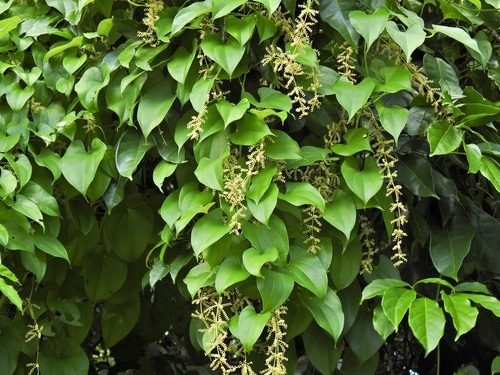
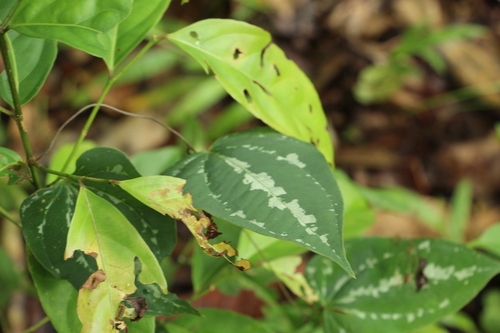
A yam. The vine climbs 10 m tall. The rhizome is 4-8 cm long by 1-5 cm wide. It is branching and spreading. The vine twines to the left. The leaves have a 3-5 pointed lobes. The leaves are simple and alternate. The leaf stalks are 2-13 cm long.
How to Grow
Sections of the rhizome 10-16 cm long are used.
Medicinal Uses
Used as a medicine and investigated as an anticancer plant.
Other Information
It is a famine food and a medicine.
Notes
It is used as an anticancer plant.
Names & Synonyms
Chatong, Hua-khao-yen
References (3)
- Lim, T. K., 2015, Edible Medicinal and Non Medicinal Plants. Volume 9, Modified Stems, Roots, Bulbs. Springer p 36
- Mareenoon, K. et al, 2008, Ethnobotany of Dioscorea L. (Dioscoreaceae), a Major Food Plant of the Sakai Tribe at Banthad Range, Peninsular Thailand. Ethnobotany Reaearch & Applications 6:385-394
- Saekoo, J. et al, 2010, Cytotoxic effect and its mechanism of dioscorealide B from Disocorea membranacea against breast cancer cells. J. Med. Assoc. Thai. 2010 Dec.:93 Suppl. 7:S277-83