Asphodelus ramosus
L.
Branched asphodel
(c) Dmitry Ivanov, some rights reserved (CC BY-NC), uploaded by Dmitry Ivanov

(c) Drepanostoma, some rights reserved (CC BY), uploaded by Drepanostoma
What to Eat
Edible parts: Roots, Caution, Medicine
The bulbs can be cooked and eaten.
Known Hazards
Where to Find It
It is a Mediterranean climate plant. It grows on dry meadows and rocky places.
Africa, Albania, Canary Islands, Europe, Italy, Mediterranean, North Africa, Sicily, Spain,
How to Identify
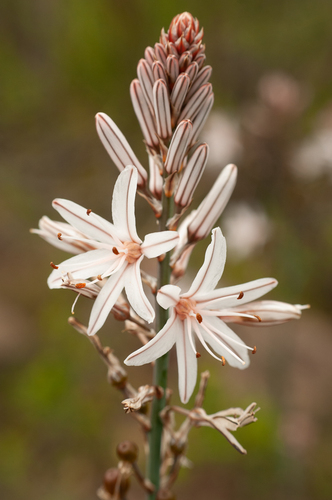
A herb. The stem is highly branched. It grows 60-80 cm tall. It has an underground storage organ. The flowers are white with a brown streak The fruit are small round capsules.
Medicinal Uses
Some traditional folk usages of the plant have been to make a glue from the plant's root. A remedy against warts is also derived from its root. According to Dioscorides, a concoction made from its roots (mixed with wine) induces vomiting. Formerly, the entire plant was used in treating venomous snake bites (its efficacy yet to be proven scientifically).
Wikipedia
Source ↗Asphodelus ramosus, the branched asphodel, is a perennial herbaceous plant in the order Asparagales. Similar in appearance to Asphodelus albus and particularly Asphodelus cerasiferus and Asphodelus aestivus, it may be distinguished by its highly branched stem and smaller fruits. There has been a lot of confusion over the nomenclature and taxonomy of the species, owing to its similarity to Asphodelus aestivus. Asphodelus ramosus is native to the Mediterranean region of southern Europe, northern Africa, and the Middle East. It can also be found in the Canary Islands. It is particularly common in coastal areas of the Mediterranean with intensive grazing and occasional fire. In some areas it shows an affinity for acidic soils, mainly schist. It can form abundant colonies, usually flowering in February to May. It has been thought to be Homer's asphodel of the underworld, but so has the closely related Asphodeline lutea. The branched asphodel is known to contain colchicine, a chemical used in the treatment of gout.
Names & Synonyms
Arvuzzi ramusi, Avuzze, Gamon, Parrazzu
References (5)
- Biscotti, N. et al, 2018, The traditional food use of wild vegetables in Apulia (Italy) in the light of Italian ethnobotanical literature. Italian Botanist 5:1-24
- Blanco-Salas, J., et al, 2019, Wild Plants Potentially Used in Human Food in the Protected Area “Sierra Grande de Hornachos” of Extremadura (Spain). Sustainability 2019, 11, 456
- Geraci, A., et al, 2018, The wild taxa utilized as vegetables in Sicily (Italy): a traditional component of the Mediterranean diet. Journal of Ethnobiology and Ethnomedicine (2018) 14:14
- Licata, M., et al, 2016, A survey of wild plant species for food use in Sicily (Italy) – results of a 3-year study in four Regional Parks. Journal of Ethnobiology and Ethnomedicine 12:12
- Pasta, S., et al, 2020, An Updated Checklist of the Sicilian Native Edible Plants: Preserving the Traditional Ecological Knowledge of Century-Old Agro-Pastoral Landscapes. Frontiers in Plant Science. Volume 11|Article 388