Uapaca acuminata
(Hutch.) Pac & K. Hoffm.
Odan

Christ Kombil, West & Central Africa programme

Christ Kombil, West & Central Africa programme

Christ Kombil, West & Central Africa programme
What to Eat
Edible parts: Fruit
We do not have specific information for this species, but the fruits of many members of this genus are edible, generally sweet and juicy. The more or less ellipsoid fruit is 20 - 25mm long and 18 - 20mm wide, containing 3 seeds.
Where to Find It
It is a tropical plant. It grows in the rainforest. It grows up to 200 m above sea level.
Africa, Angola, Cabinda, Cameroon, Congo DR, Congo R, Gabon, Nigeria, West Africa,
How to Identify
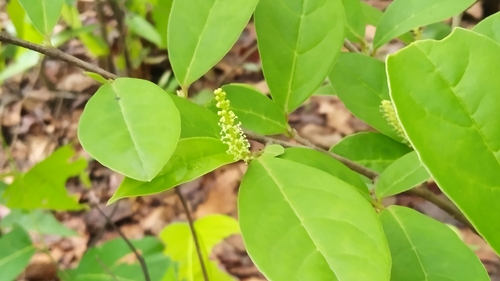
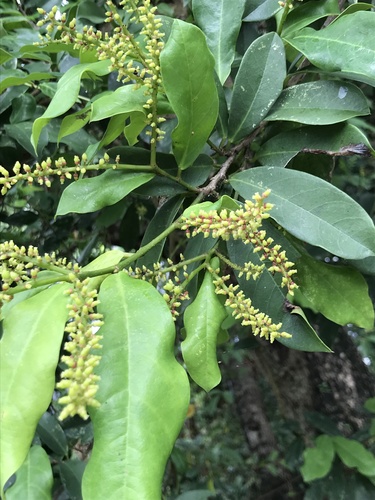
A tree. It grows 25 m tall. The trunk is 80 cm across. It has stilt roots 6 m tall. Trees are separately male and female. The fruit are round and 1.5 cm across.
How to Grow
A dioecious species, both male and female forms need to be grown if fruit and seed are required.
Other Uses
We do not have a specific description for the wood of this species. However, a general description for the wood of the West African, stilt-rooted members of this genus is as follows:- The heartwood is a pale red, red-brown, or chocolate-brown; it is usually not clearly demarcated from the paler sapwood. The texture is mostly medium to coarse; the grain generally straight; there is little lustre. The heartwood ranges from moderately durable to highly so, and is moderately resistant to termite attack. Generally care is required in seasoning, best results are obtained if quartersawn, logs should be converted soon after extraction to minimize shake and checking. The wood saws with some difficulty due to a high silica content, it generally finishes well and glues satisfactorily. It is used for purposes such as light construction, boatbuilding, flooring. A good fuel and charcoal wood.
Names & Synonyms
References (1)
- Burkill, H. M., 1985, The useful plants of west tropical Africa. Vol.2