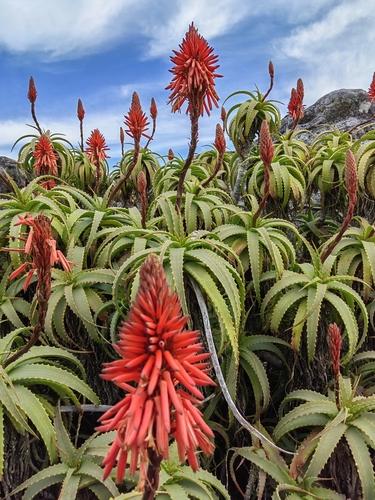
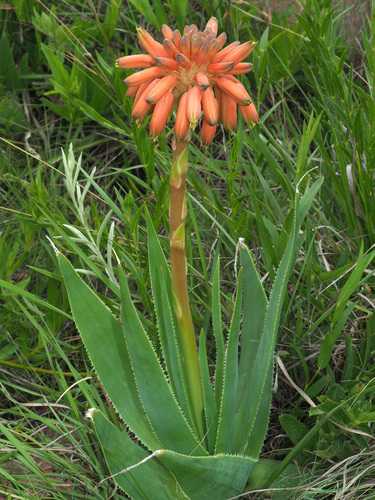
Aloe vossii
Reynolds
XanthorrhoeaceaeLeaves

iNaturalist · cc-by-nc
(c) Duncan McKenzie, some rights reserved (CC BY-NC), uploaded by Duncan McKenzie
(c) Duncan McKenzie, some rights reserved (CC BY-NC), uploaded by Duncan McKenzie

iNaturalist · cc-by-nc
(c) Duncan McKenzie, some rights reserved (CC BY-NC)
(c) Duncan McKenzie, some rights reserved (CC BY-NC)
What to Eat
Edible parts: Leaves - vegetable
The leaves are eaten as a vegetable.
Where to Find It
It is a subtropical plant.
Africa, South Africa, Southern Africa,
Countries: Angola, Burkina Faso, Burundi, Benin, Botswana, Congo (DRC), Central African Republic, Congo (Republic), Cote d'Ivoire, Cameroon, Cape Verde, Djibouti, Algeria, Egypt, Eritrea, Ethiopia, Gabon, Ghana, Gambia, Guinea, Equatorial Guinea, Guinea-Bissau, Kenya, Comoros, Liberia, Lesotho, Libya, Morocco, Madagascar, Mali, Mauritania, Mauritius, Malawi, Mozambique, Namibia, Niger, Nigeria, Rwanda, Seychelles, Sudan, Sierra Leone, Senegal, Somalia, South Sudan, Sao Tome & Principe, Eswatini, Chad, Togo, Tunisia, Tanzania, Uganda, South Africa, Zambia, Zimbabwe
How to Identify
A succulent herb without a stem. It grows 40-50 cm tall. There are 14-20 leaves in a ring. They are 25-50 cm long by 1-3 cm wide. There are teeth along the edge.
Wikipedia
Source ↗Aloe vossii is a plant that belongs to the genus Aloe that is part of the Asphodelaceae family. The species is endemic to the Soutpansberg in Limpopo.
Notes
Also put in the family Asphodelaceae.
Names & Synonyms
Tshikhopha
References (3)
- Magwede, K., van Wyk, B.-E., & van Wyk, A. E., 2019, An inventory of Vhavenḓa useful plants. South African Journal of Botany 122 (2019) 57–89
- Ruiters-Welcome, A. K., 2019, Food plants of southern Africa. Ph.D. thesis. Univ. of Johannesburg p 31
- Welcome, A. K. & Van Wyk, B.-E., 2019, An inventory and analysis of the food plants of southern Africa. South African Journal of Botany 122 (2019) 136–179