Cycas pectinata
Buch.-Ham.

(c) brewbooks, some rights reserved (CC BY-SA)

(c) tian yake, some rights reserved (CC BY-NC-ND)
What to Eat
Edible parts: Leaves, Fruit, Stem-starch, Shoots, Seeds
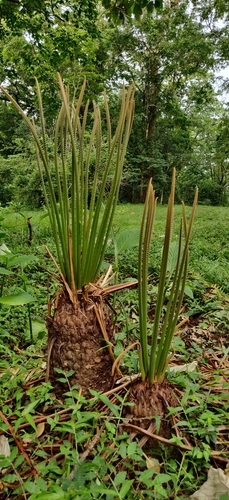
The tender leaves, shoots, and seeds are eaten; shoots are cooked as a vegetable by frying or boiling and can be stored for 15 days. Starch is also extracted from the stem.
Known Hazards
Where to Find It
A tropical plant. In Nepal they are grown between 500 and 1400 m altitude. In XTBG Yunnan.
Asia, Australia, Bangladesh, Bhutan, Cambodia, China, Himalayas, India, Indochina, Laos, Malaysia, Myanmar, Nepal, Northeastern India, SE Asia, Sikkim, Thailand, Vietnam,
How to Identify
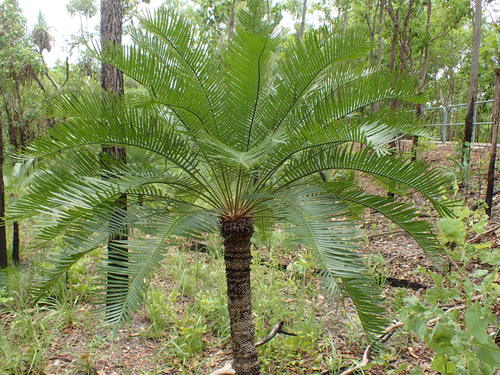
A small cycad. It is a palm like plant. It grows 2 m tall. The trunk is unbranched. The leaves occur in a ring near the top. The leaves have leaflets along the stalk. The leaflets are 20 cm long by 1.5 cm wide. They are stiff and leathery. Male and female flowers are on separate plants. Male cones are oval and erect and central. The female cones are a cluster of round woody fruits below the top of the plant. The fruit are on long stalks. The seeds are 3-4 cm long. They are orange. They are covered by upward turning scaly blades.
How to Grow
Plants are grown from offshoot buds.
Propagation: Seeds - best sown as soon as they are ripe, though the seeds of many species will take a few months to finish maturing the embryo before they are ready to germinate. Sow the seeds in a tray in a freely-draining medium and place in moderate shade. Bottom heat at about 27°c will hasten seed germination dramatically. Young roots are quite brittle and once germination takes place, the root grows rapidly. It is important to pot up the seedlings at this time in order to give them enough root-space. Grow on the plants in pots until large enough to plant out. Division of off-sets or suckers is best carried out just before the plant comes in to new growth at the start of the growing season.
Medicinal Uses
The pounded stem is used as a hair-wash for treating diseased hair roots. This species is said to have the same uses as Cycas rumphii. These uses are as follows:- The pollen is narcotic. The bark and the seeds are ground to a paste with oil and used as a poultice on sores and swellings. The juice of tender leaves is useful in the treatment of flatulence and vomiting.
Other Uses
The fleshy stem is pounded and used as a hair wash. This species is said to have the same uses as Cycas rumphii. These uses are as follows:- The bark sap is used as a glue. The fruits are strung together to make children's toys or rattles.
Wikipedia
Source ↗Cycas pectinata was the fourth species of Cycas to be named; it was described in 1826 by Scottish surgeon and botanist Francis Buchanan-Hamilton from Kamrup, Assam in northeast India. The species is one of the most widespread cycads. It is found in the northeastern part of India (Assam, Manipur, Meghalaya, Sikkim, Darjeeling), Nepal, Bhutan, northern Burma, southern China (Yunnan), Bangladesh, Burma, Malaysia, Cambodia, northern Thailand, Laos, and Vietnam. Cycas pectinata usually grow at elevation 300 m to 1200 m and in difficult terrains. In China, it grows in dry, open thickets in limestone mountains, red soil in sparse monsoon forests. Cycas pectinata grows up to 40 feet (12 m) tall and has very large, ovoid male cones. The tallest Cycas pectinata is a female plant in North Kamrup, Assam which measures 52.8 feet (16.1 m). The tree is the world's tallest Cycas plant. In Northeast India, the species is under severe threat due to clearing of forest and overcollection of male cones for preparation of traditional medicines. The species is listed in CITES Appendix II and IUCN Redlist.
Production
In Sikkim fruit are available December to January.
Other Information
The leaves are sold in markets.
Notes
There are about 20-40 Cycas species.
Names & Synonyms
Da gu, Daqu, Dezhe, Dieng-sia-goda, Guo gu, Hmab ntshav ciaj, Maprao-dao-luang, Mondaing madai, Nagehampa, Or-oh, Pagula, Tanglu, Thakal, Thaljimura, Thulo nyuro, Yendang
References (30)
- Ambasta, S.P. (Ed.), 2000, The Useful Plants of India. CSIR India. p 153
- Burkill, I.H., 1966, A Dictionary of the Economic Products of the Malay Peninsula. Ministry of Agriculture and Cooperatives, Kuala Lumpur, Malaysia. Vol 1 (A-H) p 731
- Cao, Y., et al, 2020, Ethnobotanical study on wild edible plants used by three trans-boundary ethnic groups in Jiangcheng County, Pu’er, Southwest China. Journal of Ethnobiology and Ethnomedicine (2020) 16:66
- Devi, O.S., P. Komor & D. Das, 2010, A checklist of traditional edible bio-resources from Ima markets of Imphal Valley, Manipur, India. Journal of Threatened Taxa 2(11): 1291-1296
- Devi, O. S., et al, 2021, Wild edible plants associated with the people of Thoubal Khunou village and its migrated villagers. Int. J. Adv. Res. Biol. Sci. 8(9): 72-90
- Dobriyal, M. J. R. & Dobriyal, R., 2014, Non Wood Forest Produce an Option for Ethnic Food and Nutritional Security in India. Int. J. of Usuf. Mngt. 15(1):17-37
- Dutta, U., 2012, Wild Vegetables collected by the local communities from the Churang reserve of BTD, Assam. International Journal of Science and Advanced Technology. Vol. 2(4) p 120
- Gangte, H. E., et al, 2013, Wild Edible Plants used by the Zou Tribe in Manipur, India. International Journal of Scientific and Research Publications, Volume 3, Issue 5
- Guite, C., 2016, A study of wild edible plants associated with the Paite tribe of Manipur, India, International Journal of Current Research. Vol. 8, Issue, 11, pp. 40927-40932
- Jones, D.L., 2000, Cycads of the world. Reed New Holland. p 151
- Kar, A., & Borthakur, S. K., 2008, Wild vegetables of Karbi - Anglong district, Assam, Natural Product Radiance, Vol. 7(5), pp 448-460
- Kar, A., & Borthakur, S. K., 2008, Wild edible fruits of Karbi's of Karbi Anglong district of Assam, India, Pleione 2(2): 175-181
- Konsam, S., et al, 2016, Assessment of wild leafy vegetables traditionally consumed by the ethnic communities of Manipur, northeast India. Journal of Ethnobiology and Ethnomedicine, 12:9
- Manandhar, N.P., 2002, Plants and People of Nepal. Timber Press. Portland, Oregon. p 182
- McMakin, P.D., 2000, Flowering Plants of Thailand. A Field Guide. White Lotus. p 66
- Mem. Wern. Nat. Hist. Soc. 5:322. 1826
- Patiri, B. & Borah, A., 2007, Wild Edible Plants of Assam. Geethaki Publishers.
- Pham-Hoang Ho, 1999, An Illustrated Flora of Vietnam. Nha Xuat Ban Tre. p 215
- Sarma, H., et al, 2010, Updated Estimates of Wild Edible and Threatened Plants of Assam: A Meta-analysis. International Journal of Botany 6(4): 414-423
- Sawian, J. T., et al, 2007, Wild edible plants of Meghalaya, North-east India. Natural Product Radiance Vol. 6(5): p 415
- Singh, S.R. and Singh, N.I., 1985, A Preliminary Ethnobotanical studies on wild edible plants in the markets of Manipur - 1. J. Econ. Tax. Bot. Vol. 6 No. 3 pp 699-703
- Sundriyal, M., et al, 1998, Wild edibles and other useful plants from the Sikkim Himalaya, India. Oecologia Montana 7:43-54
- Sundriyal, M., et al, 2004, Dietary Use of Wild Plant Resources in the Sikkim Himalaya, India. Economic Botany 58(4) pp 626-638
- Teron, R. & Borthakur, S. K., 2016, Edible Medicines: An Exploration of Medicinal Plants in Dietary Practices of Karbi Tribal Population of Assam, Northeast India. In Mondal, N. & Sen, J.(Ed.) Nutrition and Health among tribal populations of India. p 151
- Verheij, E. W. M. and Coronel, R.E., (Eds.), 1991, Plant Resources of South-East Asia. PROSEA No 2. Edible fruits and nuts. Pudoc Wageningen. p 327
- Whitney, C. W., et al, 2014, Conservation and Ethnobotanical Knowledge of a Hmong Community in Long Lan, Luang Prabang, Lao People’s Democratic Republic. Ethnobotany Research and Applications 12:643-658
- Wickens, G.E., 1995, Edible Nuts. FAO Non-wood forest products. FAO, Rome. p173
- Wild edible plants of Himachal Pradesh
- World Checklist of Useful Plant Species 2020. Royal Botanic Gardens, Kew
- Xu, You-Kai, et al, 2004, Wild Vegetable Resources and Market Survey in Xishuangbanna, Southwest China. Economic Botany. 58(4): 647-667.