Cycas rumphii
Miquel
Ceylon sago, False sago
(c) Colin Trainor, some rights reserved (CC BY-NC), uploaded by Colin Trainor
(c) Dion Maple, some rights reserved (CC BY-NC), uploaded by Dion Maple

(c) laurent houmeau, some rights reserved (CC BY-SA)
What to Eat
Edible parts: Seeds, Leaves, Stem starch
The starch-rich pith is extracted and processed, particularly during food shortages. Seeds are sometimes eaten after treatment by slicing, fermenting for 2 weeks, and cooking, or ground into flour. Young unfolded leaves are cooked and eaten in Malaysia.
Known Hazards
Where to Find It
A tropical plant. They occur in tropical lowland areas in grassland and forest. They grow from sea level to 700 m altitude. They are more common in places with a dry seasonal climate. It suits hardiness zones 9-11.
Asia, Andamans, Australia, Cambodia, China, Christmas Island, East Timor, Fiji, Guam, India, Indochina, Indonesia, Malaysia, Micronesia, Myanmar, New Caledonia, Pacific, Pakistan, Palau, Papua New Guinea, PNG, Philippines, SE Asia, Slovenia, Solomon Islands, Sri Lanka, Thailand, Timor-Leste, Tuvalu, Vietnam,
How to Identify
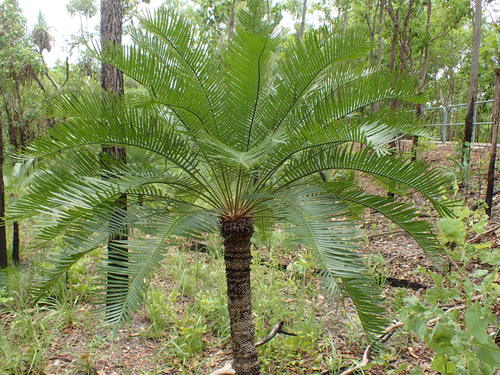
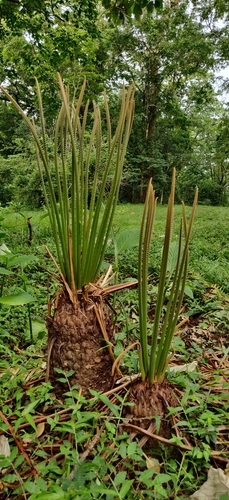
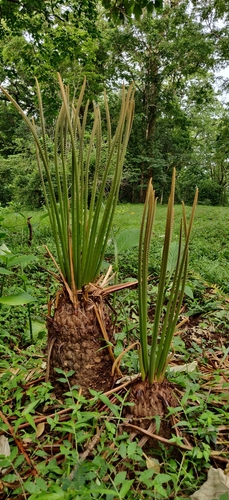
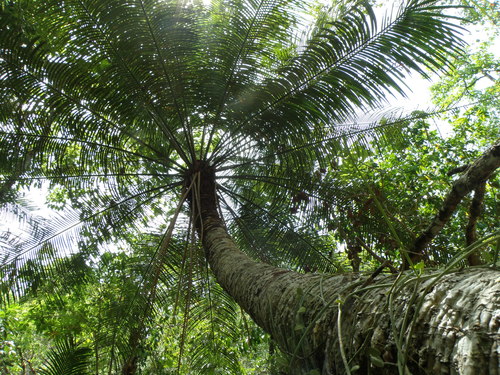
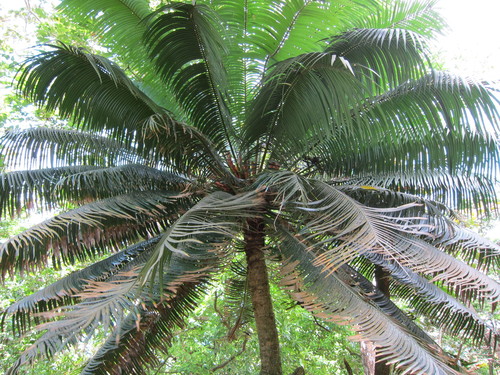
A palm like plant. The plant can be 3-10 m high. The trunk is not swollen at the base. The trunk is covered with the bases of the old leaves. The leaves have leathery leaflets with a distinct midrib. The leaves are something like feathers. They are 1-2 m long and have leaflets along the stalk. These leaflets are 28 cm long by 2 cm wide. A cone of thick leaves with large seeds is produced at the top. They are separately male and female plants. The seeds are 3-4 cm across with a thin fleshy covering and a starchy centre.
How to Grow
They can be grown from seeds. Plants, especially damaged ones produce suckers.
Propagation: Seeds - best sown as soon as they are ripe, though the seeds of many species will take a few months to finish maturing the embryo before they are ready to germinate. Sow the seeds in a tray in a freely-draining medium and place in moderate shade. Bottom heat at about 27°c will hasten seed germination dramatically. Young roots are quite brittle and once germination takes place, the root grows rapidly. It is important to pot up the seedlings at this time in order to give them enough root-space. Grow on the plants in pots until large enough to plant out. Division of off-sets or suckers is best carried out just before the plant comes in to new growth at the start of the growing season.
Medicinal Uses
The abundant pollen is strongly narcotic. The male cone scales are commonly sold as an anodyne in bazaars in India. The bark and the seeds are ground to a paste with oil and used as a poultice on sores and swellings. The juice of tender leaves is useful in the treatment of flatulence and vomiting. A gum obtained from the plant has been used medicinally, particularly as an agent that is said to produce rapid suppuration when applied to malignant ulcers. The gum also has the repute of being a good antidote for snake and insect bites.
Other Uses
The bark sap is used as a glue. A gum exudes through wounds in the plant, especially from the megasporophylls, stems and leaves. It is used medicinally and as an adhesive. When placed in water, Cycas gum begins to swell almost immediately. By the end of several days, it expands to many times its original size and becomes so colourless and transparent that it cannot be seen in water but must be felt for with a rod. Cycas gum has been likened in its properties to that of Sterculia setigera The fruits are strung together to make children's toys or rattles. The stems are used in small traditional constructions in Indonesia.
Wikipedia
Source ↗Cycas rumphii, commonly known as queen sago or the queen sago palm, is a dioecious gymnosperm, a species of cycad in the genus Cycas native to Indonesia, New Guinea and Christmas Island. Although palm-like in appearance, it is not a palm.
Production
It is a slow growing plant. Plants for sago need to be 7 years old and not to have flowered.
Notes
There are about 20-40 Cycas species. In Slovenia possibly in hot house.
Names & Synonyms
Babai, Bait, Bogak, Chatale, Fadang, Godduyicalu, Kama, Kilakora, Laupama, Maphrao-sida, Mondaing, Mong-tain, Mwaere, Nyia nwasipoyi, Paipai ro, Paiyindu, Pakas raja, Pakis haji, Paku gajah, Paku laut, Patorr, Pitogo, Pitugo, Prong-tha-le, Prong, Queen sago, Ranaguvva, Rosaimaro, Ruvoruvo, Sikas pakis haji, Sikas ratu sagu, Sauang, Takwaruru, Taronarona, Thien tue, Tutappana
References (32)
- Ambasta, S.P. (Ed.), 2000, The Useful Plants of India. CSIR India. p 153
- Arora, K., Indigenous Forest Management in the Andaman and Nicobar Islands, India.
- Awasthi, A.K., 1991, Ethnobotanical studies of the Negrito Islanders of Andaman Islands, India - The Great Andamanese. Economic Botany 45(2) pp 274-280.
- Barrau, J., 1976, Subsistence Agriculture in Polynesia and Micronesia. Bernice P. Bishop Museu, Bulletin 223 Honolulu Hawaii. Kraus reprint. p 55
- Bhargava, N., 1983, Ethnobotanical Studies of the Tribes of Andaman and Nicobar Islands, India. 1. Onge. Economic Botany 37(1): 110-119
- Borrell, O.W., 1989, An Annotated Checklist of the Flora of Kairiru Island, New Guinea. Marcellin College, Victoria Australia. p 11, 153
- Bull. Sci. Phys. Nat. Neerl. 2:45. 1839
- Clarke, W.C. & Thaman, R.R., 1993, Agroforestry in the Pacific Islands: Systems for sustainability. United Nations University Press. New York. p 235
- Cowie, I, 2006, A Survey of Flora and vegetation of the proposed Jaco-Tutuala-Lore National Park. Timor-Lests (East Timor) www.territorystories.nt/gov.au p 46
- Cundall, P., (ed.), 2004, Gardening Australia: flora: the gardener's bible. ABC Books. p 449
- French, B.R., 1986, Food Plants of Papua New Guinea, A Compendium. Asia Pacific Science Foundation p 339
- Henderson, C.P. and I.R.Hancock, 1988, A Guide to the Useful Plants of the Solomon Islands. Res. Dept. Min of Ag. & Lands. Honiara, Solomon Islands. p 138
- Henty, E.E., 1980, Harmful Plants in Papua New Guinea. Botany Bulletin No 12. Division Botany, Lae, Papua New Guinea. p 44
- Hibbert, M., 2002, The Aussie Plant Finder 2002, Florilegium. p 79
- Jones, D.L., 2000, Cycads of the world. Reed New Holland. p 156
- Lepofsky, D., 1992, Arboriculture in the Mussau Islands, Bismarck Archipelago. Economic Botany, Vol 46, No. 2, pp. 192-211
- Marinelli, J. (Ed), 2004, Plant. DK. p 366
- Martin, F.W. & Ruberte, R.M., 1979, Edible Leaves of the Tropics. Antillian College Press, Mayaguez, Puerto Rico. p 190
- Menninger, E.A., 1977, Edible Nuts of the World. Horticultural Books. Florida p 162
- Nombo, P. & Leach, J. 2010, Reite Plants: An Ethnobotanical Study in Tok Pisin and English. ANU press. p 115
- Ochse, J.J. et al, 1931, Vegetables of the Dutch East Indies. Asher reprint. p 215
- Peekel, P.G., 1984, (Translation E.E.Henty), Flora of the Bismarck Archipelago for Naturalists, Division of Botany, Lae, PNG. p 35, 33
- Phon, P., 2000, Plants used in Cambodia. © Pauline Dy Phon, Phnom Penh, Cambodia. p 187
- Pham-Hoang Ho, 1999, An Illustrated Flora of Vietnam. Nha Xuat Ban Tre. p 214
- READ,
- Sukarya, D. G., (Ed.) 2013, 3,500 Plant Species of the Botanic Gardens of Indonesia. LIPI p 826
- Thaman, R. R, 2016, The flora of Tuvalu. Atoll Research Bulletin No. 611. Smithsonian Institute p 33
- Verheij, E. W. M. and Coronel, R.E., (Eds.), 1991, Plant Resources of South-East Asia. PROSEA No 2. Edible fruits and nuts. Pudoc Wageningen. p 327
- Walter, A. & Lebot, V., 2007, Gardens of Oceania. ACIAR Monograph No. 122. p 157
- Wickens, G.E., 1995, Edible Nuts. FAO Non-wood forest products. FAO, Rome. p173
- Wiersema, J. H. & Leon, B., 2013, World Economic Plants. A Standard Reference CRC Press. 2nd Ed. p 222
- World Checklist of Useful Plant Species 2020. Royal Botanic Gardens, Kew