Dianella caerulea
Sims
Blue flax lily, Paroo Lily
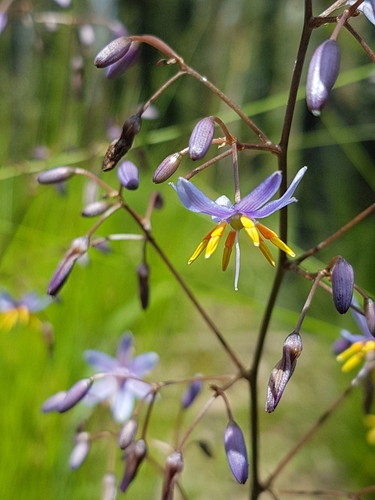
no rights reserved, uploaded by Vale Jenny Conolly
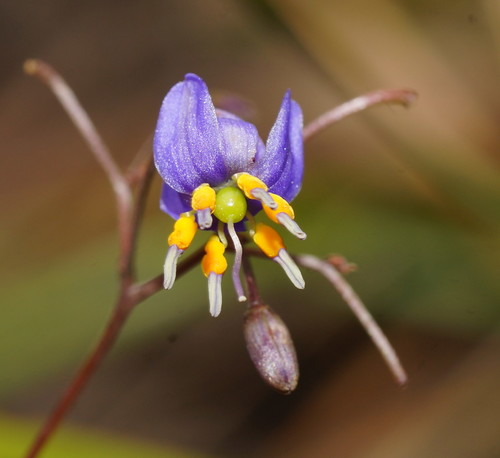
(c) Reiner Richter, some rights reserved (CC BY-NC-SA), uploaded by Reiner Richter

(c) Harry Rose, some rights reserved (CC BY)
What to Eat
Edible parts: Fruit, Root, Rhizome
The fruit can be eaten raw or cooked and grows up to 1.5cm in diameter.
Where to Find It
A tropical plant. It will grow on most soils. It can tolerate frost and drought. It suits sheltered and shady positions. It grows in coastal heaths and sand dunes and up to 1,000 m above sea level. Melbourne Botanical Gardens. Adelaide Botanical Gardens. It suits hardiness zones 9-12.
Asia, Australia*, Indonesia, Pacific, Papua New Guinea, PNG, SE Asia, Tasmania,
How to Identify
A plant which keeps growing from year to year. It forms mats. It grows to 0.5 m high and spreads to 0.3 m across. The stem is erect. The leaves are long and strap like. The clasp the stem at the base. They can be 75 cm long with rough edges. The flowers are blue in loose clusters at the ends of branches. The flowers are star shaped. The fruit are shiny blue berries. They are 7-12 mm long.
How to Grow
Succeeds in ordinary garden soil in sun or dappled shade. Requires a well-drained neutral to acid soil. Requires a sunny sheltered position when grown outdoors in Britain. This species is not very cold-tolerant, but it can survive in sheltered stable environments in dappled shade, such as a woodland, if temperatures do not drop far below zero for long periods.
Propagation: Pre-soak seed for 24 hours in lukewarm water, then sow in spring in gentle heat in a greenhouse. Germination usually takes place within 1–3 months at 25°C. Prick seedlings into individual pots when large enough and grow on under glass for at least the first two years before planting out in late spring or early summer. Divide as growth begins in spring — larger clumps can go directly into permanent positions, while smaller clumps are best potted up in a cold frame until well rooted before planting out in spring.
Medicinal Uses
None known.
Other Uses
A very strong, silky fibre is obtained from the leaves, which are also used in basket-making.
Wikipedia
Source ↗Dianella caerulea, commonly known as the blue flax-lily, blueberry lily, or paroo lily, is a perennial herb of the family Asphodelaceae, subfamily Hemerocallidoideae, found across the eastern states of Australia and Tasmania. It is a hardy plant, growing to a height and width of around 1 metre with grass-like strappy leaves. Blue flowers in spring and summer are followed by indigo-coloured berries. It adapts readily to cultivation and is commonly seen in Australian gardens and amenities plantings.
Notes
There are about 20-30 Dianella species. Also put in the family Hemerocallidaceae.
Names & Synonyms
Blueberry lily, Dianella biru
References (28)
- Anon., 2003, Native Plants for the Fitzroy basin. Society for Growing Australian Plants Inc. (Rockhampton Branch) p 15
- Bodkin, F., 1991, Encyclopedia Botanica. Cornstalk publishing, p 336
- Bot. Mag. 15: t. 505. 1801
- Brickell, C. (Ed.), 1999, The Royal Horticultural Society A-Z Encyclopedia of Garden Plants. Convent Garden Books. p 357
- Caton, J.M. & Hardwick, R. J., 2016, Field Guide to Useful Native Plants from Temperate Australia. Harbour Publishing House. p 92 (As var. producta)
- Cherikoff V. & Isaacs, J., The Bush Food Handbook. How to gather, grow, process and cook Australian Wild Foods. Ti Tree Press, Australia p 151, 195
- Cooper, W. and Cooper, W., 2004, Fruits of the Australian Tropical Rainforest. Nokomis Editions, Victoria, Australia. p 396
- Cundall, P., (ed.), 2004, Gardening Australia: flora: the gardener's bible. ABC Books. p 491
- Elliot, W.R., & Jones, D.L., 1984, Encyclopedia of Australian Plants suitable for cultivation. Vol 3. Lothian. p 259
- Greig, D., 1996, Flowering Natives for Home Gardens. Angus & Robertson. p 141
- Grieg, D., 2002, A photographic guide to Wildflowers of South-eastern Australia. New Holland. p 99
- Hardwick, R.J., 2000, Nature's Larder. A Field Guide to the Native Food Plants of the NSW South Coast. Homosapien Books. p 55
- Haslam, S., 2004, Noosa's Native Plants. Noosa Integrated Catchment Assn. Inc. p 234
- Hibbert, M., 2002, The Aussie Plant Finder 2002, Florilegium. p 85
- Hunter, J. T. & Sheringham, P., 2006, Vegetation and Floristics of Melville Range Nature Reserve. A Report to the New South Wales Parks and Wildlife Service. p 171
- Jackes, B.R., 2001, Plants of the Tropics. Rainforest to Heath. An Identification Guide. James Cook University. p 61
- Jackes, B. R., 2010, Plants of Magnetic Island. 3rd Edition. James Cook University, Australia. p 29
- Jones D, L, 1986, Ornamental Rainforest Plants in Australia, Reed Books, p 270
- Lazarides, M. & Hince, B., 1993, Handbook of Economic Plants of Australia, CSIRO. p 79
- Low, T., 1991, Wild Food Plants of Australia. Australian Nature FieldGuide, Angus & Robertson. p 113
- Melzer, R. & Plumb, J., 2011, Plants of Capricornia. Belgamba, Rockhampton. p 481
- Nicholson, N & H., 1996, Australian Rainforest Plants 3, Terania Rainforest Publishing. NSW. p 20
- Plants for a Future database, The Field, Penpol, Lostwithiel, Cornwall, PL22 0NG, UK. http://www.scs.leeds.ac.uk/pfaf/
- Ryan, M. (Ed.), 2003, Wild Plants of Greater Brisbane. Queensland Museum. p 97
- Sukarya, D. G., (Ed.) 2013, 3,500 Plant Species of the Botanic Gardens of Indonesia. LIPI p 1101
- Townsend, K., 1994, Across the Top. Gardening with Australian Plants in the tropics. Society for Growing Australian Plants, Townsville Branch Inc. p 159
- Townsend, K., 1999, Field Guide to Plants of the Dry Tropics. Society for Growing Australian Plants, Townsville Branch Inc. p 155
- Yallakool Reserve Plant List July 1, 2009 Off internet