Dioscorea bulbifera
L.
Potato yam

(c) Dinesh Valke, some rights reserved (CC BY-SA)

(c) Dinesh Valke, some rights reserved (CC BY-SA)

(c) Keyla Pruett, some rights reserved (CC BY-NC)
What to Eat
Edible parts: Tuber, Root, Bulbils, Vegetable
The aerial tubers are cooked — boiled, baked, fried, or prepared in other ways — and have an agreeable taste. They must be thoroughly cooked to destroy toxic alkaloids. Wild forms are always toxic raw, though selected cultivars have been developed with much lower levels or none at all. Aerial tubers are produced over a long period and can be harvested accordingly. The roots, usually around 0.5kg though sometimes reaching 1.5kg, are also eaten cooked, though they are not always produced. The inflorescences are also apparently eaten.
Known Hazards
Where to Find It
A tropical plant. It will grow from the coast up to about 1700 m altitude in equatorial zones. It is common near the edge of grassland and forest at mid altitudes. It grows in savannah woodland. Both wild and cultivated forms occur. It is common in the Philippines, Solomon Islands and Papua New Guinea near secondary forest at low and medium altitudes. It is cultivated in Africa and the West Indies. In Nepal it grows to 2100 m altitude. It suits hardiness zones 9-12. In Yunnan.
Africa, American Samoa, Andamans, Angola, Asia, Australia, Bangladesh, Benin, Bhutan, Bolivia, Bougainville, Brazil, Burkina Faso, Burundi, Cambodia, Cameroon, Central Africa, Central African Republic, CAR, Central America, China, Christmas Island, Chuuk, Colombia, Comoros, Congo DR, Congo R, Cook Is., Costa Rica, Côte d'Ivoire, Chuuk, Cuba, Dominican Republic, East Africa, East Timor, Ecuador, Ethiopia, Fiji, French Polynesia, FSM, Gambia, Ghana, Guam, Guiana, Guianas, Guinea, Guinée, Guinea-Bissau, Haiti, Himalayas, India, Indochina, Indonesia, Ivory Coast, Jamaica, Japan, Kenya, Korea, Laos, Liberia, Madagascar, Malawi, Malaysia, Maldives, Mali, Marquesas, Mauritius, Micronesia, Myanmar, Namibia, Nepal, New Caledonia, Niger, Nigeria, Niue, North America, Northeastern India, Pacific, Pakistan, Palau, Papua New Guinea, PNG, Peru, Philippines, Puerto Rico, Reunion, Rotuma, Sahel, Samoa, Sao Tome and Principe, SE Asia, Senegal, Sierra Leone, Sikkim, Solomon Islands, Southern Africa, South America, Sri Lanka, St Lucia, Suriname, Tahiti, Taiwan, Thailand, Timor-Leste, Togo, Tonga, Tanzania, Uganda, USA, Vanuatu, Venezuela, Vietnam, Wallis & Futuna, West Africa, West Indies, Yap, Zambia, Zimbabwe,
How to Identify
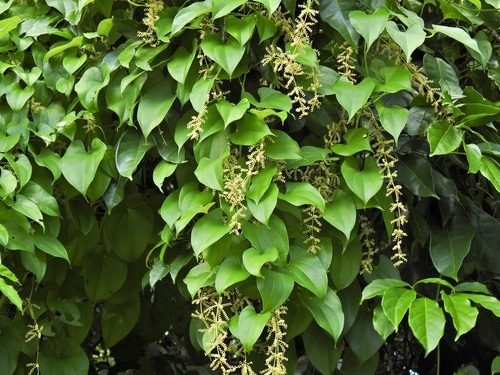
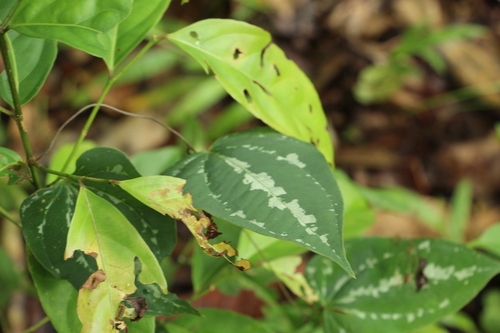
A yam with a long smooth stemmed vine, round in cross section. It winds to the left. It does not have spines. The vine can climb up into trees and grow to long lengths. The leaves are large and round. They are pointed at the tip and round at the base. About 7 veins arise from the tip of the leaf stalk. Leaves can be 14-30 cm across and slightly longer than wide. This yam produces bulbils (potatoes) in the angles of the leaves along the vine. These are often flattened and can be grey brown or purple. Under the ground it has a smaller tuber normally covered with roots. The flowers are large. The male flowers are in spikes up to 20 cm long. The female spikes are usually in pairs. The fruit are winged and about 2.5 cm long by 1.5 cm across. The seeds have wings. The bulbils normally have few fibres through the tissue compared to some yams tubers. The flesh of many varieties is yellow.
Nutrition Score: 52/100
| Part | Moisture | kJ | kcal | Protein | Vit A | Vit C | Iron | Zinc |
|---|---|---|---|---|---|---|---|---|
| Tuber | 72.5 | 455 | 109 | 2.3 | — | 32 | 1.1 | 0.7 |
| Tuber | 70.8 | 357 | 85 | 2.7 | — | 78 | 3.1 | 0.4 |
How to Grow
Either the bulbils off the vine, or the underground tubers are planted. Because the vines are long, training them up trees is convenient. The bulbils have to be stored for a period of time before they will sprout. The plant is annual and leaves die off for 1-4 months each year before re-sprouting from the tuber. Bulbils only grow shoots from one end unless the bulbil is cut into pieces. If the larger bulbils are cut, the cut surfaces should be dried and healed in a shady place for 2-3 days before planting. Bulbils are planted 8-12 cm below the surface and spacing can be 100 cm by 100 cm or variations of this. Normally nitrogen and potassium fertilisers give greater responses than phosphorus. Friable well drained soils are most suitable. Often very little cultivation or mounding is done. A high level of organic matter improves yield. Staking is normally required but often trees or living stakes are used. Branched stakes 2 m high are suitable. They need to be strongly erected as vine and tuber growth can be extensive and heavy.
Propagation: Seed is rarely produced and not normally used for propagation. Tuber cuttings are the standard method: small tubers are cut into 2–4 sections and larger ones into 6–8 sections, each with 2–3 dormant buds. Cut tubers are often left in the sun for several hours to encourage wound healing and reduce the risk of fungal infection. Aerial tubers can also be used and typically produce vigorous plants; these are often divided into 2 or more equal-sized pieces. Plants may need two growing seasons to produce full-size aerial bulbs.
Medicinal Uses
Root juice is taken internally to expel threadworm and dripped into wounds to remove worms and germs. Both the tuber and aerial bulbil of wild races have medicinal applications, particularly external ones. They are applied as a poultice for wounds, sores, boils, and inflammations; used in dressings for dermal parasitic and fungal infections; or crushed, mixed with palm oil, and massaged onto areas affected by rheumatism, breast complaints, and jigger infestations. In India, the tuber is considered diuretic and is used as a remedy for diarrhoea and haemorrhoids. The fruits are used to treat boils and fever. Sap from the vine stems is applied to purulent ophthalmia and snake-bite. The leaves are used against pink-eye, often by steam-distillation. Dioscorine has been detected in the tuber, though some Nigerian material has been reported free of it. Alkaloids occur in the leaves, stems, and especially the fruits. Diosgenin has been detected at 0–45% concentration, and saponin and several other pharmacologically active substances are also present.
Other Uses
The plant has parasiticide applications. It is grown in food forest systems.
Wikipedia
Source ↗Dioscorea bulbifera (commonly known as the air potato, air yam, bitter yam, cheeky yam, potato yam, aerial yam, and parsnip yam) is a species of true yam in the yam family, Dioscoreaceae. It is native to Africa, Asia and northern Australia. It is widely cultivated and has become naturalized in many regions.
Production
Bulbils or aerial yams are produced as soon as leaves begin to unfold and continue until the plant reaches maturity. These aerial tubers often fall from the plant. Harvesting can start 3 months after planting but immature tubers have less starch. Underground tubers are normally not harvested until the leaves die back. Wounds and damage to the tuber surface normally heals naturally given dry aerated conditions. Some varieties have aerial tubers which are seasonally dormant and only grow after an extended period of storage. Others germinate relatively quickly.
Other Information
It is a commercially cultivated vegetable. This yam is widely distributed in lowland areas of Papua New Guinea and is a supplementary starchy staple food.
Notes
There are about 650 species of Dioscorea. It can be invasive.
Names & Synonyms
Abubu, Acom, Aerial Yam, Agbanio, Ah-lu-thi, Air-potato, Akam, Ankindjek, Apuereka, Assidhakattala, Bachi, Ban tarul, Banalu, Bantarul, Ban temee, Barodaa, Basel phauk, Batata de rama, Bayag-toro, Bayal, Bejuco de natilla, Belloi, Bon-alu, Bontarul, Bubaia, Buefu, Cambare marron, Cara de are, Catoco, Chaxo poa, Chedu dumpa, Chedupaddu-dumpa, Cheeky yam, Chitangula, Chupri alu, Coolngarrie, Cu mei, Dai, Danda yam, Dandam, Dandandim-o, Dangkanda, Dau fasia, Dehs prei, Denebra, Dimoa, Drun, Dukkar-kand, Endome, Engin, Favi, Fikengere, Fui, Gaicha alu, Gaithi, Ganmanggu, Gasalu, Gathalu, Geetha, Genebra, Gethi, Gethia kanda, Ghartarul, Gidtha, Githi, Githa, Githo, Goch alu, Gosh alu, Gulgariny, Gunda, Haaran bo, Heggenasum, Helak, Ho, Hofikary, Hoi, Huang du, Huwi blichik, Indrenni, Igname bois, Igname-sau-vage, Inga piru, Iroga, Jebubug basu, Kadukand, Kadukaranda, Kadvokand, Kaile, Kaile dranu, Kaile manu, Kalangua, Ka la si, Kalialia, Karanda, Karukarinda, Karuvalli, Kasiena, Kattala, Kattu-kachil, Khoinga, Ki, Kodi, Kodikilangu, Koile mila, Konjo, Kuchung, Kurlama, Lac, Lahara, Lekut, Lindya, Litu, Lu gong lai biu, Mabuaia, Magnaheugo, Malakaka yapendalamu, Man nok, Manamund, Manyanya, Mas aloo, Mas alu, Matalu, Matara, Mataru, Methe aloo, Mithene, Mitho githa, Mpenga, Muwana, Name del aire, Name volador, Niambe-de-matom, Nika, Numwe, Ofaka, Ofa lei, Ogoko, Oi, Okoo, Otaheite yam, Pain, Palai, Pannukilangu, Papa aerea, Papa del aire, Papa voladora, Peng-khe, Pesta-alo, Pisimonaju, Piska sanga, Pitaalu, Puralu, Puri, Putsa-u, Ranmataru, Ratalu, Ratulu, Rok, Ruipan, Rukhel, Sang, Shunku papa, Sise, Soi, Soko, Suaralu, Syak, Te'e, Tewe, Tha borok, Thaphu miyung-wablai, Tikor alu, Timbom, Tito githa, To, Ubi atatus, Ubi-ubihan, Udala, Ufi lei, Uhi, Undome, Uwi gantung, Wila, Yi bao, Yoi
References (230)
- Potato yam references Dioscorea bulbifera
- Abbiw, D.K., 1990, Useful Plants of Ghana. West African uses of wild and cultivated plants. Intermediate Technology Publications and the Royal Botanic Gardens, Kew. p 27
- Acharya K. P. and Acharya, R., 2010, Eating from the Wild: Indigenous knowledge on wild edible plants in Parroha VDC of Rupandehi District, Central Nepal. International Journal of Social Forestry. 3(1):28-48
- Acipa, A. et al, 2013, Nutritional Profile of some Selected Food Plants of Otwal and Ngai Counties, Oyam District, Northern Uganda. African Journal or Food, Agriculture, Nutrition and Development. 13(2)
- Agarwal, R. & Chandra, V., 2019, Diversity of wild edible plants in the Mandal-Chopta forest, Uttarakhand. Journal of Medicinal Plants Studies 2019; 7(1): 89-92
- Ambasta, S.P. (Ed.), 2000, The Useful Plants of India. CSIR India. p 174
- Anderson, E. F., 1993, Plants and people of the Golden Triangle. Dioscorides Press. p 209
- Arinathan, V., et al, 2007, Wild edibles used by Palliyars of the western Ghats, Tamil Nadu. Indian Journal of Traditional Knowledge. 6(1) pp 163-168
- Arora, K., Indigenous Forest Management in the Andaman and Nicobar Islands, India.
- Aryal, K. P. et al, 2009, Uncultivated Plants and Livehood Support - A case study from the Cheopang people of Nepal. Ethnobotany Research and Applications. 7:409-422
- Aryal, K. P., et al, 2018, Diversity and use of wild and non-cultivated edible plants in the Western Himalaya. Journal of Ethnobiology and Ethnomedicine (2018) 14:10
- Avinash, B. K., Kumar, R., et al, 2013, Ethnoboptany of Tharus of Dudhwa National Park, India. Mintage journal of Pharmaceutical & Medical Science 6-11
- Awas, T., 1997, A Study on the Ecology and Ethnobotany of Non-cultivated Food Plants and Wild Relatives of Cultivated crops in Gambella Region, Southwestern Ethiopia. Addis Ababa University. p 78
- Bandyopadhyay, S. et al, 2009, Wild edible plants of Koch Bihar district, West Bengal. Natural Products Radiance 8(1) 64-72
- Bandyopadhyay, S., et al, 2012, A Census of Wild Edible Plants from Howrah District, West Bengal, India. Proceedings of UGC sponsored National Seminar 2012
- BARC, 2016, State of Biodiversity for Food and Agriculture in Bangladesh. Bangladesh Agricultural Research Council.
- Baro, D., Baruah, S. and Borthukar, S. K. 2015, Documentation on wild vegetables of Baksa district, BTAD (Assam). Scholars Research Library. Archives of Applied Science Research, 2015, 7 (9):19-27
- Barrau, J., 1976, Subsistence Agriculture in Polynesia and Micronesia. Bernice P. Bishop Museu, Bulletin 223 Honolulu Hawaii. Kraus reprint. p 45
- Barua, U., et al, 2007, Wild edible plants of Majuli island and Darrang districts of Assam. Indian Journal of Traditional Knowledge 6(1) pp 191-194
- Bastakoti, R., et al, 2008, Food Insecurity and dependency of Chepang Communities on Wild Edible Plants. Sustainable Forest Management and Poverty Alleviation: Roles of Traditional Forest-related Knowledge IUFRO World Series Volume 21
- BHARGAVA,
- BHARGAVA, (As Dioscorea versicolor)
- Bhogaonkar, P. Y. & Devarkar, V. D., 2018, Inventory for ethnovegetable knowledge of the tribals of Satpura hill area-Melghat, Dist. Amravati (India), Plantae Scientia, 2018; Vol. 01 Issue 01: 01-08
- Bohra, N., et al, 2017, Ethnobotany of wild edible plants traditionally used by the local people in the Ramnagar regions from Nainital District, Uttarakhand, India. Biolife 5(1): 12-19
- Borrell, O.W., 1989, An Annotated Checklist of the Flora of Kairiru Island, New Guinea. Marcellin College, Victoria Australia. p 20
- Bradacs, G., 2008, Ethnobotanical Survey and Biological Screening of Medicinal Plants from Vanuatu. PhD thesis Frankurt University. p 101
- Brouk, B., 1975, Plants Consumed by Man. Academic Press, London. p 144
- Burkill, H. M., 1985, The useful plants of west tropical Africa, Vol. 1. Kew.
- Burkill, I.H., 1911, The polarity of the bulbils of Dioscorea bulbifera Linn. J. Proc. Asiat. Soc. Bengal (n.s.)7:467-469.
- Burkill, I.H., 1966, A Dictionary of the Economic Products of the Malay Peninsula. Ministry of Agriculture and Cooperatives, Kuala Lumpur, Malaysia. Vol 1 (A-H) p 829
- Cabalion, P. and Morat, P., 1983, Introduction le vegetation, la flore et aux noms vernaculaires de l'ile de Pentcoste (Vanuatu), In: Journal d'agriculture traditionnelle et de botanique appliquee JATBA Vol. 30, 3-4
- Cao, Y., et al, 2020, Ethnobotanical study on wild edible plants used by three trans-boundary ethnic groups in Jiangcheng County, Pu’er, Southwest China. Journal of Ethnobiology and Ethnomedicine (2020) 16:66
- Castillo, C., 2013, The Archaeobotany of Khao Sam Kaeo and Phu Khao Thong: The Agriculture of Late Prehistoric Southern Thailand. Ph. D. thesis University College, London p 378
- Chandrakumar, P., et al, 2015, Ethnobotanical studies of wild edible plants of Gond, Halba and Kawar tribes of Salekasa Taluka, Gondia District, Maharashtra State, India. International Research Journal of Pharmacy 6(8)
- Chauhan, S. H., et al, 2018, Consumption patterns of wild edibles by the Vasavas: a case study from Gujarat, India. Journal of Ethnobiology and Ethnomedicine (2018) 14:5
- Cheng, Z., et al, 2022, Ethnobotanical study on wild edible plants used by Dulong people in northwestern Yunnan, China. Journal of Ethnobiology and Ethnomedicine (2022) 18:3
- Cherikoff V. & Isaacs, J., The Bush Food Handbook. How to gather, grow, process and cook Australian Wild Foods. Ti Tree Press, Australia p 22, 199
- Chettri, N. & Sharma, E., Non-timber Forest Produce: Utilization, Distribution and Status in the Khangchendzonga Biosphere Reserve, Sikkim, India.
- Chevalier, A., 1936, Contribution a l’etude de quelques especes africaines du genre Dioscorea. Bull. Mus. Natl. Hist. Nat. Paris. 2nd Ser, 8(6):520-551.
- Chevalier, A., 1947, Une igname d’Afrique employee dans les empoisonements criminels. Rev. Int. Bot. Appl. Agric. Trop. 27(291-292):56-57.
- Chowdery, T., et al, 2014, Wild edible plants of Uttar Dinajpur District, West Bengal. Life Science Leaflets. 47:pp 20-36 http://lifesciencesleaflets.ning.com
- Chowdhury, M. & Mukherjee, R., 2012, Wild Edible Plants Consumed by Local Communities of Maldah of West Bengal, India. Indian J.Sci.Res.3(2) : 163-170
- Codjia, J. T. C., et al, 2003, Diversity and local valorisation of vegetal edible products in Benin. Cahiers Agricultures 12:1-12
- Cooper, W. and Cooper, W., 2004, Fruits of the Australian Tropical Rainforest. Nokomis Editions, Victoria, Australia. p 152
- Coursey, D.G., 1967, Yams. An account of the nature, origins, cultivation and utilisation of the useful members of the Dioscoreaceae. 230pp Longmans. London.
- Coursey, D.G., 1979, Yams, in Simmonds N.W.,(ed), Crop Plant Evolution. Longmans. London. p 70
- Cowie, I, 2006, A Survey of Flora and vegetation of the proposed Jaco-Tutuala-Lore National Park. Timor-Lests (East Timor) www.territorystories.nt/gov.au p 46
- Crawford, I. M., 1982, Traditional Aboriginal Plant Resources in the Kalumburu Area: Aspects in Ethno-economics. Records of the Western Australian Museum Supplement No. 15
- D'Ambrosio, U., & Puri, R. K., 2016, Foodways in transition: food plants, diet and local perceptions of change in a Costa Rican Ngäbe community. Journal of Ethnobiology and Ethnomedicine (2016) 12:3 p 24
- Deb, D., et al, 2013, Wild Edible Plants and Their Utilization in Traditional Recipes of Tripura, Northeast India. Advances in Biological Research 7(5):203-211
- Demise, S. & Asfaw, Z., 2020, Ethno Botanical Study of Wild Edible Plants in Adola District, Southern, Ethiopia. International Journal of Research and Analytical Reviews (IJRAR) 7(2).
- Ding Zhizun, Gilbert, M. G., DIOSCOREACEAE, shu yu ke, Flora of China,
- Dutta, B., 2015, Food and medicinal values of certain species of Dioscorea with special reference to Assam. Journal of Pharmacognosy and Phytochemistry. 3(4): 15-18
- Dutta, U., 2012, Wild Vegetables collected by the local communities from the Churang reserve of BTD, Assam. International Journal of Science and Advanced Technology. Vol. 2(4) p 121
- Ekman Herbarium records Haiti
- Elliot, W.R., & Jones, D.L., 1984, Encyclopedia of Australian Plants suitable for cultivation. Vol 3. Lothian. p 282
- Facciola, S., 1998, Cornucopia 2: a Source Book of Edible Plants. Kampong Publications, p 91
- Flora of Pakistan www.eFloras.org
- Fowler, D. G., 2007, Zambian Plants: Their Vernacular Names and Uses. Kew. p 66
- Fox, F. W. & Young, M. E. N., 1982, Food from the Veld. Delta Books. p 182
- Franklin, J., Keppel, G., & Whistler, W., 2008, The vegetation and flora of Lakeba, Nayau and Aiwa Islands, Central Lau Group, Fiji. Micronesica 40(1/2): 169–225, 2008
- French, B.R., 1986, Food Plants of Papua New Guinea, A Compendium. Asia Pacific Science Foundation p 11
- French, B.R., 2010, Food Plants of Solomon Islands. A Compendium. Food Plants International Inc. p 18
- Gallagher, D. E., 2010, Farming beyond the escarpment: Society, Environment, and Mobility in Precolonial Southeastern Burkina Faso. PhD University of Michigan.
- Gangwar, A. K. & Ramakrishnan, P. S., 1990, Ethnobotanical Notes on Some Tribes of Arunachal Pradesh, Northeastern India. Economic Botany, Vol. 44, No. 1 pp. 94-105
- Garde, M., et al, 2003, A Preliminary List of Kundedjnjenghmi Plant Names. Northern Land Council. (Arnhem Land, Australia)
- Gautam, R. S., et al, 2022, Ethnobotanical Review of Wild Edible Plants of Nepal. Journal of Natural History Museum Volume 32, 2021-22 p 112
- Ghosh, C. & Das A. P., 2011, Some useful and poisonous tea garden weeds from the Darjiling District of West Bengal, India. Pleione 5(1): 91 - 114
- Gillaumin, R., 1954, Les Plantes utiles des Nouvelles-Hebrides (fin et complement) In: Journal d'agriculture tropicale et de botanique appliquee Vol. 1, No. 10-12 pp 453-460
- HANDY,
- Hardwick, G., 2001, Economically Useful Plants for Northern Australia: Master Species List. Crusader eBooks.
- Hedrick, U.P., 1919, (Ed.), Sturtevant's edible plants of the world. p 273
- Henderson, C.P. and I.R.Hancock, 1988, A Guide to the Useful Plants of the Solomon Islands. Res. Dept. Min of Ag. & Lands. Honiara, Solomon Islands. p 20
- Hiddins, L., 1999, Explore Wild Australia with the Bush Tucker Man. Penguin Books/ABC Books. p 160
- Hossain, U. & Rahman, A., 2018, Study and quantitative analysis of wild vegetable floral diversity available in Barisal district, Bangladesh. Asian J. Med. Biol. Res. 2018, 4 (4), 362-371
- Hu, Shiu-ying, 2005, Food Plants of China. The Chinese University Press. p 322
- INFOODS:FAO/INFOODS Databases
- Isaacs, J., 1987, Bush Food, Aboriginal Food and Herbal Medicine. Weldons. p 95
- Jackes, B.R., 2001, Plants of the Tropics. Rainforest to Heath. An Identification Guide. James Cook University. p 50
- Jacquat, C., 1990, Plants from the Markets of Thailand. D.K. Book House p 102
- Jadhav, R., et al, 2015, Forest Foods of Northern Western Ghats: Mode of Consumption, Nutrition and Availability. Asian Agri-History Vol. 19, No. 4: 293-317
- Japanese International Research Centre for Agricultural Science www.jircas.affrc.go.jp/project/value_addition/Vegetables
- Jardin, C., 1970, List of Foods Used In Africa, FAO Nutrition Information Document Series No 2.p 13, p 14 (As Dioscorea latifolia var. anthropophagorum)
- Jha, P. K., et al, 1996, Plant genetic resources of Nepal: A guide for plant breeders of agricultural, horticultural and forestry crops. Euphytica 87:189-210
- Jones D, L, 1986, Ornamental Rainforest Plants in Australia, Reed Books, p 287
- Joshi, N., et al, 2007, Traditional neglected vegetables of Nepal: Their sustainable utilization for meeting human needs. Tropentag 2007. Conference on International Agricultural Research for Development.
- Kala, C. P., 2009, Aboriginal uses and management of ethnobotanical species in deciduous forests of Chhattisgarh state in India. Journal of Ethnobiology and Ethnomedicine. 5:32
- Karnick, C.B., 1969, Dioscorea (yams), the food of the slaves with potential for newer drugs. Q. J. Crude Drug res. 9:1372-1391.
- Kawasaki, T., Komori, T., and Setoguchi, S., 1968, Furanoid norditerpenes from Dioscorea plants. 1 Diosbulbines a,b, & c from Dioscorea bulbifera forma spontanea Makino et Nemoto. Chem. Pharm. Bull. (Tokyo) 15:2430-2435.
- Kay, D.E., 1973, Root Crops, Digest 2, Tropical Products Institute, London, p 190, 229
- Kays, S. J., and Dias, J. C. S., 1995, Common Names of Commercially Cultivated Vegetables of the World in 15 languages. Economic Botany, Vol. 49, No. 2, pp. 115-152
- Kenneally, K.E., Edinger, D. C., and Willing T., 1996, Broome and Beyond, Plants and People of the Dampier Peninsula, Kimberley, Western Australia. Department of Conservation and Land Management. p 210
- Khakurel, D., et al, 2021, Foods from the wild: Local knowledge, use pattern and distribution in Western Nepal. PLOS ONE.
- Kiple, K.F. & Ornelas, K.C., (eds), 2000, The Cambridge World History of Food. CUP p 1715
- Kiran, K. C., et al, 2019, Diversity and Seasonal Availability of Potential Wild Edible Plants from Vidarbha Region of Maharashtra State, India. Int.J.Curr.Microbiol.App.Sci (2019) 8(2): 1434-1446
- Kumar, A., et al, 2012, Ethnobotanical Edible Plant Biodiversity of Lepcha Tribes. Indian Forester, 138 (9):798-803
- Kumar, G.M., & Shiddamallayya, N., 2014, Documentation of Wild Plant Tubers as Food Resources in Hassan District, Karnataka, International Journal of Applied Biology and Pharmaceutical Technology. 5(2) p 91
- Kuo, W. H. J., (Ed.) Taiwan's Ethnobotanical Database (1900-2000), http://tk.agron.ntu.edu.tw/ethnobot/DB1.htm
- Kuvar, S. D. & Shinde, R. D., 2019, Wild Edible Plants used by Kokni Tribe of Nasik District, Maharashtra. Journal of Global Biosciences. Volume 8, Number 2, 2019, pp. 5936-5945
- Latham, P., 2004, Useful Plants of Bas-Congo province. Salvation Army & DFID p 111
- Lautenschläger, T., et al, 2018, First large-scale ethnobotanical survey in the province of Uíge, northern Angola. Journal of Ethnobiology and Ethnomedicine (2018) 14:51
- Lawton, J.R.C., and Lawton, June R., 1967, The morphology of the dormant embryo and young seedling of five species of Dioscorea from Nigeria. Proc. Linn. Soc. Lond. 178:153-159.
- Lazarides, M. & Hince, B., 1993, Handbook of Economic Plants of Australia, CSIRO. p 82
- Lebot, V. & Sam, C., Green desert or ‘all you can eat’? How diverse and edible was the flora of Vanuatu before human introductions?. Terra australis 52 p 410
- Lembaga Biologi Nasional, 1977, Ubi-Ubian, Balai Pustaka, Jakarta. p 36
- Liefting, A., et al, Samoan plant names. http://en.wikipedia.org
- Lim, T. K., 2015, Edible Medicinal and Non Medicinal Plants. Volume 9, Modified Stems, Roots, Bulbs. Springer p 34
- Llamas, K.A., 2003, Tropical Flowering Plants. Timber Press. p 185
- Low, T., 1991, Wild Food Plants of Australia. Australian Nature FieldGuide, Angus & Robertson. p 120
- Low, T., 1992, Bush Tucker. Australia’s Wild Food Harvest. Angus & Robertson. p 106
- Lulekal, E., et al, 2011, Wild edible plants in Ethiopia: a review on their potential to combat food insecurity. Afrika Focus - Vol. 24, No 2. pp 71-121
- Macbride, J. F., 1936, Flora of Peru. Vol. 8, Part 3 No. 1 p 696
- Malaisse, F., 1997, Se nourrir en floret claire africaine. Approche ecologique et nutritionnelle. CTA., p 61
- Manandhar, N.P., 2002, Plants and People of Nepal. Timber Press. Portland, Oregon. p 202
- Marandi, R. R. & Britto, S. J., 2015, Medicinal Properties of Edible Weeds of Crop Fields and Wild plants Eaten by Oraon Tribals of Latehar District, Jharkhand. International Journal of Life Science and Pharma Research. Vo. 5. (2) April 2015
- Marinelli, J. (Ed), 2004, Plant. DK. p 452
- Martin, F.W., & Ortiz, S., 1963, Chromosome numbers and behaviour in some species of Dioscorea . Cytologia 28:96-101.
- Martin, F.W., Telek, L., and Ruberte, R., 1974, The yellow pigments of Dioscorea bulbifera. J. Agric. Food Chem. 22:335-337.
- Martin, F.W., 1974, Tropical Yams and their potential Part 2. Dioscorea bulbifera Agricultural handbook No. 466 USDA
- Masters, T., 2021, Traditional food plants of the upper Aswa River catchment of northern Uganda—a cultural crossroads. Journal of Ethnobiology and Ethnomedicine (2021) 17:24
- Maundu, P. et al, 1999, Traditional Food Plants of Kenya. National Museum of Kenya. 288p
- Massal, E and Barrau, J., 1973, Food Plants of the South Sea Islands. SPC Technical Paper No 94. Nounea, New Caledonia. p 12-15
- Medhi, P. & Borthakur, S. K., 2012, Phytoresources from North Cachur Hills of Assam -3: Edible plants sold at Hflong market. Indian Journal of Natural Products and Resources. 3(1) pp 84-109
- Medhi, P., Sarma, A and Borthakur, S. K., 2014, Wild edible plants from the Dima Hasao district of Assam, India. Pleione 8(1): 133-148
- Meitei, L. R., et al, 2022, An ethnobotanical study on the wild edible plants used by forest dwellers in Yangoupokpi Lokchao Wildlife Sanctuary, Manipur, India. Ethnobotany Research and Application 23:15
- Mekbib, Y & Deressa, T., 2015, Exploration and collection of root and tuber crops in East Wollega and Ilu Ababora zones: Rescuing declining genetic resources. Indian Journal of Traditional Knowledge. Vol. 15(1), pp. 86-92
- Miya, M. S. & Gautum, D., 2021, Checklist of floral species at the Institute of Forestry, Pokhara Campus, Pokhara, Nepal. Journal of Institute of Forestry, Nepal 18 (2021) 133-177
- Misra, R. C., et al, 2013, Genetic resources of wild tuberous food plants traditionally used in Similipal Biosphere Reserve, Odisha, India. Genetic Resources and Crop Evolution. Vol. 60 No. 2. Springer
- Monsalud, M.R., Tongacan, A.L., Lopez, F.R., & Lagrimas, M.Q., 1966, Edible Wild Plants in Philippine Forests. Philippine Journal of Science. p 459
- Mukhia, P.K., et al, 2013, Wild plants as Non Wood Forest Products used by the rural community of Dagana, a southern foothill district of Bhutan, SAARC Journal, 27 pages
- Murtem, G. & Chaudhrey, P., 2016, An ethnobotanical note on wild edible plants of Upper Eastern Himalaya, India. Brazilian Journal of Biological Sciences, 2016, v. 3, no. 5, p. 63-81
- Mutie, F. M., et al, 2023, Important Medicinal and Food Taxa (Orders and Families) in Kenya, Based on Three Quantitative Approaches. Plants 2023, 12, 1145
- N'Danikou, S. et al, 2010, Eliciting Local Values of Wild Edible Plants in Southern Bénin to Identify Priority Species for Conservation. Economic Botany, 20(10), 2011, pp. 1–15.
- NEAL,
- Nkeoua, G. & Boundzanga, G. C., 1999, Donnees sur les produits forestieres non ligneux en Republique du Congo. FAO. p 24
- Nyadanu, D., et al, 2015, Agro-biodiversity and challenges of on-farm conservation: the case of plant genetic resources of neglected and underutilized crop species in Ghana. Genet. Resourc. Crop Evol. 62(7):
- Nzigidahera, B., 2006, Assessment of Socio-cultural, Economic Characteristics and Livelihood of Riparian Population of the Kibira National Park. (Rukoma-Mutana locality). UNDP p 30
- Ochse, J.J. et al, 1931, Vegetables of the Dutch East Indies. Asher reprint. p 248
- Ojelel, S., et al, 2019, Wild edible plants used by communities in and around selected forest reserves of Teso-Karamoja region, Uganda. Journal of Ethnobiology and Ethnomedicine (2019) 15:3
- Onwueme, I.C., 1978, The Tropical Tuber Crops. Wiley, p 10
- Paczkowska, G. & Chapman, A.R., 2000, The Western Australian Flora. A Descriptive Catalogue. Western Australian Herbarium. p 60
- Pandy, R. K. & Saini, S. K., 2007, Edible plants of tropical forests among tribal communities of Madhya Pradesh. Indian Journal of Traditional Knowledge. 6(1), pp 185-190
- Parham, B. E. V., 1972, Plants of Samoa. New Zealand Department of Scientific and Industrial Research. Information Series. No. 85 p 137
- Patiri, B. & Borah, A., 2007, Wild Edible Plants of Assam. Geethaki Publishers. p 145
- Peekel, P.G., 1984, (Translation E.E.Henty), Flora of the Bismarck Archipelago for Naturalists, Division of Botany, Lae, PNG. p 95, 94
- Peters, C. R., O'Brien, E. M., and Drummond, R.B., 1992, Edible Wild plants of Sub-saharan Africa. Kew. p 17
- Phon, P., 2000, Plants used in Cambodia. © Pauline Dy Phon, Phnom Penh, Cambodia. p 235
- Plants of Haiti Smithsonian Institute http://botany.si.edu/antilles/West Indies
- Prabha, Y. P., et al, 2010, Documentation of Wild Edible Plants of Melghat Forest, Dist. Amravati, Maharashtra State, India. Ethnobotanical Leaflets 14: 751-58, 2010.
- Prafulla, S., 2017, Wild Food Diversity of Nawegaon-Nagzira Tiger Reserve in Gondia-Bhandara district of Maharashtra, India. Int. J. of Life Sciences, 2017, Vol. 5 (4): 620-626
- Prain, D., and Burkill, I.H., 1914, A synopsis of the Dioscoreas of the Old World, Africa excluded, with description of new species and varieties. J. Proc. Asiat. Soc. Bengal (n.s.) 10:5-41.
- Prain, D., and Burkill, I.H., 1936, An account of the genus Dioscorea Part 1. Species which turn to the left. Ann. Rev. Bot. Gard. (Calcutta) 14:1-210.
- Purseglove, J.W., 1972, Tropical Crops. Monocotyledons. Longmans p 102
- Rahangdale, D.R. & Rahangdale, S.S., 2014, Potential Wild Edible Plant Resources from Maharashtra Future Prospects for their Conservation and Improvement. Life Science Leaflets. http://lifesciencesleaflets.ning.com
- Rajapaksha, U., 1998, Traditional Food Plants in Sri Lanka. HARTI, Sri Lanka. p 182
- Recher, P, 2001, Fruit Spirit Botanical Gardens Plant Index. www.nrg.com.au/~recher/ seedlist.html p 5
- Ramachandran, V.S. and Nair, V.J., 1981, Ethnobotanical studies in Cannanore District, Kerala State (India). J Econ. Tax. Bot. Vol 2 pp 65-72
- Rao, M. L. S., et al, 2014, Indigenous Plant Foods which are commonly consumed by the tribal communities in Dumbriguda Area of Visakhapatnam District, Andhra Pradesh, India. Biolife. Vol 2, Issue 3
- Reddy, B. M., 2012, Wild edible plants of Chandrapur district, Maharashtra, India. Indian Journal of Natural Products and Resources. 3(1) pp 110-117
- RIRDC, 2010, New Root Vegetables fo the Native Food Industry, Australian Government RIRDC Publication 9/161
- Roa, J. A. G. & Boada, D. S. G., 2018, Fundación para el Fortalecimiento de la Fruticultura y Plantas Alimenticias no Convencionales en Colombia.
- Ruiters-Welcome, A. K., 2019, Food plants of southern Africa. Ph.D. thesis. Univ. of Johannesburg p 51
- Saidulu, P. et al, 2015, Ethnobotanical Knowledge Studied in Pocharam Wildlife Sanctuary, Telangana, India. Not Sci Biol, 2015, 7(2):164 -170
- Sarma, H., et al, 2010, Updated Estimates of Wild Edible and Threatened Plants of Assam: A Meta-analysis. International Journal of Botany 6(4): 414-423
- Savita, et al, 2006, Studies on wild edible plants of ethnic people in east Sikkim. Asian J. of Bio Sci. (2006) Vol. 1 No. 2 : 117-125
- Sheikh, N., et al, 2009, Status documentation of Dioscorea L. (Dioscoreaceae) in Meghalaya: an approach towards food security. Pleione 3(1): 74 - 82
- Singh, A. G., Panthi, M. P., & Tewari, D. D., 2012, Wild Plants Used as Vegetable in Rupandehi District of Nepal and their Ethnomedicinal Importance. J. Nat. Hist. Mus. Vol. 26, 2012, 111-125
- Singh, H.B., Arora R.K.,1978, Wild edible Plants of India. Indian Council of Agricultural Research, New Delhi. p 12
- Singh, H.B., Arora R.K.,1978, Wild edible Plants of India. Indian Council of Agricultural Research, New Delhi. p 13 (As Dioscorea versicolor)
- Smith, A.C., 1979, Flora Vitiensis Nova, Lawaii, Kuai, Hawaii, Volume 1 p 168
- Smith, K., 1998. Growing Uncommon Fruits and Vegetables. New Holland. p 104
- Smith, K & I., 1999, Grow your own bushfoods. New Holland. Australia. p 79
- Smith, M & Kalotas, A. C., 1985, Bardi Plants: An Annotated List of Plants and Their Use by the Bardi Aborigines of Dampierland, in North-western Australia. Rec. West Aust. Mus. 1985, 12(3): 317-359
- Smith, N and Wightman, G.M., 1990, Ethnobotanical Notes from Belyuen Northern Territory Australia. Northern Territory Botanical Bulletin No 10. Parks and Wildlife Commission of the Northern Territory. p 10, 11
- Smith, N. M., 1991, Ethnobotanical Field Notes from the Northern Territory, Australia, J. Adelaide Bot. Gard. 14(1): 1-65
- Smith, Nicholas et al. 1993, Ngarinyman Ethnobotany: Aboriginal Plant Use from the Victoria River Area Northern Australia. Northern Territory Botanical Bulletin No 16. Parks and Wildlife Commission of the Northern Territory. p 18, 19
- Sp. pl. 2:1033. 1753
- Stone, B. C., 1970, The Flora of Guam. A Manual for the Identification of the Vascular Plants of the Island. Micronesica. Journal of the University of Guam. p 127
- STURTEVANT,
- Sujanapal, P., & Sankaran, K. V., 2016, Common Plants of Maldives. FAO & Kerala FRI, p 114
- Sukarya, D. G., (Ed.) 2013, 3,500 Plant Species of the Botanic Gardens of Indonesia. LIPI p 921
- Sundriyal, M., et al, 1998, Wild edibles and other useful plants from the Sikkim Himalaya, India. Oecologia Montana 7:43-54
- Sundriyal, M., et al, 2004, Dietary Use of Wild Plant Resources in the Sikkim Himalaya, India. Economic Botany 58(4) pp 626-638
- Tanno, T., 1981, Plant Utilization of the Mbuti Pygmies: With Special reference to their Material Culture and Use of Wild Vegetable Foods. Kyoto University Research. African Study Monographs 1:1-54
- Taram, M., et al, 2018, Wild Food Plant Resources of Komkar Adi Tribe of Upper Siang District in Arunachal Pradesh, India. Bulletin of Arunachal Forest Research, Vol. 33(2), 27-35
- Telek, L., Martin, F.W., and Ruberte, R., 1974, Bitter substances in tubers of Dioscorea bulbifera L. J. Agric.Food Chem. 22:332-334.
- Terashima, H., et al, 1992, Ethnobotany of the Lega in the Tropical Rainforest of Eastern Zaire (Congo): Part Two, Zone de Walikale, African Study Monographs, Suppl. 19:1-60
- Terashima, H., & Ichikawa, M., 2003, A comparative ethnobotany of the Mbuti and Efe hunter-gatherers in the Ituri Forest, Democratic Republic of Congo. African Study Monographs, 24 (1, 2): 1-168, March 2003
- Teron, R. & Borthakur, S. K., 2016, Edible Medicines: An Exploration of Medicinal Plants in Dietary Practices of Karbi Tribal Population of Assam, Northeast India. In Mondal, N. & Sen, J.(Ed.) Nutrition and Health among tribal populations of India. p 151
- Thaman, R.R., 1976, The Tongan Agricultural System, University of the South Pacific, Suva, Fiji. p 396
- Thapa, L. B., et al, 2014, Wild Edible Plants used by endangered and Indigenous Raji Tribe in Western Nepal. International Journal of Applied Sciences and Biotechnology. Vol 2(3):243-252
- Tindall, H.D., 1983, Vegetables in the Tropics, Macmillan p 207
- Tiwi Plants and Animals. 2001, Aboriginal flora and fauna knowledge from Bathurst and Melville Islands, northern Australia. Northern Territory Botanical Bulletin; No. 24 p 43
- Torre, de la, L., et al, 2008, Enciclopedia de las Plantas Útiles del Ecuador. Herbario QCA. Pontificia Universidad Católica del Ecuador. p 309
- Townsend, K., 1994, Across the Top. Gardening with Australian Plants in the tropics. Society for Growing Australian Plants, Townsville Branch Inc. p 160
- Tredgold, M.H., 1986, Food Plants of Zimbabwe. Mambo Press. p 8
- Trimanto, & Hapsari L., 2016, Botanical survey in thirteen montane forests of Bawean Island Nature Reserve, East Java Indonesia: Conservation status, bioprospecting and potential tourism. Biodiversitas 17: 832-846.
- Tsering, J., et al, 2017, Ethnobotanical appraisal on wild edible plants used by the Monpa community of Arunchal Pradesh. Indian Journal of Traditional Knowledge. Vol 16(4), October 2017, pp 626-637
- Tutul, E et al, 2009, Angiospermic Flora of Runctia Sal Forest, Bangladesh. Bangladesh J. Plant Taxon. 16(1): 83-90. p 88
- Ulian, T., et al, 2020, Unlocking plant resources to support food security and promote sustainable agriculture. Plants, People, Planet. 2020;2:421–445.
- Uprety, Y., et al, 2010, Non-timber Forest Products in Bardiya District of Nepal: Indigenous Use, Trade and Conservation. J Hum Ecol, 30(3): 143-158
- Uprety, Y., et al, 2012, Diversity of use and local knowledge of wild edible plant resources in Nepal. Journal of Ethnobotany and Ethnomedicine 8:16
- Uprety, Y., et al, 2011, Plant biodiversity and ethnobotany inside the projected impact area of the Upper Seti Hydropower Project, Western Nepal. Environ. Dev. Sustain. (2011) 13:463-492
- Uprety, Y., et al, 2016, Traditional use and management of NTFPs in Kangchenjunga Landscape: implications for conservation and livelihoods. Journal of Ethnobiology and Ethnomedicine (2016) 12:19
- USDA, ARS, National Genetic Resources Program. Germplasm Resources Information Network - (GRIN). [Online Database] National Germplasm Resources Laboratory, Beltsville, Maryland. Available: www.ars-grin.gov/cgi-bin/npgs/html/econ.pl (10 April 2000)
- van Wyk, B., 2005, Food Plants of the World. An illustrated guide. Timber press. p 177
- Vickery, M.L. and Vickery, B., 1979, Plant Products of Tropical Africa, Macmillan. p 15
- Vigilante, T., et al, 2013, Island country: Aboriginal connections, values and knowledge of the Western Kimberley islands in the context of an island biological survey. Records of the Western Australian Museum Supplement 81: 145-182
- von Katja Rembold, 2011, Conservation status of the vascular plants in East African rain forests. Dissertation Universitat Koblenz-Landau p 165
- White, F., Dowsett-Lemaire, F. and Chapman, J. D., 2001, Evergreen Forest Flora of Malawi. Kew. p 96
- Walter, A. & Lebot, V., 2007, Gardens of Oceania. ACIAR Monograph No. 122 p. 74
- Wehmeyer, A. S, 1986, Edible Wild Plants of Southern Africa. Data on the Nutrient Contents of over 300 species
- Welcome, A. K. & Van Wyk, B.-E., 2019, An inventory and analysis of the food plants of southern Africa. South African Journal of Botany 122 (2019) 136–179
- Wheeler, J.R.(ed.), 1992, Flora of the Kimberley Region. CALM, Western Australian Herbarium, p 986
- White, F., Dowsett-Lemaire, F. & Chapman, J. D., 2001, Evergreen Forest Flora of Malawi. Kew Botanical Gardens. p 96
- Wiersema, J. H. & Leon, B., 2013, World Economic Plants. A Standard Reference CRC Press. 2nd Ed. p 248
- Wightman, Glenn et al. 1992, Mangarrayi Ethnobotany: Aboriginal Plant Use from the Elsey Area Northern Australia. Northern Territory Botanical Bulletin No 15. Parks and Wildlife Commission of the Northern Territory. p 18, 19.
- Wightman, G. M. & Andrews, M.R., 1989, Plants of Northern Territory Monsoon Vine Forests (Vol 1). Conservation Commission of Northern Territory. p 120
- Wildeman, E de., 1938, Dioscorea alimentaires et toxiques (morphologie et biologie). Especes er varietes congolaises. Inst. R., Colon. Belge. Sect. Sci. Nat. Mad., Collect. Octavo, Mem., vol 7. pt 2, 262 pp.
- Wilkin, P. et al, 2007, A new edible yam (Dioscorea L.) species endemic to Mayotte, new data on D. comorensis R. Knuth and a key to the yams of the Comoro Archipelago. Adansonia ser. 3, 29(2): 215-228
- Williamson, J., 2005, Useful Plants of Malawi. 3rd. Edition. Mdadzi Book Trust. p 97
- Wiriadinata, H., 1995, Ethnobotany of Economic Plants in the Baliem Valley, Jayawijaya, Irian Jaya, Indonesian Institute of Science, Bogor, Indonesia
- World Checklist of Useful Plant Species 2020. Royal Botanic Gardens, Kew
- www.zimbabweflora.co.zw 2011
- Xu, You-Kai, et al, 2004, Wild Vegetable Resources and Market Survey in Xishuangbanna, Southwest China. Economic Botany. 58(4): 647-667.
- Yimer, A., et al, 2021, Ethnobotanical study of wild edible plants used by Meinit Ethnic Community at Bench-Maji Zone, Southwest Ethiopia. Research Square. p 6
- Yuncker, T. G., 1943, The Flora of Niue Island. Bernice P. Bishop Museum Bulletin 178 p 37
- Yuncker, T.G., 1959, Plants of Tonga, Bernice P. Bishop Museum, Hawaii, Bulletin 220. p 83
- Yunupinu Banjgul, Laklak Yunupinu-Marika, et al. 1995, Rirratjinu Ethnobotany: Aboriginal Plant Use from Yirrkala, Arnhem Land, Australia. Northern Territory Botanical Bulletin No 21. Parks and Wildlife Commission of the Northern Territory. p 34.
- Zeven, A. C. & de West, J. M. J., 1982, Dictionary of cultivated plants and their regions of diversity. Wageningen. p 52, 125