Dioscorea cayenensis
Lam.
Yellow Guinea yam

Howard, W.; Lowe, E. J. (via Wikimedia Commons)

Tomwsulcer (via Wikimedia Commons)

Guillaume Léotard
(c) Martin Reith, some rights reserved (CC BY-NC)
(c) Martin Reith, some rights reserved (CC BY-NC)
(c) Martin Reith, some rights reserved (CC BY-NC)
What to Eat
Edible parts: Tubers, Root, Vegetable
The roots are cooked and eaten as a vegetable in various ways. They have a palatable, dry, mealy flesh and can reach up to 3kg in weight, with a rough outer skin and pale yellow flesh. They are sometimes dried and milled into a flour for storage, which is then stirred into boiling water and kneaded into a paste. The roots can contain up to 91% carbohydrate — the highest of any yam — with a relatively low protein content of around 2.5%. A tea can be made from the leaves.
Known Hazards
Where to Find It
A tropical plant. It occurs in the forest zones. It is less tolerant of drought than the White Guinea Yam. It does not grow where there is a long dry season.
Africa, Antilles, Benin, Brazil, Burkina Faso, Central Africa, Central America, Colombia, Congo, Costa Rica, Côte d'Ivoire, Cuba, Dominican Republic, East Africa, Ethiopia, Ghana, Guiana, Guianas, Guinea, Guinée, Guinea-Bissau, Guyana, Haiti, Ivory Coast, Jamaica, Madagascar, Mali, New Caledonia, Nigeria, Pacific, Panama, Puerto Rico, Sao Tome and Principe, Senegal, Sierra Leone, South America, St. Vincent and Grenadines, Suriname, Togo, Trinidad, Uganda, Vanuatu, Venezuela, West Africa, West Indies, Zambia,
How to Identify
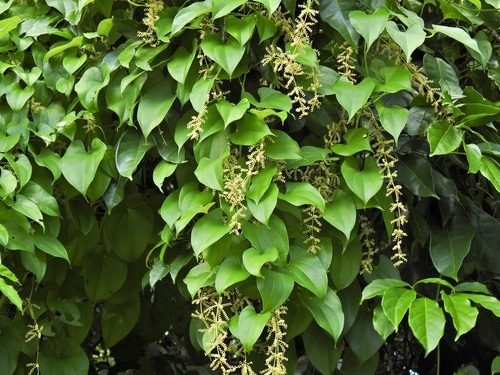
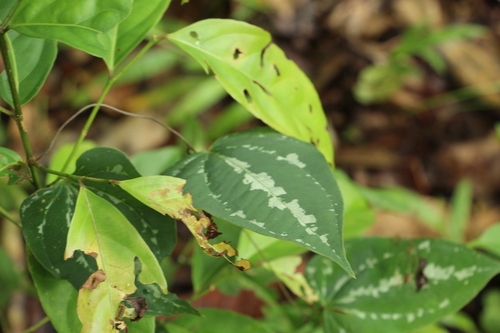
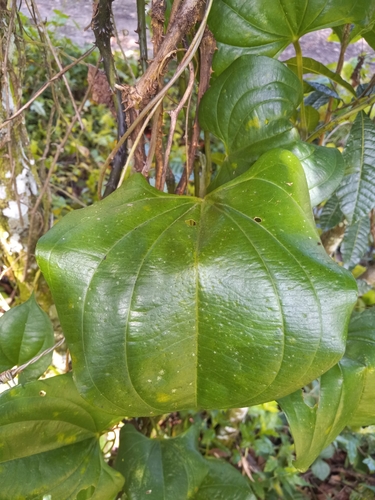
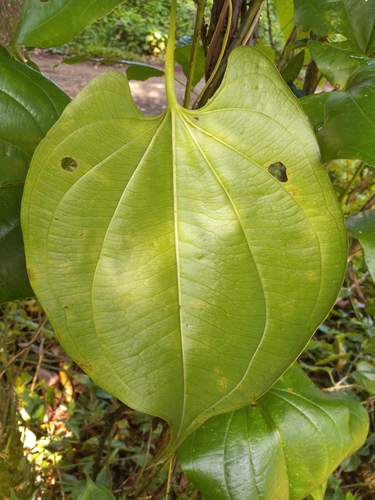
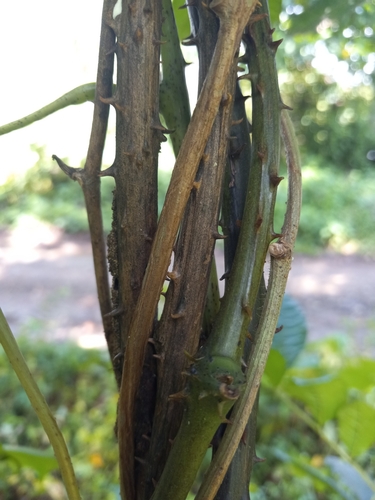
A yam with a spiny vine. There are more spines near the base. The stem can be 10-12 m long. Plants twine to the right-hand. The leaves are pale green and heart shaped near the base. They are 8-10 cm long by 3-6 cm wide. They are rather leathery. The leaves are shiny on the top surface. There are 7 veins or nerves running out from the base of the leaf. They can be produced opposite each other or one after another along the stem. The flowers occur either singly or in pairs in the axils of leaves. The tubers are large and yellow fleshed. The head of the tuber is hard and woody. There are many different cultivated varieties.
How to Grow
Tubers do not become dormant when they are mature. They cannot therefore be stored for long times and must be eaten or replanted. The tubers can be removed leaving the top part in the ground and another crop of tubers will be produced meaning it can be harvested throughout the year. Most commonly the head of the tuber is used for replanting. The tuber can be cut into setts and the different parts used. A spacing of 1.2 m between plants is considered suitable. Tubers are often planted in fairly wide deep holes.
Propagation: Seed is rarely produced and not normally used for propagation. Tuber cuttings are the standard method: small tubers are cut into 2–4 sections and larger ones into 6–8 sections, each with 2–3 dormant buds. Cut tubers are often left in the sun for several hours to encourage wound healing and reduce fungal infection risk.
Medicinal Uses
None known.
Other Uses
None known. Grown in food forest systems.
Production
Growth of the yam is almost continuous. It takes almost 12 months to reach maturity. In areas of good rainfall it gives good yields. Tubers can weigh between 2 and 10 kg. Yields of 30 t per ha are achievable.
Other Information
It is a commercially cultivated vegetable. Important in West Africa and now in some places in the West Indies.
Notes
There are about 650 species of Dioscorea.
Names & Synonyms
Affoo, Affou, Affun yam, Atous temps, Attoto yam, Ayu, Balugu, Cara de Para, Congo amarillo, Cut and come again yam, Dye yam, Egera, Endale, Fusaka, Hard yam, Haya, Lagos yam, Luliga, Mapuey morado, Mulugu, Name amarillo, Name chomo, Name negro, Ndoo, Negro yam, Niame, Ovihazo, Twelve months yam, Yellow yam
References (40)
- Abbiw, D.K., 1990, Useful Plants of Ghana. West African uses of wild and cultivated plants. Intermediate Technology Publications and the Royal Botanic Gardens, Kew. p 26
- Asfaw, Z. and Tadesse, M., 2001, Prospects for Sustainable Use and Development of Wild Food Plants in Ethiopia. Economic Botany, Vol. 55, No. 1, pp. 47-62
- Berihun, T. & Molla, E., 2017, Study on the Diversity and Use of Wild Edible Plants in Bullen District Northwest Ethiopia. Hindawi Journal of Botany. Article ID 8383468
- Bongers, F. et al (Eds), Forest Climbing Plants of West Africa: Diversity, Ecology and Management. CABI
- Brouk, B., 1975, Plants Consumed by Man. Academic Press, London. p 144
- Burkill, H. M., 1985, The useful plants of west tropical Africa, Vol. 1. Kew.
- Burkill, I.H., 1966, A Dictionary of the Economic Products of the Malay Peninsula. Ministry of Agriculture and Cooperatives, Kuala Lumpur, Malaysia. Vol 1 (A-H) p 830
- Catarino, L., et al, 2008, An annotated checklist of the vascular flora of Guinea-Bissau (West Africa). Blumea 53:1-222 p 97
- Cobley, L.S. (rev. Steele, W.M.) 2nd Ed., 1976, An Introduction to the Botany of Tropical Crops. Longmans. p 123
- Coursey, D.G., 1979, Yams, in Simmonds N.W.,(ed), Crop Plant Evolution. Longmans. London. p 70
- Eilu, G. & Bukenya-Ziraba, R., 2004, Local Use of Climbing Plants of Budongo Forest Reserve, Western Uganda. Journal of Ethnobiology 24(2): 307-327
- Facciola, S., 1998, Cornucopia 2: a Source Book of Edible Plants. Kampong Publications, p 91
- Fowler, D. G., 2007, Zambian Plants: Their Vernacular Names and Uses. Kew. p 67
- Grivetti, L. E., 1980, Agricultural development: present and potential role of edible wild plants. Part 2: Sub-Saharan Africa, Report to the Department of State Agency for International Development. p 30
- Hedrick, U.P., 1919, (Ed.), Sturtevant's edible plants of the world. p 273
- Jardin, C., 1970, List of Foods Used In Africa, FAO Nutrition Information Document Series No 2.p 13
- Kay, D.E., 1973, Root Crops, Digest 2, Tropical Products Institute, London, p 190, 237
- Kays, S. J., and Dias, J. C. S., 1995, Common Names of Commercially Cultivated Vegetables of the World in 15 languages. Economic Botany, Vol. 49, No. 2, pp. 115-152
- Kiple, K.F. & Ornelas, K.C., (eds), 2000, The Cambridge World History of Food. CUP p 1885
- J. B. A. P. M. de Lamarck & L. A. J. Desrousseaux, Encycl. 3:233. 1789
- Lim, T. K., 2015, Edible Medicinal and Non Medicinal Plants. Volume 9, Modified Stems, Roots, Bulbs. Springer p 34
- Macmillan, H.F. (Revised Barlow, H.S., et al) 1991, Tropical Planting and Gardening. Sixth edition. Malayan Nature Society. Kuala Lumpur. p 339
- Miguel, E., et al, 1989, A checklist of the cultivated plants of Cuba. Kulturpflanze 37. 1989, 211-357
- Nyadanu, D., et al, 2015, Agro-biodiversity and challenges of on-farm conservation: the case of plant genetic resources of neglected and underutilized crop species in Ghana. Genet. Resourc. Crop Evol. 62(7):
- Omawale, 1973, Guyana's edible plants. Guyana University, Georgetown p 113
- Onwueme, I.C., 1978, The Tropical Tuber Crops. Wiley, p 6
- Peters, C. R., O'Brien, E. M., and Drummond, R.B., 1992, Edible Wild plants of Sub-saharan Africa. Kew. p 17
- Plants of Haiti Smithsonian Institute http://botany.si.edu/antilles/West Indies
- Purseglove, J.W., 1972, Tropical Crops. Monocotyledons. Longmans p 104
- Salako, V. K. et al, 2013, Home gardens: an assessment of their biodiversity and potential contribution to conservation of threatened species and crop wild relatives in Benin. Genet Resour Crop Evol
- Schneider, E., 2001, Vegetables from Amaranth to Zucchini: The essential reference. HarperCollins. p 712
- Tindall, H.D., 1983, Vegetables in the Tropics, Macmillan p 210
- USDA, ARS, National Genetic Resources Program. Germplasm Resources Information Network - (GRIN). [Online Database] National Germplasm Resources Laboratory, Beltsville, Maryland. Available: www.ars-grin.gov/cgi-bin/npgs/html/econ.pl (10 April 2000)
- van Wyk, B., 2005, Food Plants of the World. An illustrated guide. Timber press. p 179
- Vickery, M.L. and Vickery, B., 1979, Plant Products of Tropical Africa, Macmillan. p 15
- Walter, A. & Lebot, V., 2007, Gardens of Oceania. ACIAR Monograph No. 122 p. 94
- Wilkin, P., 2001, Dioscoreaceae of South-Central Africa. Kew Bulletin, Vol. 56, No. 2 (2001), pp 361-404
- Wiersema, J. H. & Leon, B., 2013, World Economic Plants. A Standard Reference CRC Press. 2nd Ed. p 248
- World Checklist of Useful Plant Species 2020. Royal Botanic Gardens, Kew
- Zeven, A. C. & de West, J. M. J., 1982, Dictionary of cultivated plants and their regions of diversity. Wageningen. p 124