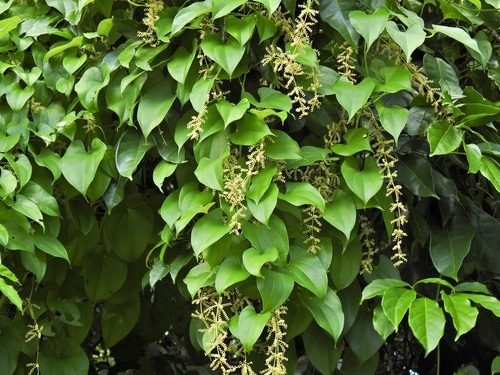
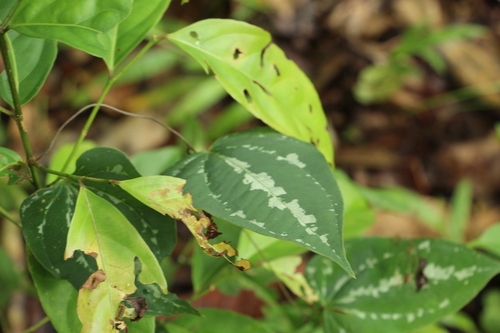
Dioscorea cinnamomifolia
Hooker
Cara acu
DioscoreaceaeRoots

gbif · cc-by
Universidade Federal Rural do Rio de Janeiro (RBR)
Universidade Federal Rural do Rio de Janeiro (RBR)
What to Eat
Edible parts: Tubers, Root
The tuber is eaten after repeated boiling, washing, and baking.
Where to Find It
A tropical plant. In Argentina it grows below 300 m above sea level.
Argentina, Asia, Brazil, Himalayas, India, Paraguay, South America,
Countries: United Arab Emirates, Afghanistan, Armenia, Argentina, Azerbaijan, Bangladesh, Bahrain, Brunei, Bolivia, Brazil, Bhutan, Chile, China, Colombia, Ecuador, Georgia, French Guiana, Guyana, Indonesia, Israel, India, Iraq, Iran, Jordan, Japan, Kyrgyzstan, Cambodia, North Korea, South Korea, Kuwait, Kazakhstan, Laos, Lebanon, Sri Lanka, Myanmar, Mongolia, Maldives, Malaysia, Nepal, Oman, Peru, Philippines, Pakistan, Paraguay, Qatar, Saudi Arabia, Singapore, Suriname, Syria, Thailand, Tajikistan, Timor-Leste, Turkmenistan, Turkey, Taiwan, Uruguay, Uzbekistan, Venezuela, Vietnam, Yemen
How to Identify
A yam. It is a climbing plant that keeps growing from year to year. It produces annual stems from a large rootstock. The stems are scrambling or twining.
Other Information
It is occasionally cultivated.
Notes
There are about 650 species of Dioscorea.
References (5)
- Chu, E. P., Figueiredo-Ribeiro, R. C. L., 1991, Native and Exotic Species of Dioscorea Used as Food In Brazil. Economic Botany, Vol. 45, No. 4, pp. 467-479 (Also as Dioscorea tuberosa)
- GUPTA, (As Dioscorea tuberosa)
- Hedrick, U.P., 1919, (Ed.), Sturtevant's edible plants of the world. p 547 (As Rajania brasiliensis)
- Kermath, B. M., et al, 2014, Food Plants in the Americas: A survey of the domesticated, cultivated and wild plants used for Human food in North, Central and South America and the Caribbean. On line draft. p 307
- Lim, T. K., 2015, Edible Medicinal and Non Medicinal Plants. Volume 9, Modified Stems, Roots, Bulbs. Springer p 38