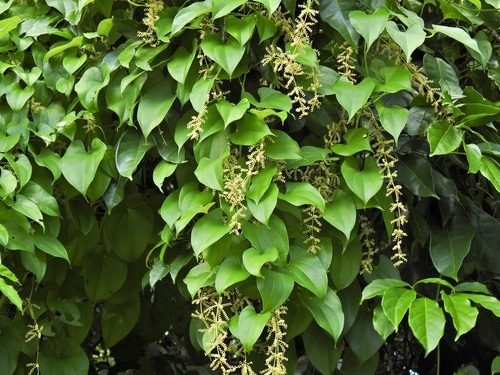
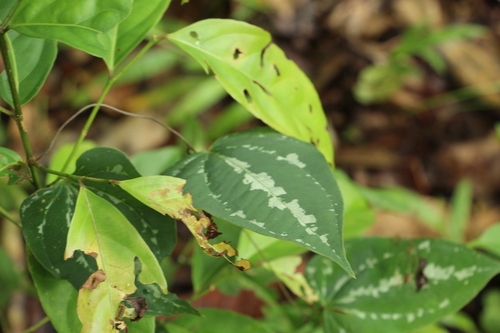
Dioscorea divaricata
Blanco
Chinese yam

Wikimedia Commons - UPLB MNH Digital Archives

Wikimedia Commons - UPLB MNH Digital Archives
What to Eat
Edible parts: Tubers, Root
The tubers are eaten boiled or baked.
Where to Find It
A tropical plant. It grows in forests and thickets at low and medium altitudes. In the Philippines found in Pangasinan, Bataan, Rizal and Laguna.
Africa, Asia, Burundi, Central Africa, China, Congo, East Africa, India, Japan, North America, Pacific, Philippines, SE Asia, USA,
How to Identify
A yam. It grows each year from the tuber. A vine with slender stems armed with scattered short spines near the base. It twines to the right. The tubers are slender, fleshy and narrow. They can be 2 m long and 10 cm across. They grow deep in the soil. The leaves are simple and opposite. The leaf stalk is 7 cm long. Leaves are spear shaped and 10 to 18 cm long. The flowers are very small and yellowish green and borne in flower clusters in the axils of leaves. The male flower stalks can be 60 cm long. The female flower stalks can be 18 cm long. The fruit are divided into 3 semicircular lobes and contain flat winged seeds. (It is similar to Dioscorea nummularia)
Notes
There are about 650 species of Dioscorea.
Names & Synonyms
Bakliakang, Dulian, Kiroi, Pakit, Sulian
References (9)
- Brown, W.H., 1920, Wild Food Plants of the Philippines. Bureau of Forestry Bulletin No. 21 Manila. p 31
- Fl. Filip. 797. 1837
- Flora Malesiana Vol 13 p 332
- Hedrick, U.P., 1919, (Ed.), Sturtevant's edible plants of the world. p 273
- Jardin, C., 1970, List of Foods Used In Africa, FAO Nutrition Information Document Series No 2.p 13
- Lim, T. K., 2015, Edible Medicinal and Non Medicinal Plants. Volume 9, Modified Stems, Roots, Bulbs. Springer p 35
- Monsalud, M.R., Tongacan, A.L., Lopez, F.R., & Lagrimas, M.Q., 1966, Edible Wild Plants in Philippine Forests. Philippine Journal of Science. p 459
- PROSEA handbook Volume 9 Plants yielding non-seed carbohydrates. p 171
- World Checklist of Useful Plant Species 2020. Royal Botanic Gardens, Kew